



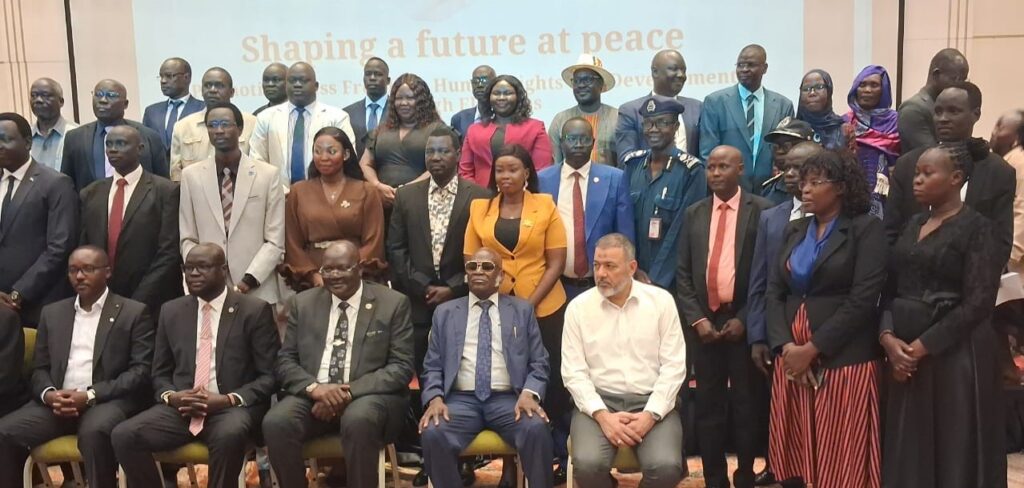
South Sudan’s Ministry of Information, Communication and Postal Services, with support from UNESCO and Japan International Cooperation Agency (JICA), on Tuesday launched a three-day Media and Security Conference aimed at improving relations between journalists and security institutions ahead of the country’s anticipated elections.
Held under the theme “Shaping a Future at Peace: Promoting Press Freedom, Human Rights and Development through Elections,” the conference brought together journalists, security officials, civil society representatives, and international partners to discuss media safety, election reporting, misinformation, artificial intelligence, and digital governance.
In his keynote address, Information Minister Ateny Wek Ateny stressed the need for journalists to practice responsible reporting during the election period, warning that inaccurate coverage could fuel division and undermine national stability.
Speaking during the opening of the conference in Juba to mark World Press Freedom Day 2026, Ateny said the media would play a crucial role as South Sudan prepares for what he described as its first vote as an independent nation.
“Once the people of South Sudan go to the polls, come December, to exercise their rights for the first time as South Sudanese, we voted as Southern Sudanese in 2010,” he said. “Responsible journalism is required; you need to be reporting responsibly, because there are people who will be saying that their votes are rigged.”
“When you are reporting, make sure that your report is in accordance with what is officially accepted by all the stakeholders,” Ateny added.
The minister described press freedom and freedom of expression as constitutional rights that should be protected within the law, adding that the media remains an important partner in nation-building and peacebuilding.
“A free, responsible, and professional media is not an enemy of the state. “Rather, it is an important partner in nation building, peace building, accountability, public awareness, and development,” Ateny stated. “It should be guided by cooperation, professionalism, dialogue, and emotional respect.”
According to the minister, journalists and security agencies are “two different sides of the same coin” because both serve the public and contribute to national stability.
“None can operate without the other,” he said, adding that investigative journalists often help uncover information useful to law enforcement and judicial authorities.
However, he cautioned journalists against what he termed irresponsible reporting, exaggeration, and personal attacks against public officials.
“If you exaggerate reporting, you will also be inciting, so you need to balance it,” he said. “You can criticize any government official; it is legal. What is illegal is to criticize the person.”
Ateny also warned social media users against sharing defamatory or harmful content online, saying those who circulate such material could face prosecution under the Cybercrime and Computer Misuse laws.
“Many people don’t know the like in the social media or sharing it, by the way, you are even participating,” he said.
In one of the speech’s strongest remarks, Ateny said modern technology and digital media can have devastating consequences if misused.
“A camera can kill more than even a gun,” he said. “A camera will leave you disgraced.”
Despite the warnings, Ateny pledged government support for journalists operating professionally and within the law.
For his part, Oliver Mori Benjamin, spokesperson of the Transitional National Legislative Assembly (TNLA), said constructive engagement between the media and security personnel is essential as the country heads toward the December elections.
“We believe constructive engagement between journalists, policy makers, law enforcement agencies, and civil society is essential in building trust and reducing unnecessary confrontation. The role of the media during elections is specifically sensitive or very sensitive,” he said. “Journalists are expected to provide accurate information, counter misinformation, and promote peaceful civic participation. At the same time, security institutions must ensure public order while respecting constitutional problems and human dignity.”

 and then