



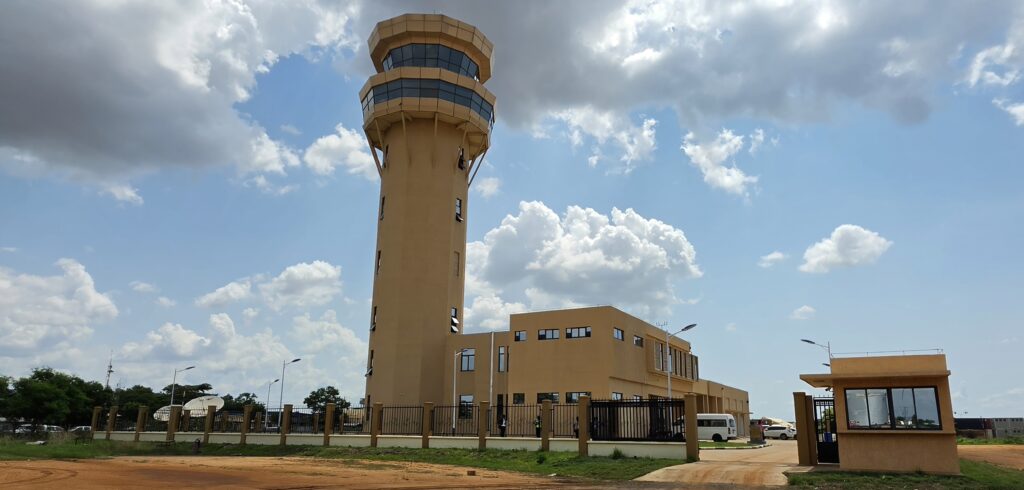
President Salva Kiir Mayardit said on Monday that South Sudan had taken control of its airspace sovereignty after launching a new air traffic management system aimed at improving aviation safety and oversight.
Speaking during the inauguration of a modern Air Traffic Management System and control tower in Juba, Kiir said the new infrastructure would enable the country to independently manage its airspace operations.
“We have reclaimed our sovereignty by taking control of our airspace,” Kiir said. “From today onwards, our airspace is in our hands.”
He directed the South Sudan Civil Aviation Authority and other relevant institutions to ensure the system operated without interruption, saying the country could not afford any failure that would undermine control of its airspace.
The launch ceremony was attended by several government officials and the Chinese ambassador to South Sudan, Ma Qiang.
The project was funded and implemented with support from China under a broader cooperation framework between Beijing and Juba.
Before South Sudan gained independence in 2011, its airspace and air traffic operations were managed from Khartoum. The system later relied heavily on foreign assistance and manual non radar procedures.
Officials said the new system would allow the South Sudan Civil Aviation Authority to oversee air traffic operations through upgraded radar and navigation systems, improving safety, efficiency and regulatory oversight in the aviation sector.
Ayiei Garang, director general of the South Sudan Civil Aviation Authority, said the system was among the most advanced in Africa and would strengthen aviation safety while increasing government revenue collection.
The infrastructure includes air navigation systems in Wau and Malakal, as well as six radars comprising three primary and three secondary radar systems, he said.
Garang said the system also featured upgraded communication and weather observation technologies aimed at improving airspace monitoring and aviation operations.
“This system improves aviation safety, strengthens airspace monitoring and improves regulatory oversight,” he said. “Most importantly, it will increase our revenue collection.”
According to Garang, the air traffic management system had remained inactive for more than four years despite the country’s growing need for improved aviation safety and airspace management.
He also called for continued investment in airbase infrastructure and security systems to safeguard the country’s airspace sovereignty.
Chinese Ambassador Ma Qiang described the initiative as the first air traffic management project implemented under the framework of China-Africa cooperation.
He said the system would help South Sudan restore full control of its airspace while supporting aviation safety and economic diversification.
The new air traffic management system will monitor, control and coordinate aircraft movements within South Sudan’s airspace using radar, communications and navigation systems.
It will provide separation services, manage flight sequencing and issue clearances to ensure safe and orderly air traffic flow.
The system is expected to strengthen aviation safety oversight, enhance airspace surveillance and improve revenue generation in line with International Civil Aviation Organization standards.

 and then