



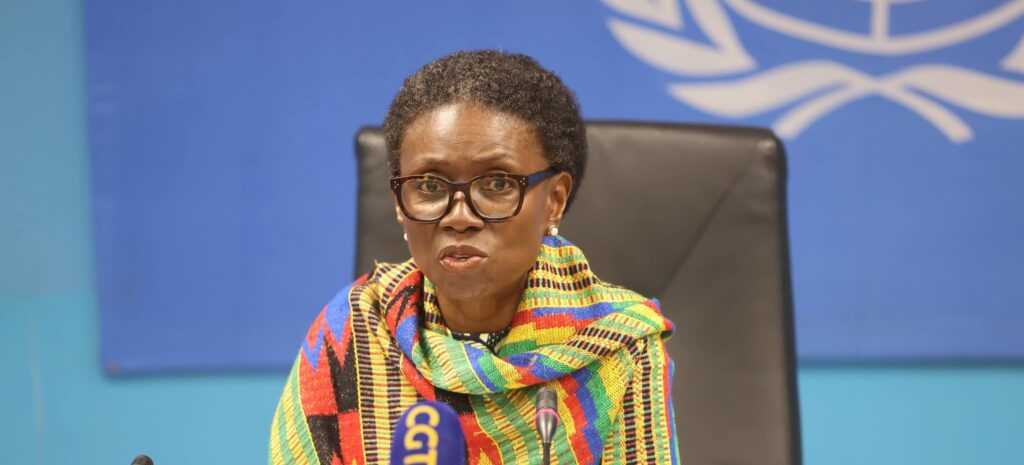
The Special Representative of the UN Secretary General, Anita Kiki, on Tuesday urged South Sudan’s leaders to end ongoing violence and commit to inclusive dialogue, warning that renewed clashes and political tensions are threatening the country’s fragile peace process.
Addressing a press conference as the new UNMISS Chief, replacing the late Nicholas Haysom, Kiki said the revitalised peace agreement remains the only viable framework for ending the country’s prolonged transition.
“We continue to believe in the peace agreement,” she said. “Inclusive dialogue that brings all parties to the table is what will take us to the end of this transition period.”
Her remarks come amid escalating insecurity in parts of the country, including Jonglei State and Akobo County, as well as growing debate over the implementation and possible amendment of the 2018 peace agreement ahead of planned elections.
Kiki repeatedly stressed that “the conflict must stop” and that differences should be resolved through dialogue.
Concerns over political developments
The UN envoy also addressed recent political tensions, including reports that President Salva Kiir dismissed dozens of SPLM-IO lawmakers from parliament. While stopping short of directly criticising the move, she warned that actions which undermine inclusivity could jeopardise the peace agreement.
“Yes, we are concerned about these actions, actions that could put the agreement in jeopardy,” she said.
Kiki said any amendments to the peace agreement should involve all signatories and stakeholders through dialogue and consensus.
“Those who were signatories to the peace agreement must be around the table,” she added.
Elections must be credible and inclusive
Questions over the country’s preparedness for elections expected in December also dominated the press conference.
Kiki did not say whether elections should proceed as scheduled, maintaining that the decision ultimately lies with South Sudanese leaders and citizens.
However, she stressed that any elections must be “credible, peaceful and inclusive.”
“To exit this transition period, elections that are peaceful, elections that are credible, and most important, inclusive, will be critical,” she said.
Journalists raised concerns about delays in key benchmarks, including constitution-making and a population census, amid continued insecurity and political disagreements.
Kiki noted that UNMISS’s current mandate focuses on monitoring the electoral process and supporting an enabling environment for peace.
UNMISS maintains presence in Akobo
The UN envoy revealed that UNMISS had suspended plans to close its base in Akobo after violence intensified in the area.
According to Kiki, the mission had initially planned to withdraw from Akobo due to UN-wide financial constraints but decided to retain peacekeepers following reports of escalating clashes.
“As displaced people begin returning to Akobo, our peacekeepers are helping to provide a much-needed protective environment,” she said.
Kiki said nearly 80,000 displaced people have returned to the area in recent weeks, while humanitarian organizations continue scaling up assistance despite funding shortages.
Civilians bearing the brunt
Kiki warned that civilians remain the main victims of the ongoing violence, with rising deaths, injuries, and displacement reported in conflict-affected areas.
“What we have seen since the intensification of conflict over the last year is that people are ultimately those who suffer,” she stated.
She said more than 10 million people in South Sudan require humanitarian assistance, while over 7 million are facing food insecurity.
The UN envoy also cited the impact of climate shocks and the influx of people fleeing the war in neighboring Sudan as additional pressures worsening the humanitarian situation.
“Peace remains the priority.”
Asked what worries her most about South Sudan, Kiki replied: “Peace. Peace. Peace.”
She acknowledged growing frustration among South Sudanese over the country’s extended transition period but urged leaders and citizens to continue pursuing dialogue and compromise.
“The vision of South Sudan is for a peaceful and stable nation. It’s possible,” she said.
Kiki added that the United Nations would continue supporting mediation efforts led by the African Union and IGAD, including initiatives involving former Tanzanian President Jakaya Kikwete.
“We want to support South Sudan in achieving its vision — a peaceful, stable, and prosperous nation,” she said.

 and then