



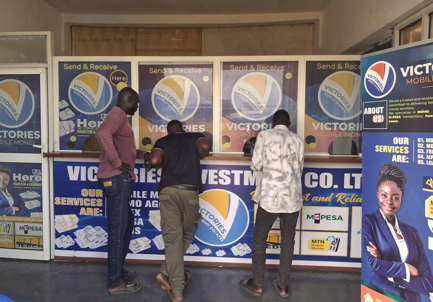
A research paper by Prof. Isaac Ayii Ayii shows that the survival rate for startup businesses in Juba is 24 hours. It requires resilience and strong financial management for a business to survive in Juba’s volatile economy, according to the don, who also serves as the Chairman of the South Sudan Business Community.
Rosemary Justin is a successful businessperson in Juba. But she did not start big as most would expect; neither did she receive enough support from local financial institutions. All Rosemary had was a savings fund of USD 300 that she spent years building.
“The first challenge I experienced after starting was a lack of enough customers,” Rosemary recalls the challenges she faced with her first business, a mobile money shop.
Though the business was domiciled in Gudele, a highly populated neighbourhood in Juba, Rosemary still struggled to draw customers to her premises. After three years of long turbulence, Rosemary was lucky to enrol for a business training class, skills that not just boosted her sales but catapulted her entrepreneurship journey to a whole new level.
“Even though I had a shop in the market, I still moved from customer to customer, making sure I had enough collections per day,” says Rosemary, who is among the beneficiaries of business training from INKOMOKO.
INKOMOKO is a social enterprise that partners with entrepreneurs in displaced communities, including women, youth, and host communities, to provide affordable capital, tailored business advisory services, and market access to build inclusive and thriving economies across Africa.
Today, Rosemary is among the mobile money and bank agents that INKOMOKO South Sudan has turned their lives around while helping improve financial inclusion in the country for underprivileged communities.
“I was a returnee from Uganda, and when I came to Juba, life was not easy. Life was so hard that things were not really working,” she revealed of the difficult circumstances that pushed her into entrepreneurship.
Six years later, Rosemary’s once-small business in Gudele has grown into a fully-fledged cash agency that advances loans to other businesses in South Sudan.
“I was employed here after completing my senior secondary. This work has helped me to provide for my basic needs so that I do not depend on my parents. I want to join a university once my results are out,” Sarah Simon, an employee at Victory Investment, a company owned by Rosemary.
Empowering the South Sudanese business community
Just as Prof. Ayii noted in his research paper, most start-ups in South Sudan face a myriad of challenges, including unfavourable taxation policies and limited access to business loans.
“We ensure that we give them skills, we give them loans, we link them to markets, and then we advocate for them to have a conducive business environment,” says William Ngabozinza, INKOMOKO Country Director in South Sudan.
Access to finance has been cited as one of the major challenges facing the business community in South Sudan.
It is even harder for refugees and returnees with no collateral to secure loans.
“Because they are refugees, no bank trusts them because they don’t have anything else to present to the bank to gain access to credit,” said William. “They are internally displaced people. They don’t have anything else to present to the bank. And you know the conditions of the bank for you to get access.”
Access to business financing
William says that INKOMOKO’s unsecured credit facilities and manageable repayment plans are a lifeline for these entrepreneurs.
“When they default, instead of arresting them, we try to understand why they defaulted,” he stated. “We then train them on how to improve their business skills. After that, we provide them with top-up financing so that they can grow.”
Since 2023, INKOMOKO has supported 5,680 entrepreneurs in South Sudan. The project targets an additional 5,400 clients by 2028. Another 1,600 small and micro businesses will receive investment, while market systems development initiatives will be piloted for 250 enterprises.
“However much we are doing business development, we understand that our model is not humanitarian; it is developmental. But we had to ensure that we help these people,” William said. “First of all, the loans they are taking, we have to forgive them. We call it loan forgiveness.”
Across the five African countries where INKOMOKO operates, including Kenya, Rwanda, Chad, and the Democratic Republic of Congo, the organization has supported more than 100,000 entrepreneurs, according to William.
In South Sudan, INKOMOKO operates in Juba, Maban, Renk, Bor, Morobo, and Mangala. Loans range from USD 300 to USD 50,000, with flexible repayment periods of between six and 36 months.
Linking local businesses to international markets
Last year, UNHCR contracted a group of women from Gorom Refugee Settlement in South Sudan to supply more than 2,000 lanyard straps worn around the neck to hold identification cards or name tags for an international forum held in Nairobi, Kenya.
Each piece sold for USD 4.50, with the proceeds going directly to the women for reinvestment.
“We have linked them to international markets,” says William. “Because of the nature of their business, if they only do this in the camp, no one will buy.”

 and then