



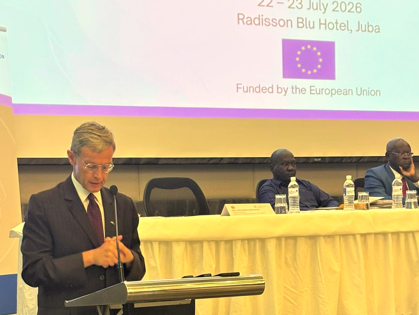
The Charge d’Affaires of the European Union (EU) Delegation, on Thursday, quizzed members of the National Legislature about why South Sudan’s health and education budgets are very small compared to the rest of Sub-Saharan countries.
Lothar Jaschke posed the question while making remarks at the opening of the civic education and public consultations event under the theme “Primer on Federal Governance” in support of the NCRC-led consultations for the national institutions of South Sudan at Radisson Blu Hotel in Juba.
He told the members of the TNLA and the Council of States that they have the right to request statements from the government on any issue, recall basic rights, and exercise these rights.
“An example when it comes to education and health. Why is the execution of the health budget less than 1 percent of the spending when the average in Sub-Saharan Africa is 10 percent? Similar with the education budget. You could ask these questions in the interest of the citizens of this country, in particular its children who want to and need to be educated,” he said. “The same with salaries. Why are people who work hard and risk their lives every day, such as public health workers, unpaid? I heard the powerful speech Rt Hon Speaker Joseph Paciko’s on 1 May 2026 in the Stadium in Juba, claiming that work should be remunerated.”
Jaschke said the Constitution-Making Process has made great progress in the last months, saying it is the greatest success story in South Sudan since the signing of the peace agreement in September 2018.
“We are proud to support this process, and we are proud of the work of Max Planck Foundation, which organised several workshops to create space for the project and produced handouts of key documents and readers around constitutional processes,” he said. “On 2 July, the NCRC Chair Dr Riang informed the RJMEC Board about the progress made in the Constitution-Making Process and stated that the permanent constitution could be finalised even before the end of the transitional process if all pull in the same direction. During this meeting, Hon Minister Lomuro acknowledged and appreciated the progress achieved.”
He stated that the role of the Legislature is key in a democracy and might become more important with a federal constitution.
The government has, of course, the bigger apparatus to consider and prepare legislation, but parliamentarians also have a role to play. The Constitution also confers the right to request statements from the Government on any issue,” Jaschke said. “For example, on the Bill of Rights. The right to life, the right to freedom from torture, the right to fair trial, religious rights, the freedoms of expression and assembly and movements, the right to education and to public health care, the right to housing.”
“Article 9 of the Constitution says that the Bill of Rights is ‘the cornerstone of social justice, equality and democracy’ and that ‘the rights and freedoms enshrined in this Bill of Rights shall be respected and promoted by all organs and agencies of Government and by all persons,’” he added.
He reminded the attendees about Minister Lomuro’s promise to shift the pending tasks of the peace agreement to a “post-election R-ARCSS agenda.”
“This was a very significant announcement which we fully welcome. It is now part of the conclusions of the RJMEC Board Meeting of 2 July, so it is official, and we can refer to it,” he said. “The reforms in the peace agreement are a promise for the future. A statement that the government is not walking away from these reforms, even after the agreement has expired, can only be welcome.”
“At the same time, we encourage as much progress as possible on implementing its provisions during the remaining lifetime of the agreement,” Jaschke added.
He said the constitution-making process is of immense importance to the future of the country and the lives of the South Sudanese and that the EU will continue supporting it.

 and then