



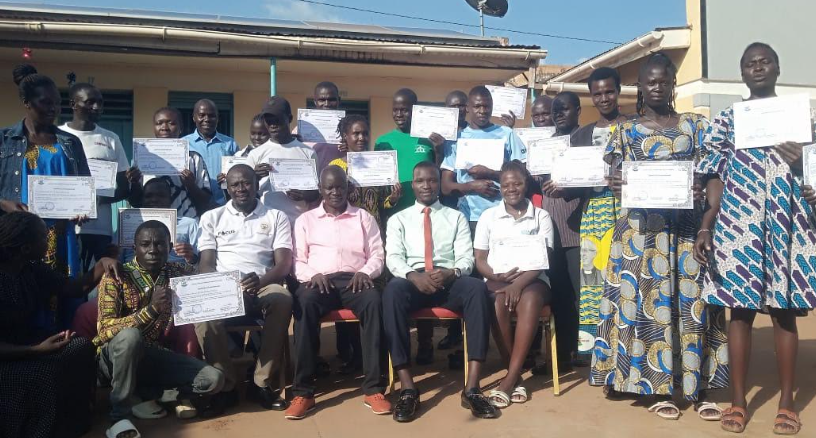
At least 20 youth representatives drawn from the five payams of Yei River County in Central Equatoria State have been certified after completing a three-day trauma healing training aimed at strengthening peacebuilding and psychosocial support within their communities.
The training, organized by the Organization for Nonviolence and Development (ONAD) in partnership with Mennonite Central Committee (MCC) South Sudan, ran from 20-22 July.
The initiative is expected to equip the youth representatives with practical skills to support individuals affected by conflict and violence, promote peaceful coexistence, and help reduce trauma-related stigma across their communities.
Speaking during the event, ONAD Project Coordinator Lupai James emphasized the importance of the training, saying it has equipped participants with practical skills to support trauma survivors and promote lasting peace within their communities.
“We have heard stories that have resulted in loss of lives because it was not clearly known that someone was actually experiencing trauma because people do not know,” he said. “As we go to our families and payams, always engage with our communities and families to be able to identify, and in our different capacities, be able to intervene to help in terms of raising awareness and counselling with the knowledge that you have received.”
Asiki Moses, a participant from Lasu Payam, described the training as productive. He expressed confidence that the knowledge gained will enable him to support and guide people experiencing trauma.
“Out of this three-day training, we have learnt about an introduction to trauma, its causes, and effects, because most of the people do not know those things. However, out of this training, most of us now have the experience, and if we go back to our communities, we will be able to identify those people who have trauma and how to solve it,” he stated. “We have also learnt about coping mechanisms: how can we cope if there is trauma in our community to ensure that you come back to your normal stage? If you have problems, make sure that you share with your friends or someone that you trust for help and support.”
Another beneficiary, Raele Jamba, praised the training as beneficial and encouraged the other participants to continue extending support to people who are still struggling with trauma in their communities.
“This trauma healing training is really good for us so that we can heal people,” he said. “It is good that we were brought from different payams and it is now our time to go to our various payams to help and support.”
Meanwhile, Yei River County Youth Association Chairperson Gaga Frank acknowledged that trauma remains widespread, particularly among young people who make up the majority of those affected by conflict-related experiences, especially in rural communities.
“Trauma is with us, but the good thing with this kind of training is that it helps us to know or derive ways of how to counter trauma. Let us use the knowledge acquired. People at the grassroots are the ones who are mostly traumatized because they even lack some basic needs, no education, and sometimes accessing health services is very difficult,” he said. “I want to say that the young people in South Sudan and Yei in particular constitute the biggest percentage in the conflict, both as perpetrators and victims. People are traumatized because of not accessing jobs, our farms, and this is all because of the conflict.”
On his part, James Wani Banja, Acting Director for Planning and Peacebuilding in Yei River County, encouraged the public not to overburden themselves with challenges beyond their control, but instead focus on issues they can positively influence.
“Let us not overstress; let us be peace lovers. If you have problems with anyone in your family or community, it is time to sit down and talk about it and seek forgiveness because by doing so, you have already released what has been disturbing you,” he said. “Mind about those things that you can do, be it taking care of your family, and the ones that you cannot solve, and seek help.”
Throughout the training, participants gained practical knowledge on the introduction to trauma, its causes and effects, trauma healing processes, coping mechanisms, resilience building, and the biblical context of trauma healing, including intergenerational and trans-generational trauma.

 and then