



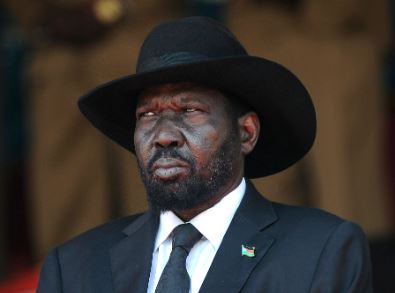
South Sudan President Salva Kiir on Wednesday said citizens want elections because they are tired of transitional arrangements.
He made the remarks during what appeared to be a tightly scripted and edited, barely 10-minute interview with Jeff Koinange, a veteran Kenyan journalist, news anchor, and talk show host, who hosts the popular current affairs program Jeff Koinange Live (JKL) on Citizen TV Kenya. The interview was conducted at the State House in Juba.
“South Sudan is ready for elections because the people want to elect their leaders and to get out of this transition, which the people think is not good with them,” Kiir, who spoke slowly and haltingly, said. “So, the election is good with them.”
Asked about the five presidents, Kiir said it worked because the country needed peace and he and other leaders had to make compromises.
“It has been tough, but we managed it. It worked, and this is how we managed to reach this day. If we were to turn to another direction, this would not have worked,” he said. “I really tried all the compromises, although I told Omer el Bashir (former Sudanese president) in Khartoum when he was still in power that if you bring me so many vice presidents, where will I accommodate them? You know Juba, you were there, and there are no houses that you have built for vice presidents.”
“Number 2, vehicles for the vice presidents to run the country are not there. What he (Bashir) was telling me was that he would work with me so that he increases oil production so that there is no gap,” Kiir narrated. “I said if you (Bashir) are committed to that, I do not have any objection.”
On the secret of the guns going silent, Kiir answered Koinanange that the people who wanted positions got them.
“It was tough, but we moved from step to step. We did not accept fighting and concentrated on the ceasefire and did whatever we could do for development.
Probed about the independence of the judiciary, the president curtly said it is independent and that the three arms of the government operate independently.
Kiir also said that there will definitely be changes after the elections.
“Now you can see the five vice presidents; what will they do? In the parliament, we have 650 members; what will they do?” he asked, adding: “Because this huge government prevented development, and they have to be reduced so that there is a window of development.”
In closing, Kiir thanked the citizens for what he termed their endurance and asked them to register to vote in the elections slated for 22 December.
“All this long transitional period should have triggered whatever disappointment, but I thank the South Sudanese for their endurance. Number two, they must go in for elections as registration of voters will start very soon,” he said. “So, I want them to register in big numbers so that when they go to vote, they pick their leaders. This will not be dictated to them.”
“The peace agreement must be maintained; people must remain united and should not fragment into tribes, because this will be the worst scenario. If people remain united, we will have no problem,” President Kiir concluded.
On 1 July, South Sudan’s parliament approved controversial amendments to the 2018 Revitalized Peace Agreement, removing requirements for a population census and a permanent constitution before elections due in December 2026, despite objections from opposition lawmakers. Earlier this week, Kiir assented to the changes to the peace agreement.
The National Legislature voted to defer the two provisions until after the elections, with parliamentary officials saying the move clears major legal obstacles to holding the vote.
The National Elections Commission (NEC) announced on June 22 that voting would take place in December 2026, meeting the legal requirement to declare the election at least six months in advance.
The commission has, however, warned that funding shortages, legal inconsistencies and delays in implementing key provisions of the 2018 peace agreement could hamper preparations.
While President Kiir’s camp insists the elections will proceed as scheduled, several opposition groups, including the SPLM-IO led by detained First Vice President Riek Machar, say key benchmarks such as security reforms, constitution-making and the unification of forces remain incomplete, raising doubts over whether conditions for a credible vote are in place.

 and then