



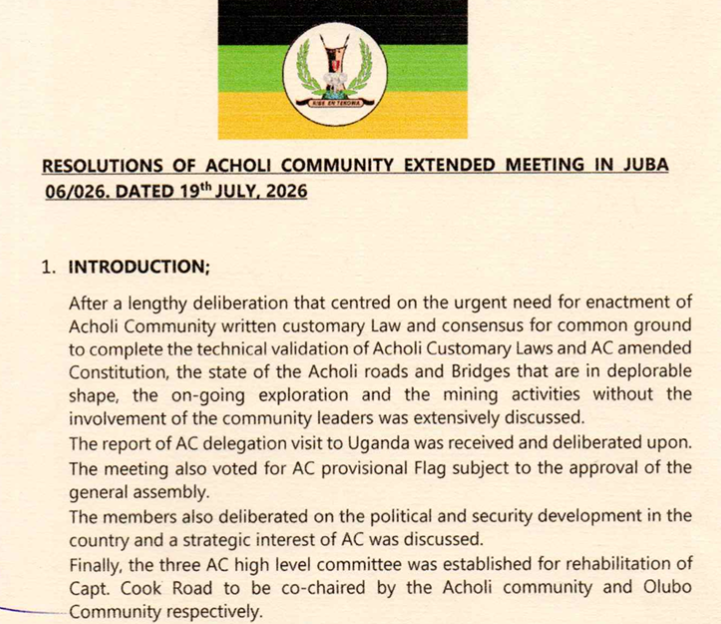
South Sudan’s Acholi Community (AC) has warned that the exclusion of local leaders and communities from ongoing mineral exploration activities in Eastern Equatoria State could fuel future conflicts if authorities fail to address their concerns.
The warning is contained in resolutions adopted during an extended consultative meeting of the Acholi Community held in Juba on 19 July, where community leaders discussed governance, security, development, natural resources and political developments affecting the Acholi people.
The meeting expressed concern over reports of mineral exploration and mining activities taking place in Acholi areas without adequate consultation with local communities and their traditional leadership.
The community resolved that its leadership should urgently engage the relevant government authorities and companies involved in mining activities to ensure local communities are consulted and benefit from the exploitation of natural resources. The meeting warned that failure to involve the affected communities could create tensions and eventually lead to conflict.
The resolutions also called on Acholi politicians and public officials to remain united in protecting community land and natural resources, cautioning against any actions that could undermine the interests of residents.
Beyond the mining issue, the meeting discussed the country’s political situation and called on President Salva Kiir and opposition leaders to resolve their differences through dialogue to preserve peace and constitutional order.
Participants acknowledged the political and economic challenges facing South Sudan and urged all political actors to avoid decisions that could further destabilize the country.
On the implementation of the Revitalized Peace Agreement, the meeting expressed concern that former Acholi combatants who had returned home had yet to be integrated into the organized forces. The community directed its leadership to engage the relevant authorities to ensure that the peace agreement is implemented fairly concerning the integration process.
The meeting also endorsed efforts to document and validate Acholi customary law, saying the process would strengthen traditional governance and preserve cultural values. It called for broad participation of chiefs, women, youth, religious leaders, teachers and government representatives in the validation process.
Community leaders further resolved to establish a committee to spearhead the rehabilitation of Capt. Cook Road, describing the route as strategically important for improving connectivity and promoting economic cooperation with neighboring communities, including those across the border in Uganda.
The resolutions also encouraged closer cooperation between the Acholi communities in South Sudan and Uganda on issues of peacebuilding, trade and border relations.
In addition, the meeting reaffirmed support for education by encouraging parents to keep children in school and called for greater mobilization of resources to improve educational opportunities within the community.
The Acholi Community said its leadership would engage national and state authorities to follow up on the implementation of the resolutions adopted during the meeting.

 and then