



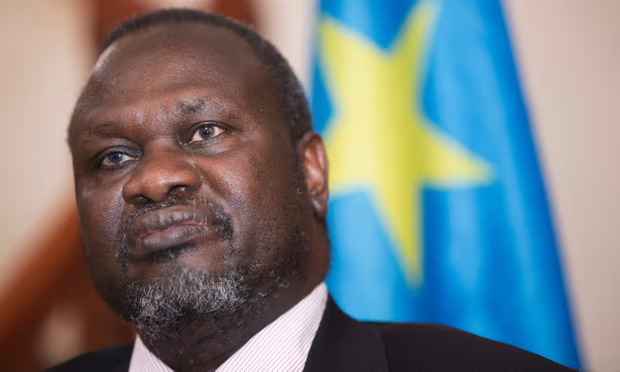
To: H.E. the President of the Republic of South Sudan
SUBJECT: LEGAL CLARIFICATION, CONSTITUTIONAL ACCOUNTABILITY, AND THE IMPERATIVE OF PUBLIC INTEREST IN THE MATTER OF DR. RIEK MACHAR TENY
Your Excellency,
I write, with due respect, in response to the official statement issued on 17 March 2026 by the Office of the President concerning the continued detention of Dr. Riek Machar Teny and the Government’s rejection of calls by the South Sudan Council of Churches (SSCC) and Cardinal Stephen Ameyu Martin Mulla for his release. While the Presidency’s communication seeks to justify its position on grounds of judicial independence, national security, and constitutional order, it is imperative, both legally and in the interest of national stability, that the Government’s position be subjected to accurate legal scrutiny and constitutional clarification.
Mischaracterisation of Judicial Independence
The assertion that the Executive lacks authority to influence or effect the release of Dr. Riek Machar on grounds of “judicial independence” is, with respect, legally inaccurate. Under Article 136(2) of the Transitional Constitution of the Republic of South Sudan, 2011 (as amended), the Minister of Justice and Constitutional Affairs is the Chief Legal Adviser to the Government and the principal prosecuting authority. This office exercises constitutionally recognised prosecutorial powers independent of judicial determination. Further, Section 25 (1) and (2) of the Code of Criminal Procedure Act, 2008, explicitly grants the Minister of Justice the authority to stay or discontinue criminal proceedings at any stage before final judgment. This legal mechanism, known as nolle prosequi, empowers the prosecution, acting in the public interest, to terminate proceedings without waiting for judicial conclusion. Accordingly, the continued reliance on judicial independence as a barrier to executive action reflects a misunderstanding of the separation of functions between prosecution and adjudication.
- On the Doctrine and Application of Nolle Prosequi
The principle of nolle prosequi, a well-established doctrine in common law jurisdictions, permits the Attorney General, in the public interest, to formally declare unwillingness to proceed with a criminal case. Its legal effects are clear:
- It terminates proceedings without constituting an acquittal;
- It allows for future re-prosecution should new evidence arise.
- It operates as a lawful and constitutional mechanism to prioritise justice, reconciliation, and national interest over procedural rigidity.
Importantly, this power is not subject to judicial control in its initiation and is exercised as part of prosecutorial discretion grounded in constitutional authority.
- Public Interest, Peace, and Precedent
The Government’s current position stands in contradiction to its own precedent. In 2014— 2015, the case of the “G-10” detainees, charged under similarly grave allegations, was discontinued and the accused released prior to judicial determination, in recognition of the overriding need for reconciliation and political stability. The selective departure from this precedent raises legitimate concerns regarding consistency, equality before the law, and the potential perception of politicised justice. It must be emphasised that the continued prosecution of Dr. Machar under the present conditions risks undermining the Revitalised Agreement on the Resolution of the Conflict in South Sudan (R-ARCSS), and may exacerbate national fragility rather than strengthen the rule of law.
- On the Defence of Military Operations and Attribution of Conflict
The Government’s justification of military operations as a constitutional duty, while legally arguable, does not negate the broader political responsibility to de-escalate tensions. Attributing the current conflict to splinter groups does not sufficiently address the underlying political crisis nor the urgent need for inclusive dialogue. Sustainable peace cannot be achieved through securitisation alone, but through credible political engagement grounded in trust and fairness.
- On Engagement with Religious Leaders
The caution issued against religious leaders risks undermining a critical pillar of South Sudan’s peace architecture. The SSCC and faith leaders have historically played a central role in mediation, reconciliation, and humanitarian advocacy. Their appeal for the release of Dr. Machar is not a political intrusion, but a moral intervention aligned with both national interest and international peacebuilding norms.
- Legal and Institutional Responsibility
It is respectfully submitted that the Office of the President and the Ministry of Foreign Affairs and International Cooperation must ensure that official state communications reflect accurate, well-researched, and professionally grounded legal interpretations. The current position, as articulated, risks conveying a misunderstanding of established legal principles, particularly the scope of prosecutorial discretion, which may inadvertently undermine the credibility of state institutions.
- Conclusion and Recommendation
In light of the foregoing:
- The Government retains clear legal authority, through the Minister of Justice, to discontinue proceedings against Dr. Riek Machar under the doctrine of nolle prosequi;
- Such action would not violate judicial independence but would rather constitute a lawful exercise of prosecutorial discretion in the public interest;
- The release of Dr. Machar would align with the spirit and letter of the R-ARCSS, support national reconciliation, and reduce the risk of renewed conflict.
Accordingly, it is urged that the Government reconsiders its position and adopts a course of action that prioritises peace, legality, and national unity over procedural rigidity and political expediency.
Respectfully submitted,
Hon. Juol Nhomngek Daniel, MP
Member, SPLM/A-IO
Cc:
The Ministry of Foreign Affairs and International Cooperation

 and then