



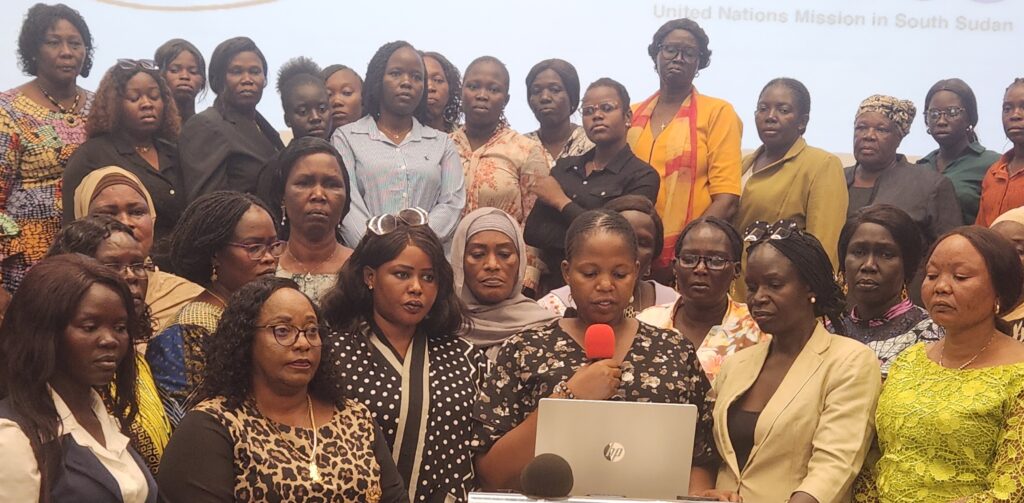
Women leaders in South Sudan on Tuesday called for urgent political action to fully implement the 35% affirmative action quota for women across all levels of government, saying women remain excluded from leadership and decision-making despite commitments under the 2018 peace agreement.
The appeal came at the end of a two-day high-level forum in Juba held under the theme, “Strengthening Women’s Participation in Governance and Peacebuilding.”
The participants included women leaders, signatories to the 2018 Revitalized Peace Agreement, civil society groups, faith-based organizations, academics, business representatives, women in the media, persons with disabilities and peace actors.
Reading a joint statement on behalf of the participants, Diako Pouline Batista, a member of parliament from Western Equatoria State, said women’s representation in political leadership and governance remained below the threshold provided for in the peace agreement and the Transitional Constitution.
“A glaring example is that only seven women out of 70 delegates participated in the recent broad-based national political dialogue,” the statement said, describing the figure as a violation of Article 16 of the Transitional Constitution.
The forum also condemned what it described as a growing trend of removing women from leadership positions and replacing them with men, saying the practice undermined the spirit and provisions of the peace agreement.
“Women’s representation must not be treated as symbolic, temporary, or negotiable,” the statement said.
Participants said the main obstacles were weak political will, inadequate enforcement mechanisms and entrenched patriarchal attitudes that continued to limit women’s participation in governance and public leadership.
They said women’s inclusion should go beyond numerical representation to ensure meaningful participation in policymaking, constitution-making, peace processes and national decision-making.
Among the recommendations adopted by the forum was a call for the 35% quota to be entrenched in the permanent constitution and for authorities to fast-track the Women’s Empowerment Bill to guarantee protections beyond the transitional period.
Delegates also proposed that whenever a woman is removed from a public office, she should be replaced by another qualified woman at the same level to preserve the minimum quota requirement.
The forum further called for the establishment of an independent national monitoring body to track women’s representation at national and state levels and publish regular compliance reports.
Participants urged political parties and appointing authorities to demonstrate commitment through concrete appointments and accountability measures, while calling on traditional and religious leaders to help dismantle barriers preventing women from participating in leadership.
They also appealed to donors, diplomatic missions, United Nations agencies and development partners to support monitoring mechanisms and tie assistance to compliance with gender quota commitments.
“As South Sudan prepares for general elections, women leaders reaffirmed their commitment to speak with one voice in defense of women’s rights, representation, and inclusion,” the statement said.
The forum said sustainable peace, democratic governance and national transformation could not be achieved without the full and meaningful participation of women.
Dr. Lorna James Elia, deputy chairperson of the Political Parties Council (PPC), said the meeting was convened to examine why implementation of the 35% affirmative action quota had continued to fall short despite commitments by political parties and signatories to the peace agreement.
She said many women had been removed from leadership positions in recent months and replaced by men, undermining efforts to achieve the quota.
“There is no deliberate effort to ensure that when women are removed from positions, they are replaced by women so that we can maintain the 35%,” she said.
Lorna said participants agreed to engage political parties and signatories to the peace agreement, including the SPLM-IO, SSOA, OPP, Former Detainees and the government, to demand explanations for the failure to replace women with women in public positions.
She said women were “tired of tokenism and numeric representation” and wanted meaningful implementation of commitments already agreed under the peace agreement.
Lorna also urged political parties to create a conducive environment for women ahead of the December 2026 elections, noting that women make up the majority of voters and should not only vote but also contest for leadership positions.
“Not only voting them, but also we want to be candidates,” she said.

 and then