



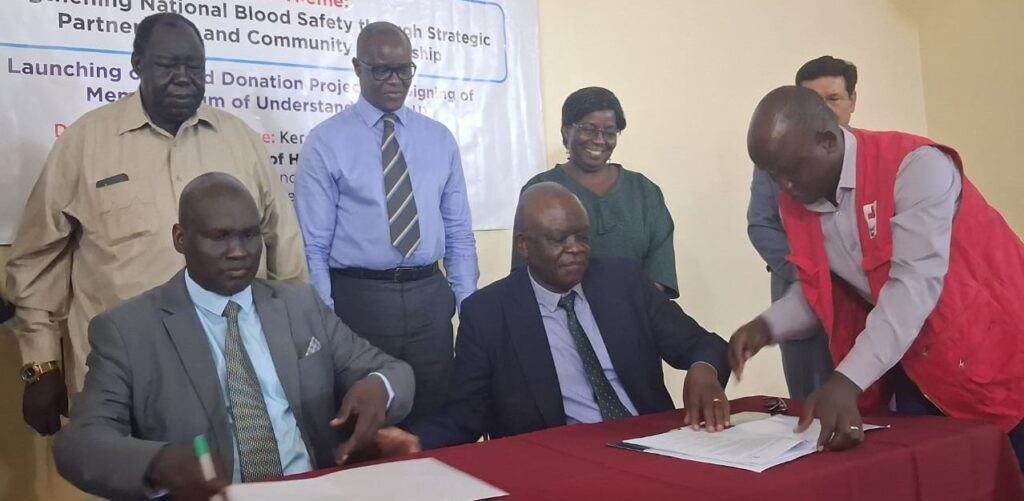
South Sudan’s health ministry on Tuesday signed a memorandum of understanding with the South Sudan Red Cross to strengthen blood transfusion services, as the country grapples with chronic shortages of safe blood and weak healthcare infrastructure.
Speaking at the signing ceremony in Juba, Dr. Harriet Pasquale, chairperson of the National Blood Committee, said the agreement marked an important step toward improving access to lifesaving blood supplies.
“It is my pleasure to be part of this very important meeting, the inception of the blood recruitment initiative, which is to be supported by the South Sudan Red Cross,” Pasquale said.
She said South Sudan’s National Blood Transfusion Services had long struggled with cultural barriers, limited funding and shortages of trained staff.
“We have been running the National Blood Transfusion Services with so many challenges,” Pasquale said. “Challenges ranging from cultural norms which hinder access to blood transfusion services to operational challenges.”
She added that shortages of skilled personnel and limited technical capacity continued to hamper efforts to improve services nationwide.
Despite the difficulties, Pasquale praised health workers and development partners for sustaining blood transfusion services in the country.
“The good news is the fact that we have always had a committed team on board which has always been driving the agenda of National Blood Transfusion Services in South Sudan,” she said.
Pasquale said the government had updated its strategic plan for blood transfusion services to help attract support from international partners and donors.
“That’s why today we’re here to sign an MOU with the partner which has come up to commit itself to support blood transfusion services,” she said.
She also urged donors and humanitarian organisations to help fund the implementation of the strategy, describing financing as one of the sector’s biggest challenges.
Pasquale thanked the South Sudan Red Cross and Swiss Red Cross for supporting blood transfusion services, and acknowledged technical and material assistance from the World Health Organization and the United Nations Development Programme through the Global Fund.
According to Pasquale, the agreement allows the South Sudan Red Cross to help establish and support blood transfusion centres, particularly in underserved areas such as Malakal in Upper Nile State.
John Lobor, secretary-general of the South Sudan Red Cross, said the agreement would strengthen blood donation campaigns and improve access to safe blood across the country.
“The signing of the MOU is a commitment from South Sudan Red Cross, and the Swiss Red Cross, to the government and the people of South Sudan in terms of supporting this program,” Lobor said.
He said the organisation’s nationwide volunteer network would play a key role in mobilising blood donors.
“We have 21 branches across the country, that is in all the 10 states plus the three administrative areas, and we have 19,000 volunteers across the country,” Lobor said.
“We intend to increase the number of voluntary non-paid blood donors through massive public awareness campaigns and addressing misconceptions about blood donation,” he added.
Lobor described blood shortages in hospitals as “a daily emergency” requiring coordinated efforts from government, humanitarian partners and communities.
South Sudan’s healthcare system remains one of the least funded sectors in the country, with health allocations accounting for less than 3% of the national budget.
Dr. Peter Adwok Otto, a member of parliament’s health committee, blamed the low funding on what he described as the government’s failure to prioritise the health sector.

 and then