



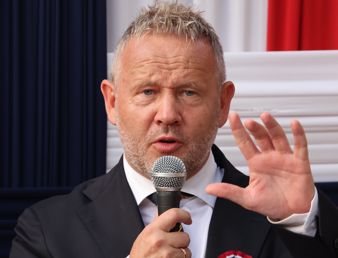
Norway’s ambassador to South Sudan said on Thursday that unilateral attempts to amend the country’s 2018 peace agreement were contrary to both the letter and spirit of the accord that underpins the transitional government.
Speaking to reporters after meeting Transitional National Legislative Assembly (TNLA) Speaker Joseph Ngere Baciko in Juba, Ambassador Roar Haugsdal said the Revitalized Agreement on the Resolution of the Conflict in the Republic of South Sudan (R-ARCSS) remained the basis of legitimacy for the transitional government.
“Unilateral changes to the agreement are not in accordance with the letter and spirit of the agreement and will not bring peace in South Sudan,” Haugsdal said.
The meeting focused on proposed amendments to the 2018 peace deal and efforts to strengthen the legal framework for consolidating peace.
Norway, together with the United States and Britain, forms part of the Troika group that has played a key role in South Sudan’s peace process and remains one of the country’s major donors.
TNLA spokesperson Oliver Mori Benjamin said the 2026 amendment bill would be tabled in parliament on Monday by Justice Minister Michael Makuei before being referred to relevant parliamentary committees for scrutiny.
Benjamin said the proposed amendments would also be discussed with key stakeholders, including the international community, civil society groups and other bodies.
The proposed changes to the peace agreement are being driven by a section of the parties to the accord led by President Salva Kiir, in what officials say is aimed at paving the way for elections scheduled for December this year.
The proposals have been opposed by the Reconstituted Joint Monitoring and Evaluation Commission (RJMEC), the body overseeing implementation of the peace deal, and by the SPLM-IO, the main opposition faction led by First Vice President Riek Machar.
The government has also faced pressure from regional and international actors not to proceed with the amendments without the participation of Machar and other peace partners.
Machar, a key signatory to the 2018 agreement, was detained in March 2025, later suspended as first vice president and is currently facing treason charges before a special court in Juba.
Regional and international bodies have repeatedly urged Kiir’s government to release him and restart an inclusive political dialogue ahead of the planned elections.
Proposed changes
Under Article 8.4 of the R-ARCSS, any amendment to the agreement must be approved by at least two-thirds of the Council of Ministers of the Revitalized Transitional Government of National Unity (RTGoNU) and by at least two-thirds of RJMEC voting members before being ratified by the Transitional National Legislature.
The proposed amendments have not been processed through RJMEC as required under the agreement.
In a response dated Feb. 26, 2026, interim RJMEC chairperson George Owinow raised what he described as “very serious concerns”, saying consultations showed that a majority of RJMEC members opposed the proposed amendments.
Makuei, however, told parliament on April 21 that RJMEC’s position amounted to obstruction, arguing that the commission lacked a dispute resolution mandate and could not block government policy decisions.
The government’s proposal introduces amendments to three chapters and one annex of the peace agreement, using terms such as “delete”, “repeal” and “substitute” to revise provisions governing elections, constitutional sequencing and the legal hierarchy of the accord.
Under the proposed constitutional and electoral changes, Article 1.2.5 would require amendments to the Transitional Constitution of South Sudan to be completed before the end of the transitional period, effectively separating elections from the permanent constitution-making process.
Article 1.2.14 would be deleted, while Article 1.20.5 would be revised to require the National Elections Commission to conduct elections 60 days before the end of the transitional period under the amended Transitional Constitution.
Article 6.4, which requires completion of a permanent constitution within 24 months of the transitional period and guides the conduct of elections, would be repealed entirely.
The proposals would also amend Article 1.20.10 to reduce the deadline for publishing the voter register from six months to three months before elections.
Articles 8.2 and 8.3, which establish the supremacy of the 2018 peace agreement over national laws and the Transitional Constitution in the event of conflict, would be deleted. The title of Chapter VIII would also be revised to remove references to the supremacy of the agreement.
Annex D provisions linked to the Elections Act would also be amended to align implementation with the amended Transitional Constitution rather than a future permanent constitution, while several timelines would be reduced from six months to three months.
Civil society comments
Civil society activist Edmond Yakani said pushing ahead with the amendments without following agreed procedures risked undermining the fragile transition and provoking regional and international backlash.
“Bypassing the step of the RJMEC on the amendment of R-ARCSS is totally a risk and possible failure of the transitional process. Parliament should stand up for the right process and procedure for the amendment of R-ARCSS as stipulated in Article 8.4 of the R-ARCSS,” Yakani told Radio Tamazuj.
Yakani said the government should demonstrate respect for decisions and calls made by the African Union Peace and Security Council on ensuring a credible and inclusive political transition in South Sudan.

 and then