



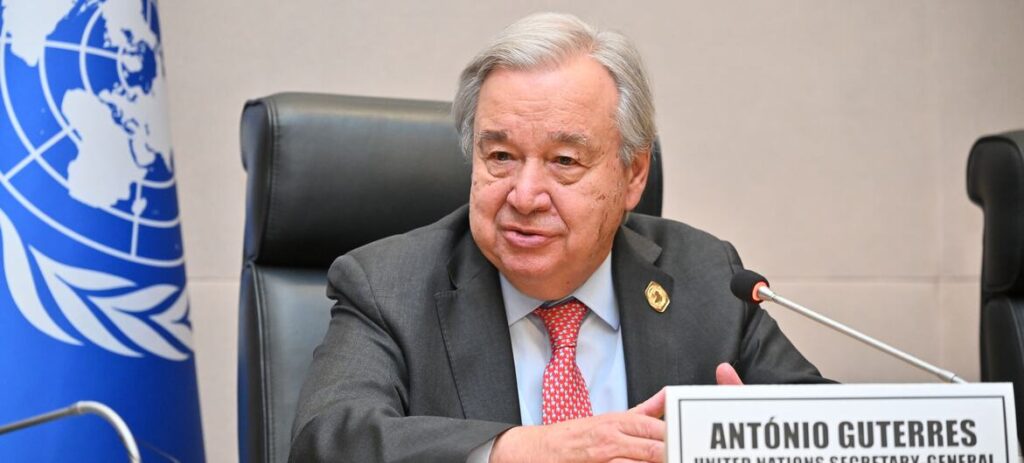
United Nations Secretary-General António Guterres on Wednesday reaffirmed the UN’s partnership with the African Union, calling the bloc “the flagship for multilateralism in Africa” and urging sweeping reforms to global finance and climate systems to better serve developing countries.
Speaking to reporters after the annual AU–UN conference in Addis Ababa, Guterres said cooperation between the African Union and the United Nations had strengthened since the start of his tenure, adding that joint frameworks on peace and security, sustainable development and human rights were delivering “meaningful impact” across the continent.
He said both institutions had agreed to further institutionalise coordination through a new declaration signed with AU Commission Chairperson Mahmoud Ali Youssouf, and stressed that Africa’s representation in global decision-making remained a central concern.
“This is Africa’s historical injustice,” Guterres said, referring to the absence of permanent African representation on the UN Security Council. “We cannot accept it.”
He reiterated support for ongoing intergovernmental negotiations on Security Council reform, arguing that the body must reflect “today’s world” to maintain legitimacy and effectiveness.
On development financing, Guterres said Africa’s economic potential — including the African Continental Free Trade Area, natural resources and a young population — was being constrained by an unfair global financial system.
He said many African countries face borrowing costs up to three times higher than benchmark rates, limiting investment in health, education and water systems. “We need to fix a system that makes it three times more expensive for developing countries to finance basic services,” he said.
The Secretary-General praised African-led reform efforts, including initiatives linked to the African Development Bank and proposals for a “new African financial architecture,” as well as support for the creation of an African credit rating agency.
He also pointed to the so-called Sevilla Commitment, describing it as a “watershed moment” for global financial reform, including measures to expand multilateral development bank lending capacity, ease debt burdens and improve developing countries’ participation in debt architecture.
On climate change, Guterres warned that a temporary overshoot of the 1.5°C warming threshold was now “inevitable but not irreversible,” urging accelerated action to limit its scale and duration.
He said Africa, which receives only around 2% of global clean energy investment, could become a major renewable energy hub, with the potential to generate far more electricity than it consumes by 2040.
However, he warned that limited grids, high capital costs and weak regulatory frameworks continued to hinder investment, and called on developed countries to scale up adaptation finance and support the Loss and Damage Fund.
Guterres also said upcoming climate negotiations, including COP32 in Ethiopia in 2027, would be critical in advancing adaptation and energy transition goals.
He added that Africa should move beyond being a supplier of raw materials in the global energy transition, and instead develop domestic industries for processing and manufacturing critical minerals.
“No more exploitation. No more plundering,” he said.

 and then