



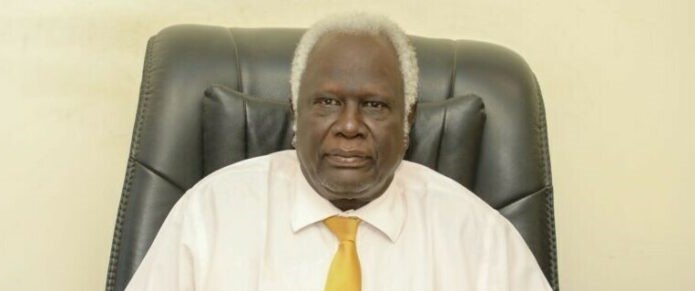
South Sudan’s National Election Commission (NEC) on Monday set December 22, 2026 as the date for long-delayed general elections, while warning of legal inconsistencies and financial constraints ahead of the vote.
NEC chairperson Prof. Abednego Akok Kacuol said the decision was anchored in provisions of the National Elections Act 2012 (as amended in 2023), which require the commission to announce a polling date at least six months in advance, but acknowledged gaps and contradictions in the wider legal framework governing the electoral process.
“I am delighted and happy to welcome you today at the headquarters of the National Election Commission,” Akok told journalists in Juba while announcing the election date.
He said the Revitalised Transitional Government of National Unity (R-TGoNU) had extended the transition period in September 2024 by two years, pushing the country’s first post-independence elections from December 2024 to December 2026.
“This fourth extension postponed the country’s first post-independent election from December 2024 to December 2026,” he said.
Akok said the NEC had been reviewing both the remaining electoral timeline and the legal framework, stressing the need for further amendments to the Elections Act by the parliament.
He cited Article 16 of the law, which requires the commission to publish the election date in the official gazette and national media at least six months before polling.
“Hence, from June 22, 2026 to December 22, 2026 is six months as specified,” he said, confirming the polling date.
However, he said unresolved legal amendments and persistent funding gaps continued to complicate preparations.
“There are many challenges facing the commission and we strongly request the government to speed up amending the existing legal gaps and provide all basic needs within a short period,” he said.
Akok urged public participation in the electoral process, saying voting remained the only legitimate means of attaining political power, and called on the media to widely disseminate the election date.
Journalists pressed the NEC chair on preparedness, including funding, voter registration, security arrangements and the feasibility of the timeline.
Akok cited legal gaps, financial shortfalls and operational constraints as key challenges.
“We need the laws enacted fully, and then regulations produced to operationalise the Act,” he said, adding that voter registration could be completed within a short period based on past experience.
“Normally, with our past experience, registration of voters doesn’t take more than a month,” he said, adding that the voter register would be published for public scrutiny, particularly in urban centres.
On funding, Akok said the total election budget stood at about $250 million, adding that the commission had received $21 million, with additional resources still required.
He later said the recently received $6 million would be distributed equally among states and the three administrative areas.
“$250,000 will be distributed to the states, they will be all equal, divided into the states and the three administrative areas,” he said.
Asked what would happen if resources were not secured within the six-month period, Akok said the NEC would proceed with implementation planning while adjusting toward a “realistic electoral timeline.”
He said political will, security and funding were primarily government responsibilities.
“The political will is not ours. It belongs to the government,” he said, adding that insecurity and funding constraints were beyond the commission’s control.
Akok said a national election security mechanism had been established and trained, but stressed that “the main source of security lies with the government.”
He also referred to an upcoming political dialogue among parties and an African Union-backed process expected in July, saying the NEC was not involved in negotiations.
“There is a political dialogue for parties that will commence in July. I am not the one doing it,” he said.
Akok dismissed media reports alleging he attended a political event wearing a red SPLM-branded cap, saying he had been invited to an event in Abyei-Chok in 2024.
“I was invited to attend that occasion. I did not wear any red cap,” he said, adding that his remarks focused on civic education.
He said the law did not specify a minimum voter turnout threshold for elections to be valid. “There is no specific number of voters specified in the Act,” he said.
On access to the disputed area of Abyei, he said the commission plans to engage local communities.
“We are planning to visit Abyei soon and see what will happen,” he said.
Rajab Mohandis, a political observer and member of the People’s Coalition for Civil Action (PCCA), told Radio Tamazuj that legal and procedural gaps could undermine credible elections in December.
“You need the law amended fully and then use the provisions of the law, as well as regulations that would be produced to operationalise the Elections Act,” he said.
He added that civic education remains limited due to the absence of a complete legal framework.
“Any civic education conducted now would be at a broader level, but not specific enough,” he said, adding the country remains “very far” from being ready.
South Sudan is preparing for its first elections since independence, but key provisions of the 2018 peace agreement remain unimplemented amid political tensions and slow reforms.
President Salva Kiir Mayardit’s camp has maintained that elections should proceed in December 2026, while some opposition parties, including the SPLM-IO led by detained First Vice President Riek Machar, have raised concerns over readiness.
Western envoys in Juba have said they support elections but insist they must be credible, inclusive and peaceful.

 and then