



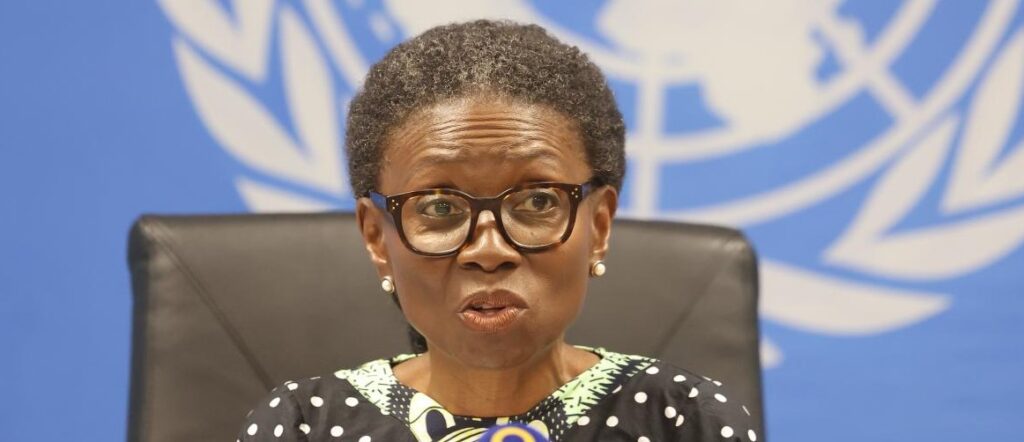
South Sudan faces mounting obstacles to holding credible, peaceful and inclusive elections in December, with political divisions, insecurity and weak institutional preparedness threatening the country’s transition, the head of the United Nations mission warned the Security Council on Thursday.
Briefing the council, the U.N. Secretary-General’s Special Representative and head of the U.N. Mission in South Sudan (UNMISS), Anita Kiki Gbeho, said preparations for the Dec. 22 polls had come to dominate the country’s political landscape, but key conditions necessary for a credible vote remained unresolved.
“While elections represent an important transition milestone, concerns are growing about whether conditions necessary for credible, peaceful and inclusive elections can be established in time,” Gbeho said.
Her warning comes as President Salva Kiir’s government insists South Sudan is on track to transition from a transitional administration to an elected government in December. However, opposition parties, civil society groups and international observers have repeatedly questioned whether the political and security environment is conducive to credible elections.
Gbeho said political trust among key stakeholders remained fragile, while the continued absence of key opposition actors from major political processes had raised concerns over inclusivity, consensus-building and confidence in the implementation of the 2018 Revitalized Peace Agreement (R-ARCSS).
She also noted that the trial of detained First Vice President Riek Machar had exceeded 100 court sessions and continued for nearly a year while he remained in detention.
The U.N. official said persistent fighting between government forces and the SPLA-IO, particularly in Jonglei State, as well as communal violence in Warrap and Lakes states, continued to displace civilians and undermine stability ahead of the planned elections.
She said violence had displaced more than 420,000 people between January and June, mainly in Jonglei, worsening an already severe humanitarian crisis marked by food insecurity and restricted humanitarian access.
South Sudan is also hosting around 1.4 million people who have fled the conflict in neighbouring Sudan, placing additional pressure on the country’s limited resources and humanitarian services, she said.
Gbeho warned that disease outbreaks, including cholera and the threat of Ebola spreading from neighbouring Democratic Republic of Congo, together with growing attacks on aid workers, were further straining an already fragile environment.
She said 36 humanitarian workers had been killed this year, while humanitarian agencies had recorded 391 access incidents, a significant increase from the same period last year.
Election conditions remain unresolved
Gbeho said critical political, security and institutional questions remained unanswered despite the approaching election date.
Among the outstanding issues, she cited the lack of political trust, restrictions on civic and political space, unresolved security arrangements, inadequate financing, uncertainty over constituency boundaries and broader institutional weaknesses.
“These realities continue to affect both implementation of the peace agreement and preparations for elections,” she said.
She nevertheless acknowledged some positive developments, including the government’s declaration that it would not resume hostilities and its continued policy of keeping borders open to people fleeing the war in Sudan.
She said the commitment to refrain from renewed fighting should now be translated into concrete reductions in violence and anchored in the 2017 Cessation of Hostilities Agreement.
Calls for inclusive dialogue
Gbeho said South Sudan already had a roadmap for completing its transition through the 2018 peace agreement, but the principal obstacle remained implementation rather than the absence of agreements.
“What is required is the political will by all South Sudanese leaders to implement commitments already undertaken,” she said.
She urged all parties to end hostilities, protect civilians and humanitarian workers, and return to genuine and inclusive political dialogue involving political parties, civil society, faith leaders, women and youth.
She said such dialogue was essential if elections were to contribute to peace rather than trigger renewed conflict.
“Inclusive dialogue is also a necessary condition if elections are to contribute to peace and stability,” Gbeho said. “Elections, if managed well, can become a path towards peace rather than a trigger for increased tensions.”
The U.N. also welcomed a planned African Union needs assessment mission, saying it could provide an objective assessment of whether the minimum conditions for credible elections exist and help identify the political, security and institutional measures still required.
Gbeho urged the Security Council to maintain a united approach in supporting regional peace initiatives and encouraging South Sudan’s leaders to choose dialogue over confrontation.
“The people of South Sudan have endured extraordinary hardship,” she said. “They deserve a transition that is inclusive, credible and capable of delivering the peaceful and stable South Sudan for which they have waited so long.”

 and then