



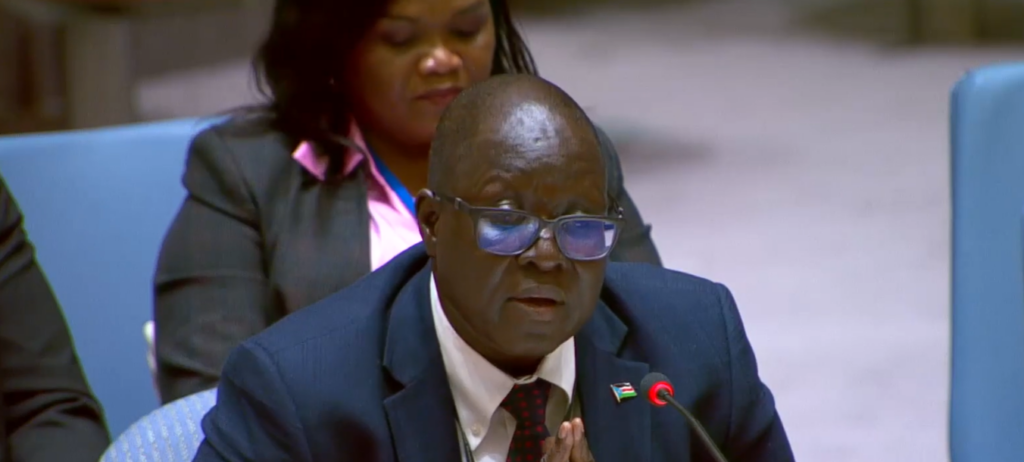
South Sudan told the United Nations Security Council on Thursday that concerns over preparations for December’s planned elections remain manageable despite persistent insecurity, economic hardship and political tensions, pushing back against suggestions that the country is unprepared for the vote.
Addressing the council, South Sudan’s Deputy Permanent Representative to the United Nations, Ambassador Sabino Nyawella Amaikwey, acknowledged that challenges remained but said the government was committed to ensuring citizens elect their leaders as scheduled.
“South Sudan acknowledges the concerns expressed regarding preparations for elections. While challenges remain, we are confident that they are manageable through continued national efforts and cooperation with our regional and international partners,” Nyawella said.
His remarks came after U.N. officials and the country’s peace monitor warned the Security Council that critical political, security and institutional conditions required for credible, peaceful and inclusive elections in December remain unmet.
Nyawella identified insecurity, economic pressures and international sanctions as the main obstacles facing the electoral process.
“The principal obstacles are well known: continued insecurity caused by armed groups, severe economic constraints exacerbated by the sanctions regime, and the need for greater clarity regarding the benchmarks for lifting those measures,” he said.
The government also rejected suggestions that recent changes in the implementation of the 2018 Revitalized Peace Agreement (R-ARCSS) were unilateral, saying they were undertaken within the framework of the accord after prolonged delays.
“The temporary absence of certain leaders—whether by choice or because they are subject to legal processes—cannot indefinitely suspend implementation of an agreement intended to benefit the entire nation,” Nyawella said.
The comments refer to the detention and ongoing trial of First Vice President Riek Machar, whose arrest in March 2025 has deepened political divisions and raised concerns among regional and international partners over the future of the peace agreement.
Government dismisses concerns over census
Nyawella said the government remained determined to hold elections in December this year and dismissed concerns that the absence of a national census or a permanent constitution should delay the vote.
He argued that neither was a legal prerequisite for elections and said the country’s priority was compiling a credible voter register.
“We are fully aware that the national census, which is very important for long-term planning, is not a prerequisite for elections and could not hold such an important process hostage,” he said.
“Our own independence referendum demonstrated that democratic choice can be exercised without an immediate prior census.”
South Sudan’s parliament recently amended the peace agreement to remove the completion of a permanent constitution and a population census as conditions for holding elections, a move criticised by opposition groups and some international partners.
Criticism of U.N. reporting
Nyawella also criticised aspects of the U.N. Secretary-General’s latest report, urging future reporting to rely on what he described as verified facts and balanced analysis.
He objected to references describing some armed groups as “armed youths”, saying organised groups such as the White Army should be identified consistently where evidence permits.
He also rejected allegations that the government was deliberately obstructing the work of the U.N. Mission in South Sudan (UNMISS), saying any restrictions on movement were intended to protect U.N. personnel operating in insecure areas rather than hinder the mission.
Nyawella attributed some operational shortcomings to capacity constraints, which he said had been exacerbated by international sanctions.
Commitment to peace
Despite the challenges, the government reaffirmed its commitment to implementing the peace agreement and working with the United Nations, the African Union, the Intergovernmental Authority on Development (IGAD) and other partners.
“The people of South Sudan deserve peace, stability, and the opportunity to determine their future through democratic means,” Nyawella said. “That remains our unwavering commitment.”
The government has repeatedly said the country is ready to transition from a transitional administration to an elected government following the December polls. However, the United Nations, the Reconstituted Joint Monitoring and Evaluation Commission (RJMEC), opposition parties and civil society groups have warned that major political, security and institutional challenges still threaten the credibility of the elections.

 and then