



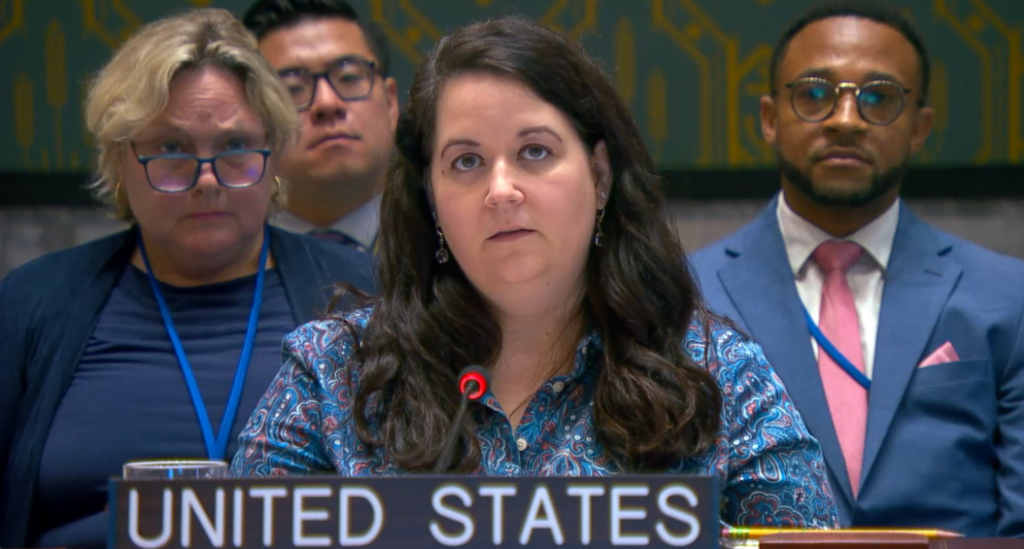
The United States accused South Sudan’s leaders on Thursday of using repeated promises of elections to distract the international community and attract donor funding while failing to address the country’s worsening humanitarian, economic and security crises.
Addressing the U.N. Security Council, U.S. Ambassador Jennifer Locetta, the Alternative Representative for Special Political Affairs, said the country’s leaders had spent years making what she described as insincere commitments on elections instead of pursuing genuine peace and reforms.
“For years, South Sudan’s leaders distracted the international community with insincere elections talk to attract donor assistance, while perpetuating the humanitarian, economic and security crises,” Locetta told the Council. “This continues today.”
Her remarks represent one of the strongest recent public criticisms by Washington of South Sudan’s political leadership as the country prepares for elections scheduled for December.
Locetta said South Sudan’s leaders had failed to deliver the peace and stability envisioned when the country gained independence in 2011, while violence against civilians continued to rise.
She cited U.N. figures showing that between April and July, at least 418 people were killed, 400 injured, 122 abducted and more than 420,000 displaced by conflict.
She also pointed to renewed fighting in Akobo shortly before Independence Day between the South Sudan People’s Defence Forces (SSPDF) and the Sudan People’s Liberation Movement-in-Opposition (SPLM-IO).
“The onus lies with South Sudan’s leaders,” Locetta said, adding that public resources were not being used for the benefit of citizens.
The U.S. envoy also criticized government restrictions on the U.N. Mission in South Sudan (UNMISS), saying the peacekeeping mission had recorded 86 violations of its Status of Forces Agreement between April and July, including 84 cases in which authorities restricted its movements.
Despite those obstacles, she said, UNMISS continued protecting civilians, escorting humanitarian convoys and helping to de-escalate violence in conflict-affected areas.
Locetta argued that lasting peace in South Sudan would require direct political dialogue, saying such efforts were difficult while suspended First Vice President Riek Machar, whose SPLM-IO is the second-largest signatory to the 2018 peace agreement, remains under house arrest and on trial.
She said that if elections proceed, South Sudan’s leaders should ensure they are held in peaceful conditions and financed with the country’s own resources rather than external donor support.
“The people of South Sudan need leaders who choose peace over power, and accountability over impunity,” Locetta said, urging the government to end violence, resume dialogue among the peace agreement’s signatories and cooperate fully with UNMISS.

 and then