



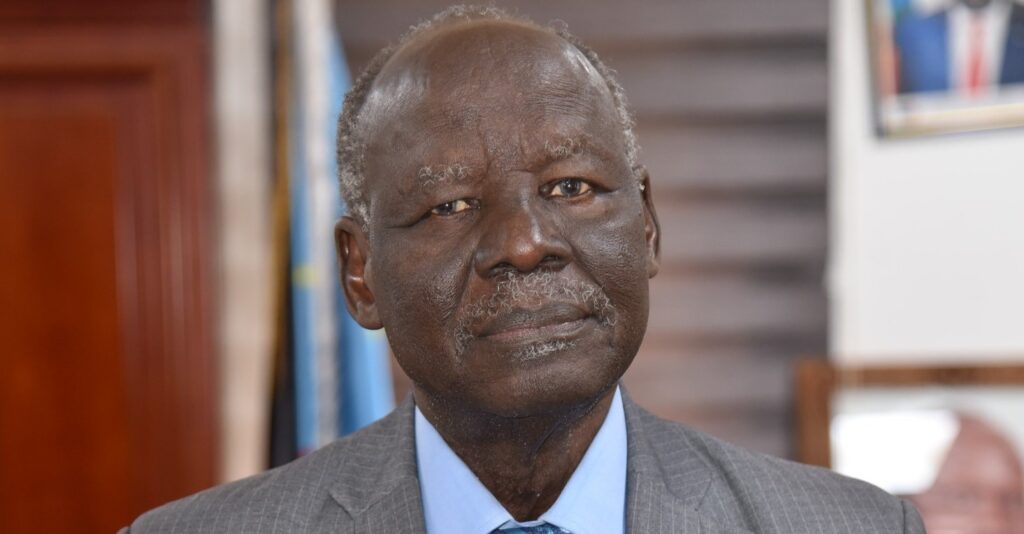
The opposition National Democratic Movement (NDM) said on Friday it would consult with like-minded political parties on whether to boycott the country’s planned elections, arguing that conditions for a free and credible vote do not exist.
The party’s chairman, Lam Akol Ajawin, stopped short of announcing a boycott but said no decision would be taken unilaterally if the government proceeded with elections in December without addressing concerns over security, political freedoms and implementation of the 2018 peace agreement.
“It is not for me,” Lam told reporters when asked whether he was signalling a boycott. “We are going to consult with the like-minded parties. Everything is open until we sit down and discuss the position that we take.”
South Sudan is due to hold its first post-independence elections, but opposition parties, civil society groups and some international partners have repeatedly questioned whether the country has met the political and security benchmarks required for a credible vote.
Lam said the NDM believes there is no conducive environment for elections, citing restrictions on political activities, insecurity and what he described as shrinking political space for opposition parties.
“We are saying that there is no free space. That’s why it is not possible to hold elections when parties cannot address rallies and cannot move freely,” he said.
He said the party would first consult with other opposition groups before deciding whether to participate in or boycott the polls.
Lam also challenged recent amendments to the 2018 Revitalised Agreement on the Resolution of the Conflict in South Sudan (R-ARCSS), arguing they were adopted without the consensus required under the 2018 peace agreement and the Transitional Constitution.
According to Lam, the amendments bypassed the peace implementation mechanisms and failed to comply with constitutional procedures.
“If you consider all this, the amendment is ultra vires,” he said.
The opposition leader also questioned the independence and preparedness of the National Elections Commission (NEC), accusing it of lacking transparency over preparations for the vote.
He said the commission should publish a comprehensive electoral timetable covering voter education, voter registration, recruitment of election officials and polling, adding that many citizens had yet to see voter registration centres despite official announcements that preparations were underway.
Lam further rejected suggestions that the NDM shares responsibility for delays in implementing the peace agreement, saying one signatory party had dominated decision-making while concerns raised by other parties were ignored.
He said the NDM had consistently called for broader dialogue, including with non-signatories to the peace agreement, to address the underlying causes of South Sudan’s conflict.
The remarks add to growing uncertainty over South Sudan’s electoral process as opposition parties and civil society organisations continue to question whether the political and security conditions required for credible elections are in place.
The NDM aligns with a faction of the South Sudan Opposition Alliance (SSOA) led by Josephine Lagu that is a signatory to the 2018 peace agreement.
Akol, a veteran opposition politician, founded the NDM in 2016. He previously led the SPLM-Democratic Change (SPLM-DC) and unsuccessfully challenged President Salva Kiir in the 2010 presidential election before South Sudan’s independence.
 and then