



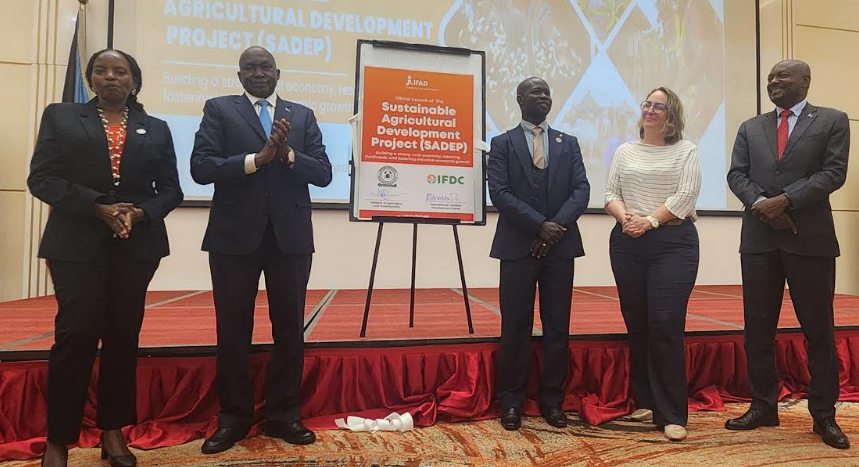
The Government of South Sudan and the International Fund for Agricultural Development (IFAD) on Tuesday launched a USD 41.8 million agricultural programme to improve food security and strengthen the livelihoods of more than 100,000 people in four counties across the country.
The Sustainable Agriculture Development Programme (SADEP), together with the Strengthening Adaptation through Institutional Building and Resilient Livelihoods in South Sudanese Agro-Pastoral Landscapes (SABRELA) project, will be implemented in Terekeka, Mundri West, Mvolo and Bor counties over the next seven years, focusing on climate-smart agriculture, fisheries, nutrition, market access and resilience to climate change.
Launching the programme on behalf of Vice President James Wani Igga, who chairs the Economic Cluster, the Minister of Livestock and Fisheries, Onyoti Adigo Nyikwac, said the initiative is expected to help transform South Sudan’s agriculture sector while reducing the country’s dependence on imported food.
“The government of South Sudan remains firmly committed to transforming agriculture from predominantly subsistence production into a productive, resilient, commercialized, viable and market-oriented sector,” he said. “To our young people in particular, agriculture should not be viewed as an occupation of last resort. Across the value chain—from production and mechanization to processing, logistics, digital agriculture, finance, marketing and agribusiness—there are numerous opportunities for innovation, entrepreneurship and employment.”
Caroline Mwongera, IFAD Country Director for South Sudan and Eritrea, described SADEP as one of the fund’s largest recent investments in South Sudan, saying it would directly benefit more than 100,000 rural residents through investments in climate-smart agriculture, fisheries development, nutrition, stronger rural institutions and improved access to markets.
“Today marks a very important milestone for IFAD in our partnership with the government and the people of South Sudan,” she said. “We are gathered here not only to launch two projects, but to begin a new phase in rural transformation, resilience and inclusive economic growth.”
She said the accompanying SABRELA project, financed by the Global Environment Facility (GEF), will strengthen institutions, improve natural resource governance and help communities better withstand increasingly frequent floods, droughts and other climate-related shocks.
Meanwhile, Clement Juma, Minister of Agriculture and Food Security, said the projects come at a time when South Sudan continues to struggle with food insecurity despite possessing vast fertile land, abundant water resources and favourable climatic conditions.
“These initiatives represent much more than development projects,” he stated. “They are strategic investments in the future of South Sudan’s agriculture and rural economy.”
Juma urged all stakeholders—including state and county governments, research institutions, civil society organizations and the private sector—to work together to ensure the projects deliver measurable improvements in the lives of rural communities.
The implementing partners also pledged to ensure the programme produces tangible results for farmers.
Ania Okinczy, Country Director of Welthungerhilfe (WHH) South Sudan, said the programme marks the beginning of a long-term partnership aimed at transforming the country’s food system rather than simply increasing agricultural production.
“The problem is not that South Sudan cannot produce. The problem is that our food system is not yet sufficiently developed—from the farm or the river to the market and ultimately to the consumer,” she said. “That is the challenge that we must confront. We are hopeful that when you go to Mundri, Mvolo, Terekeka or Bor, you will see more than a project.”
“You will see the impact of SADEP among over 18,000 households, with healthier children, empowered women, more resilient households and a thriving private sector,” Okinczy added.
For his part, Alana Sebit Owot, Country Representative of the International Fertilizer Development Center (IFDC) South Sudan, said the project presents an opportunity for the country to move beyond years of humanitarian assistance toward sustainable agricultural development.
“For over many years, we have been more into humanitarian interventions,” he said. “SADEP is coming with an opportunity to move away from the humanitarian aspect into more developmental strategies where we need to address the key challenges facing our smallholder farmers.”
He pledged that IFDC, together with WHH and the Ministry of Agriculture, would ensure value for money through strong coordination and local ownership.
The programme builds on IFAD’s previous investments in South Sudan’s agriculture sector and is expected to strengthen food production, improve rural incomes and build resilience against climate-related shocks in some of the country’s most agriculture-dependent communities.

 and then