



South Sudan’s Ministry of Wildlife Conservation and Tourism has urged the Transitional National Legislative Assembly (TNLA) to ensure wildlife protection laws are incorporated into the country’s pending land policy and other land-related legislation.
The call was made on Friday by the Ministry’s Land Use Planning Committee during a meeting with the TNLA Standing Specialized Committee on Wildlife Conservation.
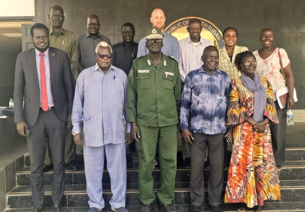
The meeting brought together members of the ministry’s Land Use Planning Committee, members of the parliamentary wildlife committee and representatives of African Parks.
Reading the statement from the Land Use Planning Committee, its Secretary General, Bennet Bojo Nicholas, said protected areas, wildlife corridors and buffer zones depend on land policies and legislation that clearly recognize their status and management.
“The committee has therefore asked parliament to advocate for the appropriate integration of the Wildlife Conservation and Protected Areas Act into the forthcoming Land Policy and subsequent land legislation,” he said.
Bojo also called for stronger coordination among government institutions involved in mining, infrastructure, agriculture and land development, particularly where their activities affect protected areas, wildlife and surrounding communities.
“It also requested parliament to establish quarterly meetings with the committee to discuss emerging land-use issues and identify areas requiring parliamentary support,” he said.
The committee was established in March through a ministerial order to strengthen land-use planning, protected-area governance, wildlife conservation and coordination among government institutions and communities.
Martin Ring Malek, deputy chairperson of the ministry’s Land Use Committee, said identifying land designated for wildlife is critical to protecting animals and supporting South Sudan’s economy.
“We aim to make sure that we identify the land which is allocated to animals,” he stated.
He said communities sometimes cross into protected areas, creating challenges between communities and wildlife authorities, and called for closer cooperation between the two committees.
Meanwhile, Wilson Lodiong, chairperson of the parliamentary Standing Specialized Committee on Wildlife Conservation, called for broader consultations on land use.
“The land belongs to the animals, the land belongs to the people, even the water is part of the land that we are on,” he said.
He called for a two- to three-day workshop involving the Ministries of Mining, Agriculture, Forestry and Wildlife, Water and Irrigation, and other stakeholders to clarify responsibilities and improve coordination.
Lodiong also urged consultations with communities and authorities around major wildlife areas, including Nimule, Badingilo, Boma and the Jonglei landscape. He further said the Land Policy is still under consideration and has not been finalized or signed by the president.
For his part, Timmy Berke, coordinator at African Parks, pledged continued support to the ministry and parliamentary committee.
“I appreciate the coordination a lot with the Ministry and the Steering Committee. We’re here to continue to support where we can,” he said. “The Wildlife Act was recently passed in February; it’s not mentioned there, and there’s great importance for different land uses.”
The discussion broadened to several related wildlife governance issues, where parliamentarians requested updates on the regulations being developed to operationalize the Wildlife Act.
Concerns were also raised about illegal wildlife killing, trade, and export, including cases where influential individuals or security personnel may be involved. Members emphasized parliament’s oversight role and the need for stronger coordination with MWCT on enforcement.
Parliament also requested that relevant international wildlife agreements, including CITES, be brought forward through appropriate domestic processes so that international commitments are properly reflected in South Sudan’s legal framework.

 and then