



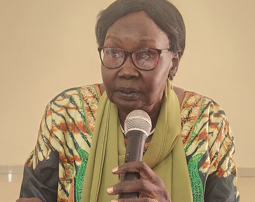
South Sudan is yet to build functioning state institutions, the chairperson of the Civil Service Commission, Prof. Julia Aker Duany, has said, warning that weak public administration is undermining the country’s ability to govern and deliver services to its people.
Speaking during a panel discussion organised by the South Sudan Human Rights Defenders Network (HRDN) in Juba on Tuesday, she questioned whether the country had genuinely begun the process of state-building since gaining independence.
“Have we really started building a state? Have we built a state?” she asked. “No, we have not built a state.”
Prof. Duany said the country’s institutions remain too weak to address the country’s political, economic and social challenges, arguing that the country had carried the tools and mindset of liberation into the process of building a state.
“When we came in 2005, we were bombarded with a lot of resources,” she said. “We carried the tool of liberation to build a state.”
According to Duany, state-building requires a different set of tools, including stability and security, effective laws, responsible management of national resources, socioeconomic development and social justice.
She said South Sudan’s failure to establish effective institutions was evident in the condition of its public administration.
“Our public administration is one of the weakest in the region,” Duany said, adding that some public institutions and commissions lack basic facilities needed to operate.
She cited the Civil Service Commission itself as an example, saying that despite its role as a public institution, it does not have an office.
“So where are the institutions?” she asked.
Prof. Duany also questioned the government’s ability to provide basic services, pointing to challenges in education, health, clean water, roads, food security and rural development.
She argued that the problem was not simply a lack of laws, but the inability of institutions to implement them.
“If we are really serious, we need to go back to basics,” she said, calling for a renewed focus on building institutions capable of implementing the laws already in place.
Despite her criticism of the state’s institutions, Duany said South Sudan has considerable human resources that could contribute to building a functioning country.
She pointed to the number of South Sudanese with PhDs, master’s degrees, bachelor’s degrees and other qualifications, questioning why the country has failed to make better use of its educated population.
“We have the knowledge. We have the resources,” she said.
Duany argued that South Sudan should draw lessons from other countries while adapting those experiences to its own traditions and circumstances.
She also stressed that citizens should play an active role in strengthening the country’s institutions rather than assuming that government alone is responsible for building the state.
Prof. Duany further called for stronger cooperation between government and civil society, saying the two should not view each other as adversaries.
“Why should I be your enemy?” she asked, addressing civil society representatives.
She said civil society organisations, journalists and other groups should be able to bring problems to government institutions, while government should listen and act on credible information.
“If a civil society person comes in our office and tells us this is a bad thing, we should be rushing out and go and correct that thing,” she stated.
Duany argued that strong governance depends not only on government institutions but also on the flow of information between citizens, civil society and the state.
She urged South Sudanese to use existing knowledge and resources to address the country’s challenges rather than waiting for outside actors to provide solutions.
“There are no institutions. There is no state. We are just trying to figure it out,” she said, while maintaining that South Sudan still has an opportunity to change course.
Duany’s remarks come as South Sudan continues efforts to complete its political transition and establish a permanent constitutional order.

 and then