



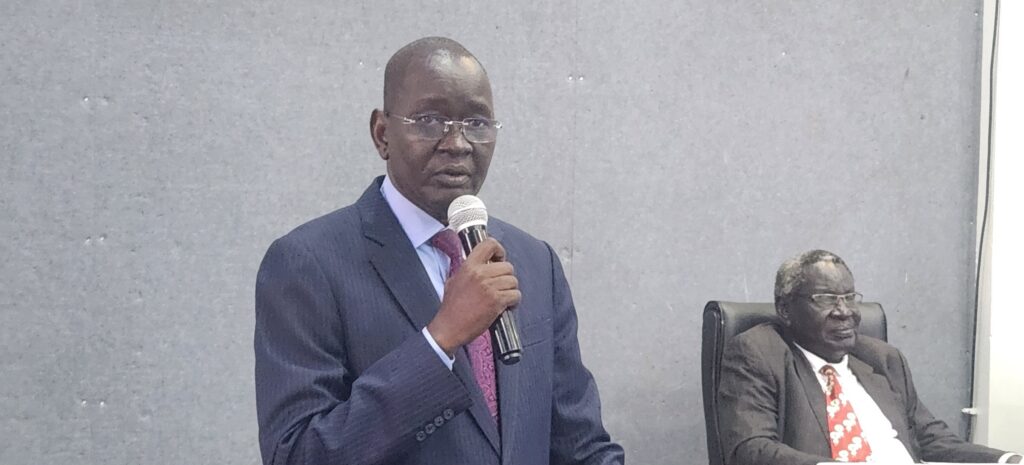
Former Deputy Information Minister Jacob Maiju Korok challenged long-standing narratives about the Murle area in Pibor, saying its struggles stem from neglect rather than conflict.
Speaking at the launch of his book, Development of Neglected Murle-Land through Its Potential Resources, on Saturday in Juba, Korok said the area has been unfairly characterized by violence while its development needs remain largely ignored.
“This is not merely a book launch. It is a declaration of hope, a call for reflection, and a roadmap for transformation,” Korok told government officials, community leaders, and youth representatives.
Korok emphasized that Murle land, rich in livestock, fertile land, water resources, and human potential, has been excluded from national development priorities for decades.
“A land of full potential yet labeled only by conflict and crisis,” he said. “Murle land is not defined by war. It is defined by neglect.”
He argued that underdevelopment is the result of policy failure, not inherent instability, and urged policymakers to rethink their approach. “It is not incapable. It is neglected,” he said.
Korok’s book documents historical marginalization and the gap between the region’s potential and current reality. It calls for a shift in how Murle land is perceived nationally and internationally.
The event drew community elders, youth groups, and development stakeholders, many echoing concerns about the region’s exclusion from infrastructure and investment planning.
“Neglect is a policy failure, not a destiny. And what has been neglected can be developed,” Korok said.
South Sudan’s Minister of Livestock and Fisheries, Onyoti Adigo Nykwac, called the publication “historical” and an “eye-opener” on the region’s untapped potential, highlighting fertile land, water, fisheries, livestock, and tourism opportunities. He noted these resources remain underutilized due to insecurity and internal conflict.
Nykwac urged communities, particularly youth, to embrace peace and reconciliation, saying sustainable development cannot occur amid violence. He also emphasized self-reliance and better use of local resources, suggesting the book could help shift mindsets toward long-term economic growth.
Government spokesperson Ateny Wek Ateny described the work as a “roadmap” that brings the Murle community back onto the national and global stage. He said the book documents challenges and provides practical development solutions, urging policymakers and academics to treat it as a reference.
Ateny highlighted historical marginalization in Murle and other rural areas, linking underdevelopment to past policies and lack of infrastructure. “Communities are less likely to engage in conflict when they have economic opportunities and something to lose,” he said, calling for investment in infrastructure, education, and tourism to unlock local potential.
Alangi Stephen Ogut, Korok’s wife, described the book as a “call to action” inspired by her husband’s vision to transform Murle into a thriving area. She said it reflects his commitment to shifting the narrative around Murle from neglect to opportunity.

 and then