



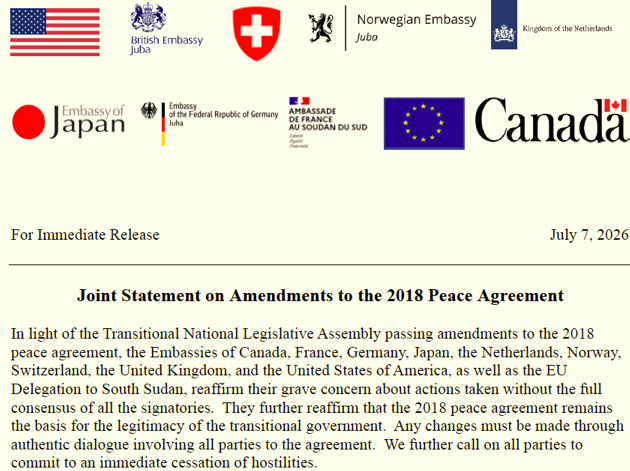
A group of Western embassies and the Japanese Mission in South Sudan on Wednesday released a Joint Statement regarding the Amendments to the 2018 Peace Agreement by the National Legislature, stressing that changes should be undertaken using genuine discourse.
Last Wednesday, 1 July, South Sudan’s parliament approved controversial amendments to the 2018 Revitalized Peace Agreement, removing requirements for a population census and a permanent constitution before elections due in December 2026, despite objections from opposition lawmakers.
The National Legislature voted to defer the two provisions until after the elections, with parliamentary officials saying the move clears major legal obstacles to holding the vote.
A Wednesday statement extended to radio Tamazuj said that in light of the Transitional National Legislative Assembly passing amendments to the 2018 peace agreement, the Embassies of Canada, France, Germany, Japan, the Netherlands, Norway, Switzerland, the United Kingdom, and the United States of America, as well as the EU Delegation to South Sudan, reaffirm their grave concern about actions taken without the full consensus of all the signatories.
“They further reaffirm that the 2018 peace agreement remains the basis for the legitimacy of the transitional government,” the embassies said. “Any changes must be made through authentic dialogue involving all parties to the agreement. We further call on all parties to commit to an immediate cessation of hostilities.”
Last Thursday, the Troika countries said any changes to South Sudan’s 2018 peace agreement must be agreed through an inclusive dialogue involving all signatories, warning that the accord remains the foundation of the transitional government’s legitimacy despite its shortcomings.
Speaking on behalf of the United States, Britain, and Norway during a meeting of the Reconstituted Joint Monitoring and Evaluation Commission (RJMEC), U.S. Ambassador to South Sudan Michael J. Adler said the peace agreement remains the legal basis for the transitional government despite repeated failures by its signatories to fully implement it.
“The agreement remains the basis for the legitimacy of the transitional government. Any changes must be made through dialogue involving all parties to the agreement,” Adler said at the time.
The statement came a day after South Sudan’s parliament approved controversial amendments to the 2018 peace agreement, postponing the requirements for a national population census and the completion of a permanent constitution until after elections scheduled for December 2026, despite objections from the opposition.

 and then