



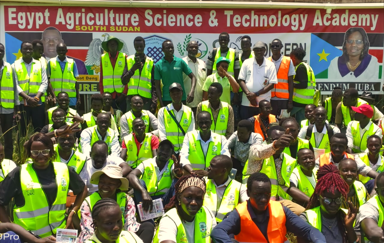
An Egyptian vocational school in South Sudan’s capital, Juba, is seeking to boost food security across the country through increased agricultural productivity and scientific research.
Established in 2012, the Egypt Agriculture Science and Technology Academy has been providing vocational skills in agriculture and computer science, and says it has trained over 18,000 locals over the years.
Speaking to Radio Tamazuj, Medhat Shafik Henin, the academy’s director, said they are now seeking to boost the country’s agricultural sector through research and modern technology.
“South Sudan heavily relies on oil and food imports, yet it has huge agricultural potential, so the Egypt Agriculture Science and Technology Academy is seeking to boost agricultural production,” he said. “South Sudan does not have a seed bank. So, we are establishing the first-ever agricultural research center, seed bank to preserve local varieties, and agricultural business center (ABC) to boost local economy.”
Shafik warned of severe nationwide food insecurity if climate-resilient agriculture is not adopted.
“In recent years, South Sudan has experienced changes in weather patterns in the form of floods and drought,” he stated. “With modern technology, the country can overcome drought issues by artificially making rains and using climate-resilient methods and crops.”
The academy’s director said they officially opened a 30,000-square-meter center on 5 September 2026 to pilot the project.
“The land hosts the research center to train 250 university students, provide free kindergarten education for underprivileged children, empower 500 local farmers with climate-smart agricultural skills, and rehabilitate street children by providing life-support skills and food,” he said. “For the University students, this will be a great opportunity where each student will be provided with a piece of land to practice their class skills.”
“Our land is just one kilometer away from the White Nile, and underground water is just 3 to 5 meters deep,” Shafik added.
He suggested that the country can also boost agriculture by enforcing it as a compulsory national service that would require primary and secondary school leavers to engage in before being awarded their academic certificates.
For his part, John Madit, a resident of Juba’s Referendum suburb, said the initiative is a game-changer.
“For the young people, this could create employment opportunities and change our mindset from that of dependency,” he said.
Meanwhile, John Kunyjok of the University of Juba said the institution was seeking partnerships to boost agriculture.
“We were invited by the Egypt Academy for a field visit to analyze to see if the soil is good for agriculture. We collected samples and took them to our lab for each student to practically participate in the process,” he said. “Up to now, paperwork has yet to be finalized on the partnership on how the university will guide the process.”

 and then