



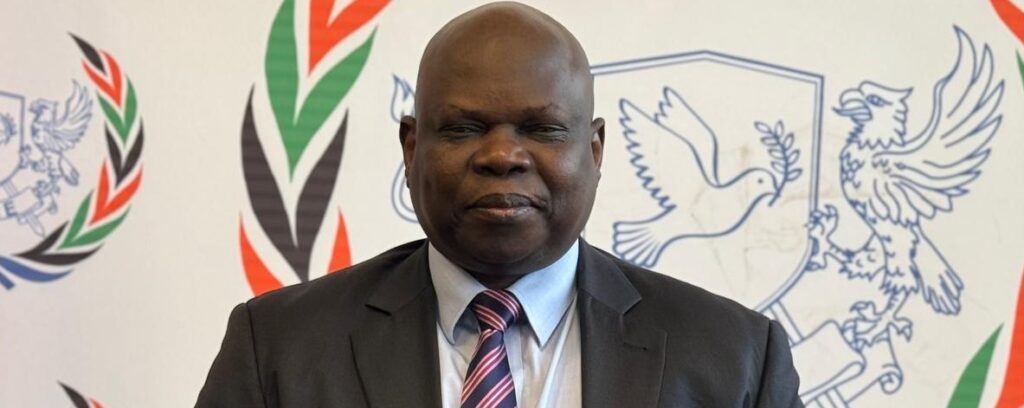
South Sudan’s opposition coalition, the United People’s Alliance (UPA), has called for an inclusive political dialogue to be held outside the country before elections scheduled for December, saying only broad-based negotiations in a neutral venue can restore confidence in the peace process and create conditions for credible polls.
The position follows consultations in Nairobi on Wednesday between UPA leaders and the African Union’s Ad Hoc High-Level Committee for South Sudan (C5), which is engaging political stakeholders as concerns mount over the implementation of the country’s 2018 peace agreement and preparations for the planned elections.
The C5 separately met the opposition SPLM-IO delegation led by Oyet Nathaniel, which also rejected the government’s proposed inter-party dialogue in Juba and called for talks under regional or international mediation.
UPA, a coalition of opposition groups led by Pagan Amum of the Real SPLM, emerged from the Kenyan-mediated Tumaini peace initiative and has positioned itself as one of the main opposition blocs outside South Sudan.
Bor Gatwech, UPA’s spokesperson, told Radio Tamazuj on Thursday that the coalition told the AU delegation that any political dialogue should include all political parties, civil society, women’s groups, youth representatives and religious leaders, and should take place in a neutral country rather than in Juba.
“The C5 consulted us on the way forward for the political process because it recognises us as one of the key stakeholders,” Gatwech said. “Our proposal is for an inclusive national political dialogue bringing together all political forces, civil society, women’s groups and faith-based organisations in a neutral venue.”
He said UPA supports elections that meet international standards but argued that such conditions could only be achieved through an inclusive political settlement.
“We stand for elections and for ending the transition,” he said. “But you cannot hold elections where only one party is free to campaign while key opposition leaders remain under detention.”
Gatwech said the coalition believes South Sudan’s political crisis can no longer be resolved through unilateral decisions by the government or through dialogue limited to parties aligned with President Salva Kiir.
“The government is proposing a dialogue that includes only parties sharing its views while excluding the main opposition inside the country, SPLM-IO, and us as the main opposition outside,” he said. “That kind of dialogue cannot move the country forward.”
He argued that the 2018 Revitalized Agreement on the Resolution of the Conflict in South Sudan (R-ARCSS) had largely failed because its principal parties were no longer working together.
“We were not signatories to the 2018 agreement, but we expected those who signed it to take the country out of transition through credible elections,” he said. “Instead, the agreement has broken down.”
Gatwech urged the African Union, the Intergovernmental Authority on Development (IGAD) and the broader international community to press the government to engage in meaningful negotiations with all opposition groups.
He dismissed arguments that elections alone would reduce the size of government and improve service delivery, saying South Sudan’s economic crisis stemmed from deeper governance failures.
“The size of government is not the reason people lack services,” he said. “Many lawmakers are not even being paid.”
Asked about political parties that have publicly endorsed the December elections, Gatwech questioned whether they represented genuine opposition.
“If you are not challenging President Kiir, you are recognised as a party,” he said. “Those parties are effectively partners of the SPLM. Elections must be open to everyone.”
Despite its criticism, UPA said it remains prepared to participate in elections if dialogue produced the legal, political and security conditions required for a credible vote.
“Even if that means holding elections in December 2026, we can still meet the timeline if the government genuinely engages in dialogue and creates a conducive environment,” Gatwech said. “No single party should manipulate elections to claim a mandate from the people.”
The C5, chaired by South Africa and comprising Algeria, Chad, Nigeria and Rwanda, is mandated by the African Union to support implementation of South Sudan’s 2018 peace agreement. It has intensified diplomatic efforts since late 2025 amid growing concern over the deteriorating peace process following the detention of First Vice President Riek Machar in March 2025.
The committee has backed South Sudan’s planned December elections but said they must be credible, peaceful and conducted in accordance with the peace agreement. It also called for a ceasefire, inclusive dialogue and the release of political detainees, particularly Dr. Riek Machar.
South Sudan is due to hold its first elections since independence under the 2018 peace deal that ended a five-year civil war. The vote has been postponed repeatedly, while opposition groups, civil society organisations and international observers have questioned whether conditions exist for credible elections, citing insecurity, delays in implementing the peace agreement and insufficient funding.
President Kiir’s government says the country is ready to move from a transitional administration to an elected government following the December polls.

 and then