



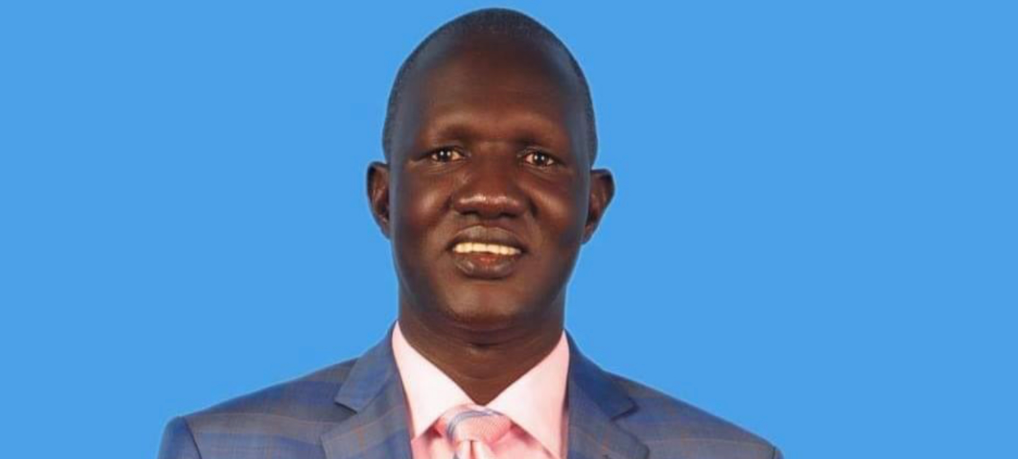
South Sudan’s inter-party dialogue failed to reach consensus after political parties challenged the government’s plans to hold elections in December, arguing that conditions for credible polls were absent, political analyst and government critic Abraham Awolich has said.
Awolich, a former managing director of the Sudd Institute and co-founder of the People’s Coalition for Civil Action (PCCA), said the talks held in Juba last month failed because the government wanted political parties to endorse decisions already taken by President Salva Kiir rather than negotiate a consensus on the country’s political future.
In an interview with Radio Tamazuj on Wednesday, Awolich said participants called for the postponement of the December 22 elections and negotiations on a new political arrangement, while government representatives insisted that the polls should proceed regardless of the prevailing circumstances.
Awolich said the dialogue should have taken place before the president dissolved parliament, the cabinet and other transitional institutions. “We had characterised this inter-party dialogue as a banquet among people who had already agreed to violate the constitution,” he said.
He accused the government of seeking to use the talks to secure political endorsement of Kiir’s decisions and establish an arrangement that would allow him to remain in power without holding general elections.
However, he said, participating parties insisted that the necessary conditions for credible elections did not exist and called for negotiations on an alternative political arrangement.
According to Awolich, some participants proposed postponing the elections without extending the mandates of the Revitalised Transitional Government of National Unity (RTGoNU) and the institutions established under the 2018 peace agreement. They argued that any new arrangement should be negotiated through the inter-party dialogue.
Government representatives, however, maintained that the December elections should proceed regardless of the political and security environment, he said.
He added that attempts to prepare a final resolution without the agreement of all participating parties were abandoned after concerns emerged that excluded parties would publicly reject the document.
The dialogue was subsequently abandoned without publicly agreed resolutions, he said.
Lomuro’s departure
Awolich also linked tensions surrounding the inter-party dialogue to the firing of Martin Elia Lomuro from the position of cabinet affairs minister, saying he had played a central role in the process.
He described Lomuro as a hardworking official who had helped keep the government functioning but said disagreements within the government had contributed to his removal.
Awolich alleged that tensions between Lomuro and individuals he described as influential within the government intensified during the inter-party dialogue and after the government restricted the movement of officials following the dissolution of transitional institutions.
He said Lomuro’s departure would further weaken an already dysfunctional government.
Calls for inclusive dialogue
Awolich said his organisation had proposed an inclusive national political dialogue involving South Sudanese inside and outside the country, facilitated by international mediators.
He argued that the expiry of the extended transitional period and the absence of conditions for credible elections require a broader political process to determine the country’s future.
“The power now relapsed back to the people of South Sudan,” he said, calling for an inclusive process that would lead to a constitutional and political settlement.
He said decisions about the country’s future should no longer be left solely to the signatories of the 2018 peace agreement.
However, Awolich expressed doubts that further negotiations with the government would produce meaningful results, saying opposition parties had lost confidence in dialogue following developments affecting the SPLM-IO and other signatories to the peace agreement.
Awolich also endorsed concerns raised by the UN Commission on Human Rights in South Sudan over what it has described as a constitutional coup through legislation.
He said amendments to the National Elections Act and the subsequent dissolution of parliament and the cabinet violated the 2018 peace agreement because they were undertaken without consensus among the parties or approval through the agreement’s monitoring mechanisms.
“We completely concur with the assessment of the UN Human Rights Commission in South Sudan,” he said.
Awolich questioned the caretaker administration’s authority to govern without a functioning parliament, including its ability to approve public spending and enter into agreements with foreign governments.
Elections under scrutiny
He also questioned the legal and administrative basis for the December 22 elections, saying the government had prioritised polling over the constitutional and census processes envisaged under the 2018 peace agreement.
Awolich said the absence of a permanent constitution and an updated population census undermined preparations for credible elections.
He accused the ruling Sudan People’s Liberation Movement (SPLM) of gaining an unfair advantage by campaigning across the country while opposition leaders faced restrictions on movement.
He also questioned the independence of the National Elections Commission following the replacement of its former chairperson, Abednego Akok Kacuol, with Gabriel Bol Deng Majok.
Awolich said the appointment had further undermined public confidence in the commission’s impartiality.
Detainees in Juba
Awolich criticised the trial of former vice president Riek Machar over the March 2025 Nasir attack, describing him as a victim of the peace process.
He said the attack should be investigated but called for the case against Machar to be stopped and for him to be released to continue participating in the peace process.
Awolich also called for the release of former intelligence chief General Akol Koor, former vice president Benjamin Bol Mel and other detainees accused of involvement in coup plots.
He said those facing criminal allegations should either be released or formally charged and brought before a court.
“We call for the unconditional release of all detainees, and if there is a strong case, they should be taken to court,” he said.
Opposition loses faith in dialogue
Asked about the way forward amid the political impasse, Awolich said opposition parties had increasingly lost confidence in negotiations with the government.
He argued that repeated failures to implement the 2018 peace agreement had eroded confidence in dialogue as a means of resolving the country’s political crisis.
While acknowledging calls for an inclusive national dialogue, he said such an initiative might not produce a meaningful breakthrough under the current political circumstances.
Awolich said broader public mobilisation was necessary to bring about political change and end the current system of government.

 and then