



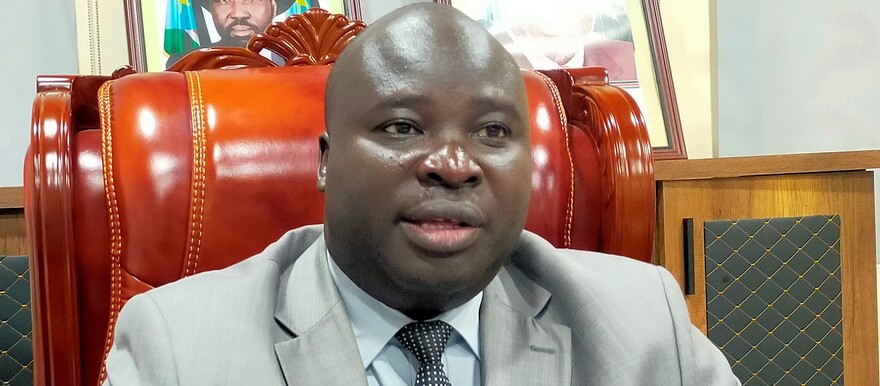
The opposition SPLM-IO has rejected President Salva Kiir’s proposed inter-party dialogue ahead of South Sudan’s December elections, saying any negotiations to revive the country’s faltering peace process should take place at a neutral venue under regional or international mediation.
The position was conveyed to a delegation from the African Union’s Ad Hoc High-Level Committee for South Sudan (C5), which met SPLM-IO leaders led by acting chairman Oyet Nathaniel Pierino on Monday as part of consultations with South Sudan’s political stakeholders.
The C5, chaired by South Africa and comprising Algeria, Chad, Nigeria and Rwanda, is mandated to support implementation of the 2018 Revitalized Agreement on the Resolution of the Conflict in South Sudan (R-ARCSS). The committee has stepped up diplomatic engagement since late 2025 amid growing concern over the deteriorating peace process following the detention of First Vice President Riek Machar in March 2025.
In an exclusive interview with Radio Tamazuj on Thursday, Oyet said the meeting focused on Kiir’s proposal for an inter-party dialogue ahead of elections scheduled for December, after the deadline for political party registration expired on June 30.
According to Oyet, the C5 delegation sought the SPLM-IO’s views on the country’s political crisis and prospects for reviving the peace agreement.
He said the movement told the delegation that its position remained unchanged, accusing Kiir’s government of dismantling the 2018 peace agreement by detaining Machar, taking over positions allocated to the SPLM-IO under the accord and attacking SPLA-IO forces.
“The agreement has already been dismantled,” Oyet said. “President Salva Kiir detained Dr. Riek Machar, who was his partner in implementing the peace agreement. He has also dismantled the security arrangements and taken over positions allocated to the SPLM-IO. Therefore, the elections he intends to conduct fall outside the agreement we signed.”
Oyet argued that holding elections before implementing key provisions of the peace agreement—including permanent constitution-making, security sector reform and the unification of forces—would violate the sequence set out in the accord.
Kiir-led dialogue
Oyet said the SPLM-IO welcomes South Africa’s efforts to help restore peace in South Sudan but rejects any dialogue chaired by President Kiir.
Instead, he said, the movement wants negotiations at a neutral venue under regional or international mediation aimed at restoring implementation of the 2018 peace agreement.
“We reject an inter-party dialogue led by President Salva Kiir because he cannot be both a party to the conflict and the person leading the inter-party dialogue,” Oyet said.
“What we want is negotiations in a neutral venue to return all the parties to the implementation of the peace agreement.”
He said the SPLM-IO supports the resolutions adopted at the C5 Plus Summit held on the sidelines of the African Union summit in Addis Ababa in February, which called for de-escalation, implementation of the peace agreement, the release of political detainees, including Machar, and credible elections.
Calls for greater pressure
Oyet said the SPLM-IO had urged the C5 and the Intergovernmental Authority on Development (IGAD) to intensify efforts to revive the peace process but expressed frustration at the lack of progress.
He called on the international community to increase pressure on the government in Juba, including by enforcing existing sanctions and the United Nations arms embargo on South Sudan.
“President Salva Kiir has been acquiring weapons despite the arms embargo,” he alleged. “The international community should ensure sanctions are enforced and violations of the embargo are addressed.”
Opposition coordination
On relations with other opposition groups, Oyet said the SPLM-IO was continuing consultations with the United People’s Alliance (UPA), led by Pagan Amum, the South Sudan Opposition Movements Alliance (SSOMA), and other political actors on efforts to revive the peace process.
He said the movement also maintains military and political cooperation with the National Salvation Front (NAS), led by Gen. Thomas Cirillo, while consultations with other opposition groups continue.
According to Oyet, the C5 delegation is consulting a broad range of political stakeholders before travelling to Juba to meet President Kiir and present its findings to the committee.
The C5 delegation comprised four South African officials led by an adviser to South African Deputy President Paul Mashatile, who also serves as South Africa’s special envoy to South Sudan.
Peace process under strain
The C5 has become increasingly active as concerns grow over the future of South Sudan’s fragile peace process. At its February summit in Addis Ababa, chaired by South African President Cyril Ramaphosa and attended by Kiir, the committee reaffirmed support for the 2018 peace agreement, called for de-escalation, urged implementation of outstanding reforms and pressed for the release of political detainees, including Machar.
The committee also endorsed South Sudan’s planned December elections but stressed that they should be credible, peaceful and conducted in accordance with the peace agreement. It urged the government to adequately fund electoral institutions and said there should be no further extension of the transitional period beyond February 2027.
Machar’s detention in March 2025 deepened divisions within the SPLM-IO, which has since split into rival factions. One, led by acting chairman Oyet Nathaniel Pierino, is aligned with the movement’s military wing and controls territory in parts of the country. The other, headed by interim chairman Stephen Par Kuol and based in Juba, is recognised by Kiir’s government as its partner in implementing the peace agreement.
South Sudan is scheduled to hold elections in December under the 2018 peace agreement that ended a five-year civil war. The vote has already been postponed several times, while opposition parties, civil society groups and international observers have questioned whether conditions exist for credible elections, citing persistent insecurity, delays in implementing the peace agreement and inadequate funding.
Kiir’s camp says the country is prepared to transition from a transitional government to an elected one following the December vote.

 and then