



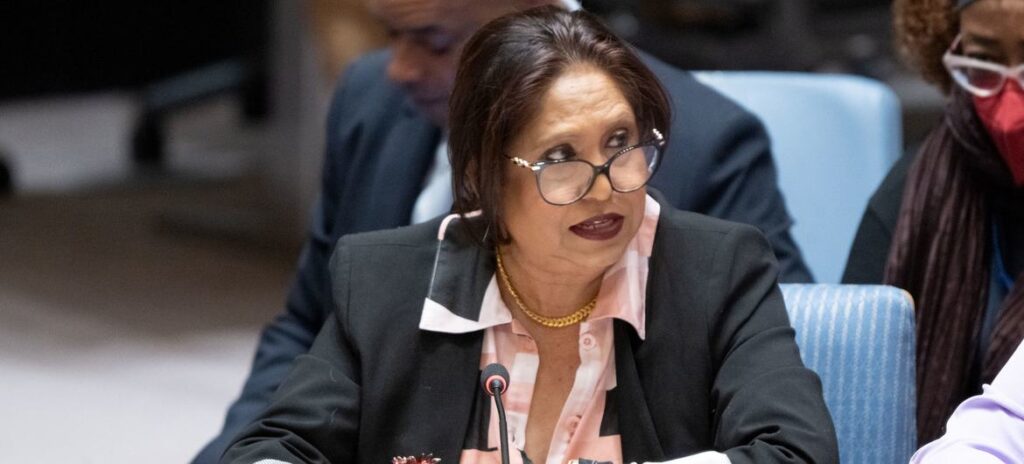
United Nations Special Representative of the Secretary-General on Sexual Violence in Conflict, Pramila Patten, expressed grave concern over the stalled implementation of critical protection measures to prevent and address conflict-related sexual violence in South Sudan.
Patten, who was speaking on Monday on the margins of the 70th Session of the Commission on the Status of Women (CSW70) in New York, called for an immediate cessation of all hostilities and conflict-related sexual violence and urged all parties to engage in inclusive dialogue.
“While legal, policy, and political frameworks to end sexual violence exist, we are witnessing stagnation in their implementation, particularly regarding the Action Plan for the Armed Forces on Addressing Conflict-Related Sexual Violence in South Sudan,” she said. “This persistent implementation gap is creating a protection vacuum where sexual violence continues to be used as a ‘cost-free’ tactic of conflict. I urge the Government to expedite prior commitments on addressing and responding to conflict-related sexual violence and to allocate the necessary budgetary resources to swiftly move from paper to practice and effectively prohibit all violations and acts of sexual violence.”
For the year 2025, the United Nations verified incidents of rape, gang rape, sexual slavery, and forced marriage against the backdrop of a troubling landscape of impunity. State security forces remain implicated, with incidents involving the South Sudan People’s Defense Forces, the National Police Service, and the National Security Service reported near checkpoints and during night patrols. Rape and abduction, including for sexual slavery and exploitation, were also attributed to the Sudan People’s Liberation Army-In Opposition in Central Equatoria.
According to the UN, community-based militias and non-state armed groups continue to use sexual violence as a tactic to displace populations, a pattern particularly prevalent in Western and Central Equatoria.
“This trend remains a critical concern as United Nations monitoring in early 2026 indicates heightened risks in hotspots such as Jonglei, Unity, and Upper Nile, where humanitarian and security conditions continue to deteriorate,” the statement reads in part.
Vulnerability is compounded by historic flooding and climate-induced displacement, alongside regional spillover from the conflict in Sudan, which has forced thousands of women and girls into precarious environments, exacerbated the risks of sexual violence, and made access to services increasingly difficult.
“Against this backdrop of converging crises, we must also address the acute service delivery gap,” said Special Representative Patten, noting that only 10 state hospitals currently host Family Protection Centers, rendering specialized care out of reach for survivors in the most remote and affected areas. This limited coverage is increasingly untenable as South Sudan receives refugees and returnees fleeing Sudan, placing extraordinary pressure on already overstretched systems. Humanitarian actors also face severe access constraints, including bureaucratic impediments and direct attacks on medical facilities and healthcare personnel, violations that undermine the sanctity of healthcare and further restrict life-saving aid.
Special Representative Patten recognized the critical work of South Sudanese Women Human Rights Defenders, who remain the primary lifeline for survivors by maintaining frontline access and community trust despite overt targeting by armed actors, shrinking civic space, and severe funding cuts.
“The international community must stand with South Sudanese civil society in these dire times. Funding cuts are not just budget lines; they are lifelines. Their reduction directly translates into the loss of life-saving medical care, psychosocial support, and the monitoring capacity of Women Protection Advisers working in the United Nations peace operation,” Patten added. “As we convene for CSW70, I urge Member States and partners to match their commitments to survivors of sexual violence with concrete support to close the resource gap.”
Highlighting the need for a comprehensive justice response, the Special Representative underscored the importance of operationalizing the transitional justice architecture envisioned under the Revitalized Agreement on the Resolution of Conflict in the Republic of South Sudan.
“While national efforts continue, gaps in domestic accountability leave many survivors without recourse and undermine the deterrent effect of the law,” she said. “To break the cycle where a lack of accountability fuels further conflict, it is vital to strengthen judicial and restorative frameworks. I encourage all stakeholders to fully operationalize the transitional justice mechanisms envisioned in the Revitalized Peace Agreement. This is a necessary step toward restoring the rule of law and ensuring a future of peace and dignity for all survivors of conflict-related sexual violence.”

 and then