



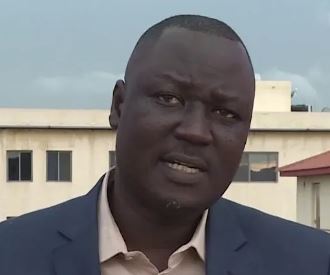
The president of the Union of Journalists of South Sudan (UJoSS), Oyet Patrick, on Tuesday called on the government to end media censorship, invest in digital infrastructure, and support the transition of South Sudan’s media industry into the online space as traditional print journalism continues to decline.
Speaking during the ongoing Media and Security Conference in Juba to mark World Press Freedom Day 2026, Oyet said South Sudan had made “notable and commendable progress” in advancing press freedom over the past five years despite ongoing challenges facing the sector.
“Over the past five years, South Sudan has made some notable and commendable progress in advancing press freedom,” he said. “Why I say this is because there are improved relations between us in the media, and those in the government, and the security sector.”
Oyet noted that South Sudan previously led the East African region in the press freedom index, although the country’s ranking declined this year due to several factors, including censorship by security agencies.
In the 2025 press freedom world ranking by Reporters Without Borders, South Sudan was ranked 109, out of 180 countries; however, this year, it dropped to 118, a decline that Oyet attributed to the continued censorship.
“One of the things that made us decline is the issue of censorship. The idea of the National Security Service personnel still deciding which story should go, especially in a newspaper, or which one should not go, remains a challenge,” he said. “We are actually shooting ourselves in the foot because the media is moving. In the next 10 to 15 years, I predict we may not have any newspapers being printed anymore.”
Citing the example of a German newspaper that stopped printing and transitioned fully online after 44 years, Oyet said South Sudan’s print media is struggling due to low newspaper sales and declining advertising revenues.
“Papers are not being bought, there are no advertisements, and people are advertising online. The audiences are more interested in online content and rumors than in the actual newspapers,” he stated. “I am happy that last week our honorable minister said he is already in talks with META to see ways of monetizing content, because I am told some media houses in East Africa pay the entire staff of their media with all the money they get online.”
Oyet also stressed that improving the media environment is a shared responsibility involving journalists, government institutions, civil society, and development partners. He called for stronger professional training, ethical journalism, and self-regulation within the media sector.
The UJoSS chief also proposed the establishment of a National Fund for Public Interest Media to support struggling media houses across the country.
“That the government and partners could contribute to that fund. As we move forward, all actors must embrace a spirit of collaboration over confrontation. The journey towards a truly free, safe, and independent media in South Sudan requires deliberate partnership and sustained dialogue among government, media, civil society, private sector, security sector, and international partners,” he said. “We have planned at least for 20 to 30 years and have registered a circle for journalists. We urge you, journalists, to be fully members of this circle so that you benefit from it.”
However, Oliver Mori Benjamin, Spokesperson of the Transitional National Legislative Assembly (TNLA), defended censorship of news content in South Sudan, saying journalists should expect “more censorship” as the country prepares for elections scheduled for December this year. He said censorship should not always be viewed negatively, comparing it to guidance provided by parents, teachers, and editors.
“What has always struck my attention in such workshops is only one word which has never been missed in any of the workshops involving journalists. The fear of the word censor or censorship,” he said. “What is that process by itself? It is censorship, and it is done so that we improve our performance. So, let us not take the word censorship to develop enmity among us and those trying to put us correct, whether they are in the security services or even as the chief editor. Because what you are saving is not yours as an individual. The security personnel are saving the country.”
“So you have to abide by those instructions given to you, not for your good alone, but for the good of the country,” Mori added.
As South Sudan prepares for elections anticipated in December, Mori warned journalists to expect tighter controls on media content.
For Abdul Wadood, a UNESCO official, the role of the media is paramount in South Sudan, especially with the country preparing for elections in December.
He stressed that, as the country also marks World Press Freedom Day, there is a need to reaffirm a shared responsibility and free flow of information and to counter any forms of misinformation and disinformation affecting the country.

 and then