



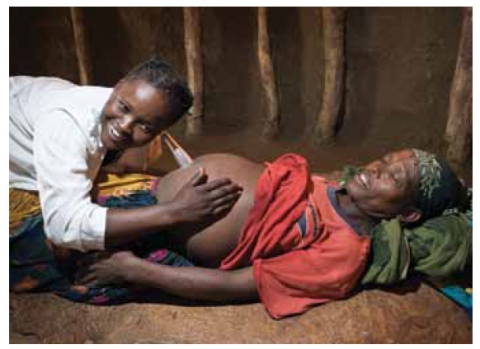
Health personnel and citizens in Northern Bahr El Ghazal State have raised concerns over the death of twelve women during childbirth at the Aweil State Hospital, the only referral hospital in the Northern Bahr el Ghazal State, since January.
Most of the deaths have been blamed on a lack of blood and other complications.
According to the statistics, between 30 and 40 expectant mothers are attended to at the hospital daily, with between 10 and 15 giving birth.
The lack of essential drugs for pregnant mothers, a poor referral system from grassroots health centers to the hospital, an influx of Sudanese refugees, and wage delays for the health workers are among the factors contributing to the maternal mortality rate.
Speaking to Radio Tamazuj last week, a man who preferred anonymity said he lost a relative who succumbed during a surgical operation to save her life after developing complications during delivery last Thursday.
“My uncle’s daughter passed away at the Aweil State Hospital on Thursday during the delivery,” he narrated. “She was an adult woman named Juer Garang Bak, and she lost her life after the operation failed. She left behind other children.”
A nurse serving at the hospital, who did not reveal her name because she is not authorized to speak to the media, revealed that four women died during delivery between January and March. Seven expectant mothers passed away in April alone. He blamed the lack of blood and other medical complications for the deaths.
“Last month (April), seven pregnant women died because of the lack of blood, and another four have lost their lives due to different cases between January and March,” he explained. “That is why you see some of the health personnel speaking about blood donation and support from community members who voluntarily decided to donate blood.”
The hospital’s blood bank prioritizes only certain critical conditions for blood transfusions, and not every pregnant woman is accessing the services, said the nurse.
“Yes, we have a blood bank, and if you donate the blood, it will be ready for the patient and pregnant mothers who are identified with low blood volume, but not all pregnant mothers are eligible to receive the blood donation,” the nurse further explained.
Another health practitioner at the Aweil State Hospital attributed the high maternal mortality rate to a lack of proper feeding, a lack of drugs in the hospital, poor health education programs, and delayed payment of health workers.
“The maternal mortality rate is high because, you know, the current situation; there is no good feeding, there are no drugs in the hospital, the health education is not going well in the health facilities because our workers, including those here at the hospital, spend six or more months without being paid,” he explained. “Our laboratory equipment is very old and cannot give accurate diagnoses and test results. We also have a problem in the referral system in the counties, which affects the normal labor, leading to a higher mortality rate.”
On his part, Dr. Nguach Nguach Aguot, the Director for Aweil State Hospital, stated that the first challenge at the hospital is overcrowding caused by the local population, the influx of Sudanese refugees, and South Sudanese citizens from neighboring states, including Warrap State.
“We have been experiencing overcrowding caused by the influx of Sudanese refugees and South Sudanese citizens from the neighboring states such as Warrap State,” he said. “We do not want to appreciate ourselves, but our medical performance is remarkable.”
According to Dr. Nguach, the UN children’s agency, UNICEF, the leading donor to the hospital, stopped support in May 2025, but renewed assistance in late May this year. The lack of medicines forced the doctors to send patients to purchase drugs from pharmacies and private clinics.
“I am sorry; the medicines are not enough. Of course, UNICEF is the one supporting the Aweil State Hospital with the medicines, and the last medical consignment we received was in May 2025,” he said. “We had been struggling in the past, and sometimes prescribed medications and sent patients to buy the drugs from commercial pharmacies and private medical centers.”
“Finally, UNICEF has just donated to us a new consignment in late April this year,” Dr. Nguach added.
He commended the cooperation between the hospital and Médecins Sans Frontières (MSF), saying sometimes deaths occur after doctors have done their best.
“MSF is working positively with us in the state because it is taking care of the maternity and pediatrics departments, and there are no problems in those departments,” Dr. Ngauch stated. “Such a big hospital will always record deaths, but the doctors do their best until the last minute when a situation gets out of control. Our doctors and gynecologists are all available to address any health matter.”
The hospital has over 400 employees under the government and MSF; the government employed 239 health personnel, and there is an unidentified number of volunteers and MSF employees, he added.
Dr. Ngauch disclosed that health workers at the facility downed their tools in the past due to delayed payment of incentives, but that they were paid and have since been working.
Meanwhile, Awut Kuel Kuel, a local women’s activist, urged the government to employ more qualified medical personnel to support expectant mothers.
“We want the government to support women delivery initiatives, recruit more doctors, and provide essential drugs for expectant women,” she said. “We also encourage husbands to accompany their pregnant wives whenever they go to the hospital.”
Another activist, Angelina Agau Thiep, said the mortality rate is connected with several issues, including the effects of climate change, and urged the authorities to roll out awareness campaigns.
“The authorities should carry out massive awareness campaigns for pregnant women to keep rehydrated by drinking a lot of water and sit in the shade to cope with the effects of climate change,” she said. “Secondly, the medical workers are another reason behind the deaths because they do not receive their monthly salaries, and that makes them unprepared psychologically to handle the situation of expectant mothers. Salaries and incentives must be paid on time so that they will carry out their duties effectively.”
“Aweil State Hospital cannot accommodate the huge number of mothers coming from the grassroots, and the government should upgrade the county health facilities to address such cases to ease the overcrowding at the state hospital,” Agau opined.

 and then