



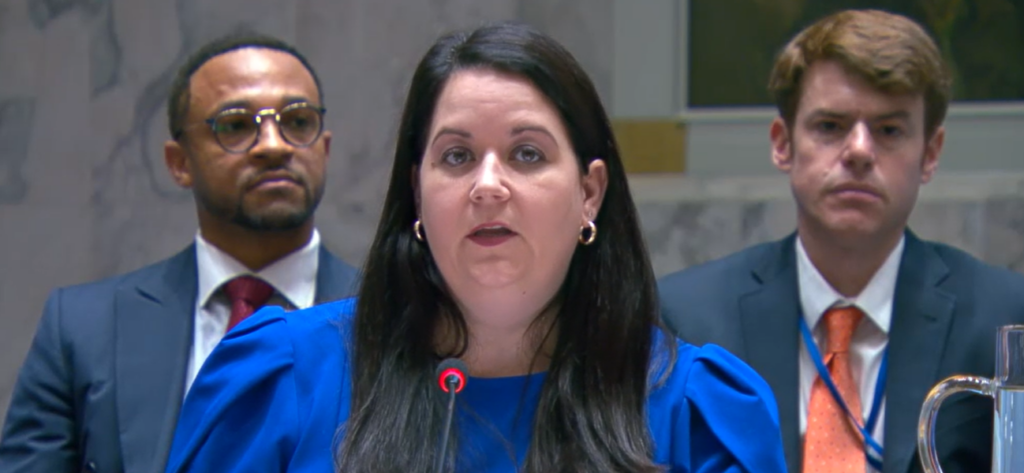
The United States on Friday blamed President Salva Kiir for a lack of progress in South Sudan’s peace process after the U.N. Security Council renewed sanctions on the country, including an arms embargo, for another year.
The 15-member council adopted Resolution 2821 with nine votes in favour and six abstentions, renewing measures that include an arms embargo, travel bans and asset freezes.
The resolution also extended the mandate of the Panel of Experts, which assists the work of the South Sudan Sanctions Committee, until July 1, 2027.
The African members of the Security Council — the Democratic Republic of Congo, Liberia and Somalia — abstained, alongside China, Pakistan and Russia.
Under council rules, a resolution requires at least nine votes in favour and no veto from any of the five permanent members — the United States, Russia, China, Britain and France — to be adopted.
Drafted by the United States, the resolution renewed the measures without substantive changes to the text adopted a year ago.
Speaking after the vote, U.S. Deputy Representative for Special Political Affairs Ambassador Jennifer Locetta said Washington was “disheartened” by the lack of progress on benchmarks tied to the sanctions and by worsening political and security conditions in South Sudan.
“Let’s be clear. This lack of progress is due to a lack of political will by President Kiir, as well as other South Sudanese leaders,” Locetta told the council.
She urged South Sudan’s leaders to return to direct dialogue to de-escalate violence and criticised the detention and trial of a signatory to the 2018 peace agreement, saying it was “farcical” to suggest meaningful dialogue was taking place under such conditions.
The United States also called on the transitional government to declare a national ceasefire, release detainees, renounce political violence and use public revenue to support citizens.
South Sudan has struggled to fully implement the 2018 peace agreement that ended a five-year civil war between forces loyal to Kiir and those aligned with First Vice President Riek Machar.
Key provisions, including security reforms, constitution-making and preparations for elections, have repeatedly been delayed.
Washington said the Security Council could not accept actions that undermine transitional agreements or obstruct the peace process.
Locetta also accused South Sudan’s leaders of perpetuating the marginalisation they once accused Sudan’s rulers in Khartoum of imposing before South Sudan gained independence in 2011.
“Through bad governance and misuse of revenue, that marginalization continues, imposed by South Sudan’s own leaders,” she said.
The U.N. sanctions regime on South Sudan, which includes asset freezes, travel bans and a comprehensive arms embargo, was first established in March 2015.

 and then