



New information from Nairobi confirms that South Sudan intends to remain within the bilateral Government-to-Government (G-to-G) petroleum framework. Juba has signalled it will formally revoke its earlier termination notice, shifting the debate from whether the G-to-G survives to how it must be redesigned.
As part of the proposed reboot, Kenya’s State Department for Petroleum announced that fuel will be supplied on a Cost, Insurance, and Freight (CIF) Mombasa basis, adhering strictly to Kenya Bureau of Standards specifications.
While keeping Kenya as South Sudan’s primary energy corridor is strategic, these initial tweaks do not resolve the deeper structural flaws that wrecked the first phase of the agreement.
The original flaw: concentration risk
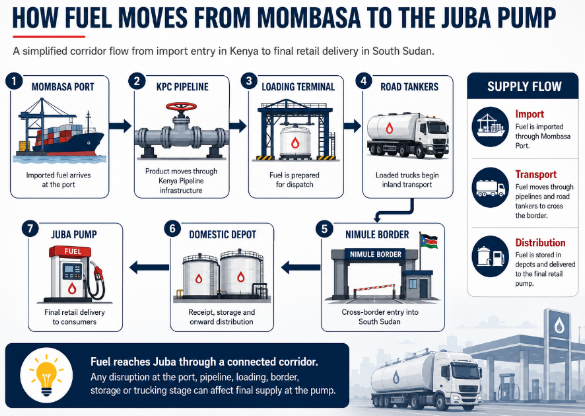
The original G-to-G framework was conceptually sound. For a landlocked nation, leveraging the Port of Mombasa, the Kenya Pipeline Company (KPC) network, and the Northern Corridor makes operational sense.
The breakdown occurred in execution.
By designating a single private intermediary—Pacific Petroleum—to import petrol and diesel for all licensed South Sudanese marketers, the arrangement created immense concentration risk. A strategic national supply line became entirely dependent on the balance sheet and operational capacity of one company.
When Pacific struggled to evacuate fuel from KPC and the GAPCO terminal in Mombasa, the bottleneck echoed all the way to Juba, leading to artificial scarcity and market disruption.
Changing suppliers versus fixing the bottleneck
To solve the evacuation crisis, South Sudan nominated three additional suppliers alongside Pacific: Gulf Energy, Sovereign Energy Oil Trading, and Skysoar Holding.
Diversification is necessary, but adding names to a list does not automatically solve a physical logistics failure. The public must ask a fundamental question: What operational problem does each new supplier actually solve?
- Gulf Energy brings an established track record, visible assets, and deep familiarity with Kenya’s downstream sector.
- Sovereign Energy and Skysoar Holding, both South Sudan-based nominees, present a far less verifiable public record regarding large-volume imports, terminal capacity, or KPC throughput.
Key Takeaway: Opacity is a material commercial risk. Without transparent qualification criteria—proven financing, guaranteed KPC allocation, and minimum lifting capacity—Juba risks replacing a single-company monopoly with an opaque four-company allocation system.
Why CIF Mombasa prices do not guarantee cheap fuel in Juba
Pricing fuel on a CIF Mombasa basis improves international procurement transparency, but Mombasa is only the starting line.
A competitive landed price at the port tells consumers very little about the final pump price in Juba. True price discovery requires total visibility across every link of the supply chain:
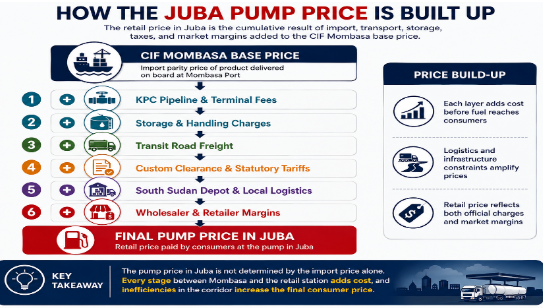
Without a public breakdown of these intermediate costs, consumers cannot assess whether the new deal actually lowers prices or merely redistributes profit margins among new middlemen.
The unspoken problem: The bottleneck in Juba
The supply chain does not end at the Kenyan border. Even if Kenya guarantees pipeline capacity and loading slots, South Sudan’s limited strategic fuel storage creates a dangerous reverse bottleneck.
If receiving depots in Juba are full or inefficient, offloading slows down. Tankers end up idling in Juba rather than returning to Kenya to reload. As truck turnaround times stretch, fewer vehicles remain available at Mombasa, backing up the entire corridor.
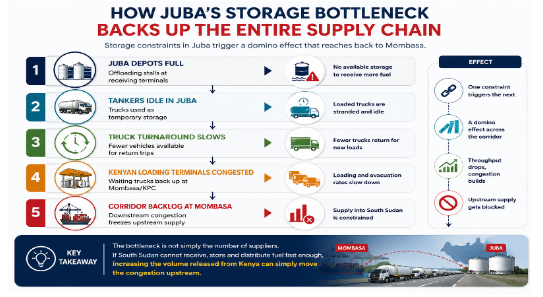
An apparent upstream evacuation failure in Kenya often originates as a downstream storage failure in South Sudan.
Furthermore, South Sudan lacks a national petroleum inventory and demand-forecasting system. Without real-time data connecting retail sales, depot inventories, and importer nominations, suppliers rely on guesswork, leading to periodic cycles of over-supply and sudden shortages.
Secure the corridor, do not allocate the market
South Sudan does not need to choose between a flawed state monopoly and a complete abandonment of bilateral energy ties. The path forward requires a clear separation of roles:
- Kenya must secure the corridor: Guarantee pipeline access, terminal loading slots, quality controls, and fair infrastructure tariffs.
- South Sudan must protect the national interest: Build strategic fuel reserves, enforce transparent pricing formulas, and manage national demand data.
- The private sector must compete freely: Allow any licensed importer with verifiable capital, logistics capacity, and terminal access to participate on equal terms.
Conclusion
The renewed talks in Nairobi are a positive step, but clarifying fuel delivery to Mombasa addresses only part of the problem.
The guiding principle for the final agreement must be clear: The G-to-G arrangement should guarantee South Sudan access to Kenya’s petroleum infrastructure; it should never guarantee specific private companies a captive market in South Sudan.
If negotiators lock in infrastructure rights, price transparency, and open competition, this deal can deliver lasting energy security. If they do not, South Sudan will discover that changing supplier names does nothing to fix a broken supply chain.
The writer is an energy-sector professional with extensive experience in downstream petroleum logistics, supply chain management, and fuel infrastructure across Sudan and South Sudan. He can be reached at warillewarille@yahoo.co.uk.
The views expressed in ‘opinion’ articles published by Radio Tamazuj are solely those of the writer. The veracity of any claims made is the responsibility of the author, not Radio Tamazuj.

 and then