



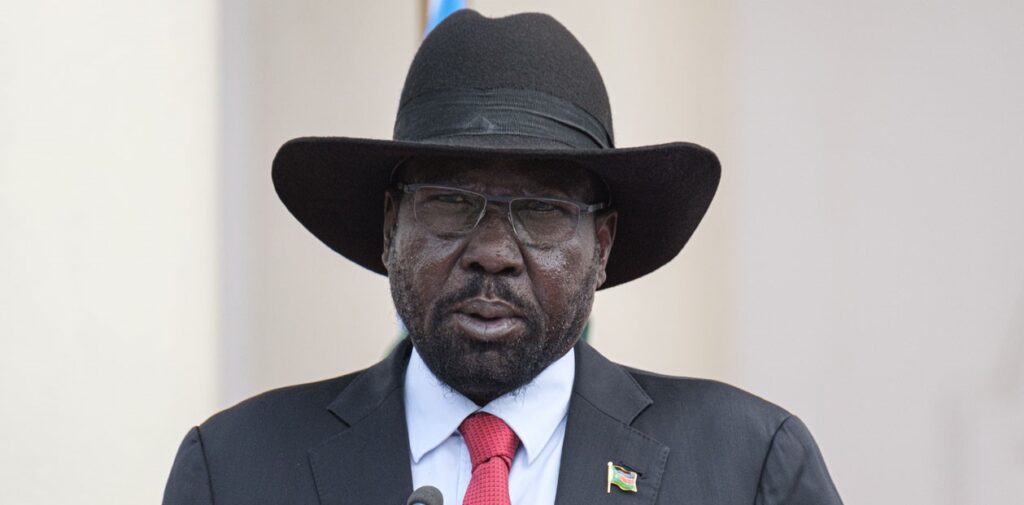
South Sudan’s President Salva Kiir Mayardit has dismissed Upper Nile State Governor Jacob Dollar Ruot and reappointed General James Koang Chuol, according to a decree announced late on Monday.
The changes were read on state-run South Sudan Broadcasting Corporation (SSBC). Kiir did not give reasons for the decision.
Dollar Ruot was appointed in October 2025, replacing Koang, who was then reassigned as deputy minister of defence and veterans affairs, a position he held until his reappointment as governor.
Both Dollar and Koang are from Nasir County in Upper Nile State, which saw deadly clashes in March 2025 between the South Sudan People’s Defence Forces (SSPDF), the SPLA-IO and allied White Army forces. Opposition leader Riek Machar was later detained and taken to court over his alleged role in the violence.
The two officials are members of Kiir’s ruling Sudan People’s Liberation Movement (SPLM).
Boboya James Edimond, a political analyst and executive director of the Institute of Social Policy Research in South Sudan, told Radio Tamazuj the reshuffle was likely driven by worsening insecurity in Upper Nile and neighbouring Jonglei states.
He said ongoing clashes between government forces and the White Army in areas including Nasir, as well as fighting in Akobo, suggested state leadership had struggled to contain the situation.
He said the government may be relying on Koang’s military background to restore control in a key frontline area.
However, he questioned the effectiveness of the move, noting Koang had previously served as governor without significant improvement in security or governance.
Edimond said repeated reshuffles reflected a broader pattern in Kiir’s administration that had yet to deliver lasting stability, arguing that recycling officials risks weakening governance and public confidence.
He urged broader leadership inclusion and full implementation of the 2018 peace agreement, stressing the need for sustained political dialogue.
Separately, Ter Manyang Gatwech, an independent activist with the Nile Institute for the Study of Human Rights and Transitional Justice, said frequent changes of state officials undermined governance and accountability.
He said leaders needed time to understand challenges and deliver results, warning that short tenures encouraged poor performance and disrupted continuity. He also said new appointees were often quickly influenced by entrenched interests, reducing effectiveness.
Manyang called for the appointment of experienced officials and sufficient time in office to allow performance to be properly assessed.
South Sudan is governed under a 2018 peace agreement, whose implementation has repeatedly been delayed. Under the deal, Kiir retains authority to appoint and dismiss senior officials at both national and state levels.

 and then