



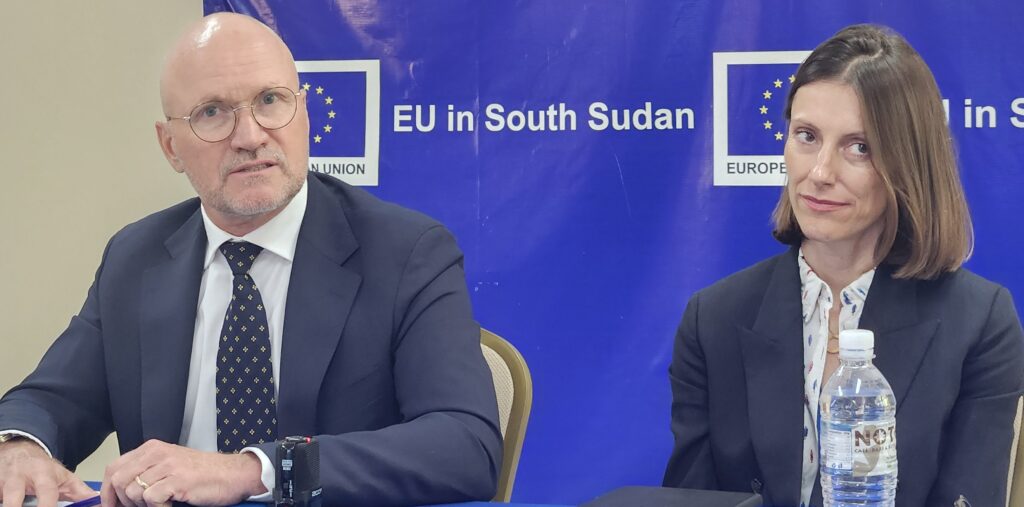
The European Union’s top diplomat in South Sudan has warned that the country’s long-awaited elections may fail to take place in December this year if current political, security and technical conditions remain unchanged.
Pelle Enarson, Head of Delegation of the European Union to South Sudan, said the situation on the ground does not currently allow for credible elections, citing insecurity, lack of political consensus and insufficient preparations.
“Elections cannot take place if it’s exactly like it is now,” Enarson said during a press briefing in Juba on Monday.
“From a technical point of view, it won’t be possible to have elections in December if preparations do not start immediately.”
He said that while elections are still theoretically possible, time is rapidly running out.
“At some point, the technical will take over and say we can’t, it’s just not feasible.”
The EU diplomat said the security situation makes voting impossible in some areas. Ambassador Enarson pointed to ongoing violence in parts of the country as a major obstacle to holding nationwide elections.
He said areas including Jonglei and Upper Nile remain volatile, making it impossible to safely conduct voting.
“Akobo is the prime example of why you can’t have elections. How are people going to perform elections in such a volatile situation?” he said.
He added that politically driven violence has also been reported in the Equatoria region, further complicating preparations.
The EU envoy also criticised the current political environment, saying it lacks the inclusiveness required for credible elections.
“The current government of unity is no longer a government of unity,” he said. “All parties are not equally involved in the preparations.”
He stressed that any electoral process must involve all political actors and be based on consensus.
“There needs to be a political deal among all the parties on how these elections are going to be conducted.”
Beyond security and politics, Enarson highlighted significant technical shortcomings, including the absence of key institutional structures.
“There is no legal department yet in the National Election Commission. So how are they going to conduct elections when there is no mechanism for dispute resolution?” he asked.
He also said government financing would be critical for credible polls.
“It cannot be the international community that takes this responsibility. The government must show it is willing to finance elections in a substantial way.”
While warning that the December timeline is increasingly unrealistic, Enarson suggested a short technical extension of the transition period could be considered if agreed politically.
“One smart solution is to have a very short technical extension, instead of December, you can have elections in March,” he said.
“But not a two-year or three-year extension.”
Despite the concerns, the EU said it would continue supporting South Sudan across multiple sectors, including agriculture, education, health, infrastructure and peacebuilding.
Enarson said the bloc’s priority remained full implementation of the 2018 peace agreement and support for the population.
“Peace for us is the first priority, but we also need to support the South Sudanese people at the same time.”
He added that South Sudan has strong potential for growth if stability is achieved.
“This is a country with incredible assets, both natural and human, but it needs peace and stability to realise that potential.”
Enarson also said the EU would maintain its presence in South Sudan despite a global restructuring of its operations.
He said some technical functions would be moved to a regional hub in Nairobi, but political engagement would continue in Juba.
“The EU is here to remain as a partner, we are not pulling out,” he said.
Last week, the United States told the U.N. Security Council that South Sudan is not prepared to hold credible elections, warning that minimal preparations, delayed decisions and lack of funding continue to undermine the country’s fragile peace process.
Washington also cast doubt on the feasibility of the polls, citing U.N. Secretary General reports that preparations remain “minimal to nonexistent”, with key decisions delayed and funding gaps unresolved.
South Sudan is governed under a 2018 peace agreement that has repeatedly faced delays in implementation.
The transitional government, led by President Salva Kiir, is seeking to amend key provisions of the 2018 deal to pave the way for elections scheduled for December 2026. The cabinet has approved the proposals and forwarded them to parliament for ratification, but lawmakers have yet to table the bill.
The move has drawn criticism from the Reconstituted Joint Monitoring and Evaluation Commission, international partners, and the main opposition faction led by detained First Vice President Riek Machar, who say the government bypassed required procedures by advancing the amendments without their endorsement.

 and then