



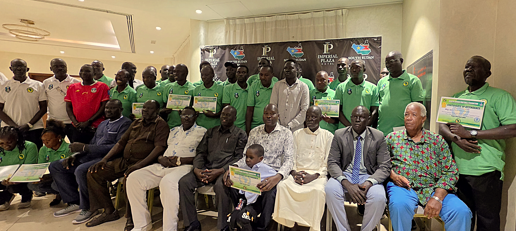
The South Sudan Football Association (SSFA) will prioritize locally trained coaches over foreign hires as part of efforts to rebuild the country’s football system, officials said at the graduation of a new group of certified trainers.
The policy shift was announced as 24 candidates completed a four-month Confederation of African Football (CAF) B diploma course in Juba, a programme authorities say is central to improving standards and reducing reliance on external expertise.
“We have full dependence on the local national coaches; we do not spend on foreigners, it is enough that we have one expert,” said Makur Majok, the First Vice President of the SSFA.
The course, which began on November 10 and ended on March 19, was expanded beyond standard requirements to address long-standing gaps in coaching education.
Dr. Peter James,the Director of Coach Education and a technical expert for the SSFA, said the 24 candidates completed more than 126 days of training and 478 hours of instruction, far exceeding the minimum 160 hours.
“The minimum standard for this course is 160 hours, but in our case, as South Sudan, we are a bit different,” he said, noting that the last similar training was conducted in 2014, leaving a significant skills gap.
“We intend to localize or nationalize our coaches in our profession. We cannot keep on waiting for people to come from outside to develop football in this country,” he added.
He said the programme was designed to ensure local coaches meet international standards and can drive long-term development from grassroots to national level.
Officials say weak coaching structures have been a key factor behind the country’s poor performance in regional competitions.
“For our national team to improve, we must have qualified coaches in place… without the training of coaches, I think that our dream is being lost every time,” Dr. James said.
Meanwhile, Francis Amin Michael, President of the South Sudan Football Association, said the federation is working to overcome systemic challenges while pushing forward reforms.
“We are still far behind; we still have a long way to go,” he said.
He added that despite progress in governance, major gaps remain in resources and infrastructure.
“In the current situation, there is a problem… we do not have the means to carry out the desired projects,” he said.
He also highlighted the pressures faced by football administrators in the country.
“When we travel, people think we are relaxed… on the contrary, we are suffering,” he said, pointing to financial and logistical constraints.
Among the graduates, Lilian Prima said the training had equipped coaches with modern tactical knowledge and confidence to improve results.
“With the courses that we have for four months… we have been learning different formations, how to manage the players, how to win the game,” she said.
She added that the new skills could help transform the sport nationally.
“I believe that football is going to change with the knowledge that we get… everything is going to work,” she said.
The federation says investing in local coaching capacity is a more sustainable path for South Sudan, as it seeks to build a competitive football system from within.

 and then