



One of the most persistent and dangerous arguments in South Sudanese politics is the allegation that Dr. Riek Machar Teny does not cooperate with President Salva Kiir Mayardit simply because he does not submit to every personal or political demand made in the name of “cooperation.” This argument reflects a fundamental misunderstanding of what government means in constitutional and legal terms. A government is not a private household in which everyone must obey the head of the family. It is not a military barracks in which every order is lawful merely because it comes from a commander. Nor is it a personal kingdom in which the will of the ruler automatically becomes the law of the land.
Rather, the government is a legal and institutional system. It consists of constitutional organs, public institutions, laws, procedures, powers, duties, and limitations. The President is an important part of that system, but the President is not the entire system. The President occupies an office created by the Constitution; he does not personally own the Constitution. This is the essential distinction that South Sudan must understand: cooperation with the Government is not the same as personal submission to the President. The distinction is the difference between constitutional democracy and personal rule.
The president leads the government, but is not the government
The Transitional Constitution of the Republic of South Sudan recognizes the President as Head of State and Government. However, this does not transform the President into the Constitution, the Legislature, the Judiciary, the public service, the political parties, or the people of South Sudan. The President is therefore the head of a constitutional system, not a substitute for that system. The distinction is simple:
The president leads the government, but he cannot become the government. He is an office-holder in the government, which is an institution. This is why the President may leave office, but the Government continues. The President may change policy, but the Constitution remains, as he does not have the power to change the Constitution single-handedly. The President may make political decisions, but the law remains the boundary of those decisions, and the President may command the Executive, but he cannot lawfully command the Constitution to disappear.
The above explanation of the complicated legal relationship between the government, institution, constitution, and President is the meaning of the system regulated by constitutional supremacy and the rule of law. As a matter of law, the president is not above the system, but he is the highest political officer within the system. Failure to get this concept clearly makes the disagreement with the president falsely presented as disagreement with the country, which further makes criticism or disagreement with the president become treason against the nation, and constitutional resistance is labelled disloyalty. This is where the crime that President Kiir Mayardit and his supporters accuse Dr. Riek Machar of lies. Dr. Riek Machar Teny is fighting to keep the system in its true constitutional meaning to avoid the institutions dying slowly as personalities become stronger than the State.
The government is a system of institutions, not a personal loyalty network
A constitutional government operates through distinct institutions performing distinct functions. The Legislature makes laws, approves public finances, and exercises oversight, which is part of its representation of the people. The Executive implements laws and policies, administers the State, and conducts the daily business of government. The Judiciary interprets and applies the law and adjudicates disputes. These institutions are not decorations surrounding the President. They are the machinery through which the people exercise sovereign power. The constitutional design is therefore based on a simple principle: no single person should become the entire State.
A country in which every minister, general, civil servant, parliamentarian and political leader must first ask, “What does the President personally want?” before asking, “What does the Constitution require?” is not operating according to constitutional government. It is operating according to a personal government. The danger is not merely that a president is powerful. The greater danger is that the institutions surrounding the president become so weak that the president becomes the only institution that matters. When the office becomes more important than the law, the State begins to shrink. When personal loyalty becomes more important than constitutional duty, institutions become empty shells. When obedience to an individual becomes the measure of patriotism, citizens are no longer serving the Republic; they are serving a personality.
The historical lesson of Dr. John Garang and President Kiir is not blind obedience
Those who accuse Dr. Riek Machar of failing to cooperate with President Kiir often invoke the historical relationship between the late Dr. John Garang de Mabior and President Salva Kiir Mayardit. But this history must be understood honestly. The relationship between Dr. Garang and President Kiir cannot be reduced to a simple model in which one leader personally commanded and the other merely obeyed. The SPLM/A was built around political objectives, collective struggle, discipline, leadership, and a broader vision of justice, equality, and democratic transformation.
The lesson of history is not that one leader must blindly obey another. The lesson is that political movements require collective leadership, political discipline, institutional mechanisms, and lawful ways of resolving disagreements. Dr. John Garang was not the Constitution, nor is President Salva Kiir currently the Constitution. Dr. Riek Machar is not only the Constitution. This comes down to one point: no individual, however powerful, popular, or historically important, can lawfully become the embodiment of the State.
The moment the political argument becomes “You must cooperate with the President because the President is the Government,” the constitutional argument has already been abandoned. The Question Is: Cooperate with What? The statement that “Dr. Riek Machar does not cooperate with President Kiir” must be subjected to a simple question: Cooperate with what?
If cooperation means cooperation with the Constitution, the laws of the Republic, legitimate government institutions, peace, and the national interest, then every political leader has a duty to cooperate. But if “cooperation” means personal obedience to the wishes of the President, even where those wishes allegedly conflict with constitutional obligations, legal procedures, institutional arrangements or a negotiated peace agreement, then that is not constitutional cooperation. That is a personal submission.
A minister does not serve the President personally, but he or she serves the Republic. A civil servant is not a personal employee of the President, but he is a public servant. A political leader does not cease to have constitutional duties merely because he disagrees with the President.
The question in a constitutional system is not simply “Who issued the order?” The question is: Was the order lawful? The President deserves constitutional respect, but the Constitution deserves constitutional obedience. Those are not always the same thing.
Disagreement is not the same as non-cooperation
It is intellectually lazy to treat every disagreement between Dr. Riek Machar and President Kiir as proof that Dr. Riek Machar refuses to cooperate. The existence of disagreement is not evidence of the absence of cooperation. In a constitutional system, disagreement may actually demonstrate that institutions are functioning. Parliament may disagree with the Executive.
The Judiciary may disagree with the Executive. Political parties may disagree with one another.
Constitutional office-holders may challenge executive decisions.
The real question is not whether disagreement exists. The question is whether disagreement is resolved peacefully and through lawful institutions. A democracy in which nobody is allowed to disagree with the President is not a democracy. It is an echo chamber. A government in which every official must agree with the President before considering the law is not collective leadership. It is a political submission. South Sudan does not need institutions that merely echo the President. It needs institutions strong enough to tell every leader, including the President, when the law requires restraint.
South Sudan’s crisis is the personalization of the state
South Sudan’s deepest institutional crisis is not simply that leaders disagree. The deeper problem is that the State has repeatedly been personalised. Political institutions are too often treated as extensions of political personalities. Public offices are frequently understood as instruments of loyalty. Government appointments are interpreted as rewards for political allegiance. Security institutions are sometimes perceived through the lens of individual commanders rather than constitutional authority. Public resources become political tools.
The State becomes a ladder to power rather than a structure for public service. A country cannot build a permanent Republic with temporary personal loyalties. A State cannot become strong when its institutions are weaker than the individuals who occupy them. A Constitution cannot protect citizens if every constitutional question is answered with the sentence: “But the President wants it.” That sentence is the beginning of constitutional decay.
The president should be the first servant of the system
True leadership is not the art of making everyone personally dependent on the leader. True leadership is the creation of institutions that continue to serve the people even after the leader has left office. A great President does not ask, “How can the Government obey me?” A great President asks, “How can the Government serve the people through the law?” The President should be the first servant of the constitutional system, the first guardian of the rule of law, and the first defender of institutional integrity.
The President should not be the sun around which every institution is forced to orbit. The Constitution should be the North Star by which every institution navigates, including the Presidency. South Sudan must therefore build a professional civil service based on merit rather than personal loyalty, an independent Judiciary, a Legislature capable of genuine oversight, transparent public financial management, and security institutions loyal to the Constitution and the Republic. The most important question should not be: “Who is loyal to President Kiir?” It should be: “Who is loyal to the Constitution, the Republic and the people?”
Conclusion: South Sudan must choose the republic over the personality
The allegation that Dr. Riek Machar does not cooperate with President Salva Kiir merely because he does not submit to the President’s personal will is based on a fundamental confusion between the State and the individual who temporarily occupies its highest office. Dr. John Garang was not the Government; Salva Kiir is not the Government, nor is Riek Machar the Government. They are political leaders operating within a State that is supposed to be governed by constitutional institutions, laws, and the sovereign will of the people.
The President is powerful, but the Constitution is higher. The President leads the Executive, but the State is larger than the Executive. The President commands the lawful machinery of government, but he does not personally own the Republic. The law must not bend every time a powerful person speaks. The Constitution must not become a piece of paper that survives only when it agrees with the wishes of the powerful. South Sudan must never accept the dangerous idea that to cooperate with the Government means to personally surrender to the President.
A constitutional government is not a human being. It is a system. The President is the head of that system, but he is not its replacement. Therefore, the true question is not whether Dr. Riek Machar cooperates with President Salva Kiir as a person. The true question is whether all leaders, including President Salva Kiir and Dr. Riek Machar, are willing to cooperate with the Constitution, the law, the peace framework, and the people of South Sudan. Because when the President becomes the law, the Republic becomes a personality. When the law governs the President, the President becomes a public servant. South Sudan must choose the Republic over the ruler, the Constitution over the personality, and institutions over personal loyalty. That is not rebellion. That is the very foundation of constitutional government.
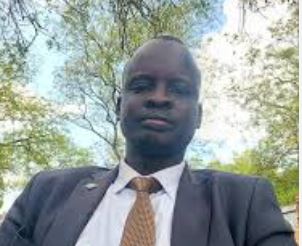
The writer, Juol Nhomngek Daniel, is a South Sudanese constitutional lawyer, academic, and political figure. He studied law at Makerere University in Kampala, Uganda. He is an independent legal researcher and constitutional expert and serves as a lecturer and Deputy Dean of the College of Law at Starford International University in Juba. He is also a member of the Sudan People’s Liberation Movement-in-Opposition (SPLM-IO).
The views expressed in ‘opinion’ articles published by Radio Tamazuj are solely those of the writer. The veracity of any claims made is the responsibility of the author, not Radio Tamazuj.

 and then