



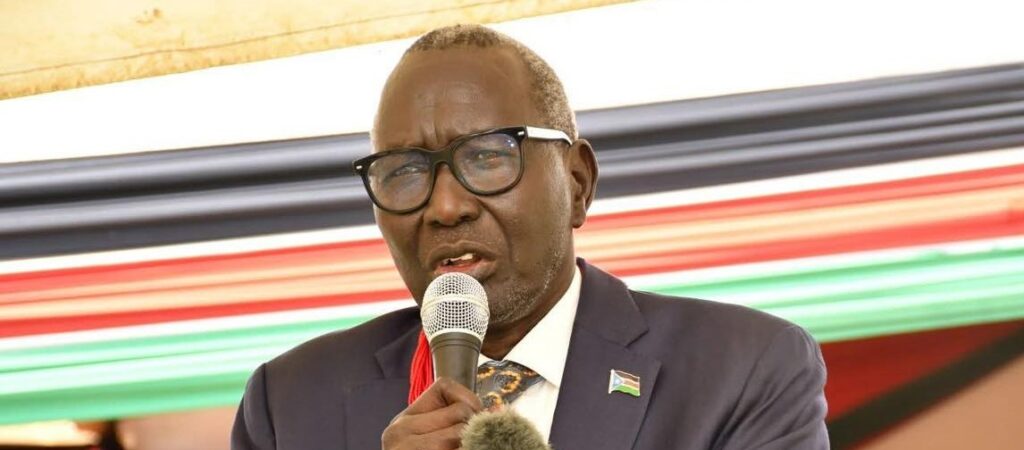
I welcome Mr. Sokiri Lo Poni’s article, “The Economist Dhieu and the Contradictions of Holding Elections,” and the important issues it raises regarding the future of our country, the implementation of the Revitalised Peace Agreement, democratic governance, and accountability in public institutions. These are matters of profound national importance that deserve open, honest, and constructive discussion.
However, I believe Mr. Sokiri’s critique rests largely on a misreading of the central argument advanced in my article, “Elections: A Pathway to Peace, Democracy, and National Legitimacy in South Sudan.” My article neither advocated elections at any cost nor ignored the serious challenges confronting our country. Rather, it sought to stimulate a candid national conversation about the growing uncertainty surrounding the implementation of the Revitalised Peace Agreement and the consequences of an indefinitely prolonged political transition.
At the heart of my argument was a simple but important question: What options remain available to South Sudan if the implementation of the peace agreement continues to stagnate and critical transitional benchmarks remain unmet? Raising this question should not be interpreted as an endorsement of flawed elections or as a rejection of the peace agreement itself. On the contrary, it reflects concern about the political vacuum, institutional paralysis, and uncertainty that may emerge if the transition remains perpetually unresolved.
Mr. Sokiri presents the debate as though there are only two mutually exclusive choices: either complete implementation of every provision of the peace agreement before any election is contemplated, or the holding of elections designed to perpetuate authoritarian rule. Such a binary framing oversimplifies a far more complex political reality. The challenge before South Sudan is not merely whether elections should be held, but how the country can simultaneously advance peace implementation, strengthen institutions, expand political space, and prepare for a credible democratic transition.
Democracy is not a single event; it is a process. Elections alone do not guarantee democracy, but neither can democracy mature indefinitely without electoral legitimacy. Sustainable political order requires a careful balance between peacebuilding, institution-building, constitutional development, and democratic participation. The central question, therefore, is not whether peace or democracy should come first, but how both can be advanced in a mutually reinforcing manner.
Mr. Sokiri also devotes considerable attention to allegations of corruption within the South Sudan Revenue Authority (SSRA) during my tenure as Chairman of its Board of Directors. I share his view that public institutions must be accountable and that allegations involving public resources must be investigated thoroughly and transparently.
Indeed, I have publicly stated that the findings of the security investigation into the alleged misappropriation of public resources within the Authority should be made public so that the people of South Sudan can know the truth. During the handover of office to my successor, Hon. David Deng Athorbei, I reiterated the importance of transparency and accountability and expressed my support for any lawful investigation.
I have never opposed scrutiny, nor do I fear any accountability process. Public service carries responsibilities as well as privileges, and those entrusted with managing public institutions must always be prepared to account for their stewardship.
What I reject, however, is the tendency to transform allegations into verdicts before investigations have been concluded and their findings made public. Genuine accountability must be grounded in facts, credible evidence, and due process—not in speculation, assumptions, or political prejudice. To abandon these principles would undermine not only justice for individuals but also public confidence in the very institutions tasked with enforcing accountability.
The absence of publicly available findings from the ongoing investigation is itself a matter of legitimate public concern. I therefore agree with Mr. Sokiri that the relevant authorities owe the public clarity regarding the status and outcome of the inquiry. Transparency serves both accountability and fairness. It protects the public interest while also safeguarding individuals from premature judgment.
More broadly, I find it regrettable that policy disagreements are increasingly reduced to questions of personal motive or political affiliation. It is entirely possible for patriotic South Sudanese to disagree on the sequencing of reforms, elections, constitutional processes, and peace implementation while remaining committed to the same overarching goals: peace, democracy, justice, stability, and national unity.
The real challenge before our nation is not how to silence opposing views but how to create the political space necessary for robust and respectful debate. South Sudan’s future will not be secured through accusations and ideological rigidity, but through dialogue, compromise, institutional reform, and a shared commitment to the national interest.
Ultimately, the central issue remains the implementation of the Revitalised Peace Agreement and the uncertainty surrounding the transitional process. South Sudan cannot afford perpetual transition, nor can it afford a return to conflict. The task before political leaders, civil society, and citizens alike is to identify a realistic path that preserves peace, strengthens democratic institutions, and restores popular legitimacy to the state.
These objectives are not contradictory. They are complementary and mutually reinforcing. Accountability strengthens legitimacy. Democracy strengthens peace. Peace creates the conditions for democratic governance. Together, they form the foundation upon which a stable, united, and prosperous South Sudan can be built.
The writer, Stephen Dhieu Dau, is a senior member of the SPLM and a former National Minister of Finance and Planning.
The views expressed in ‘opinion’ articles published by Radio Tamazuj are solely those of the writer. The veracity of any claims made is the responsibility of the author, not Radio Tamazuj.

 and then