



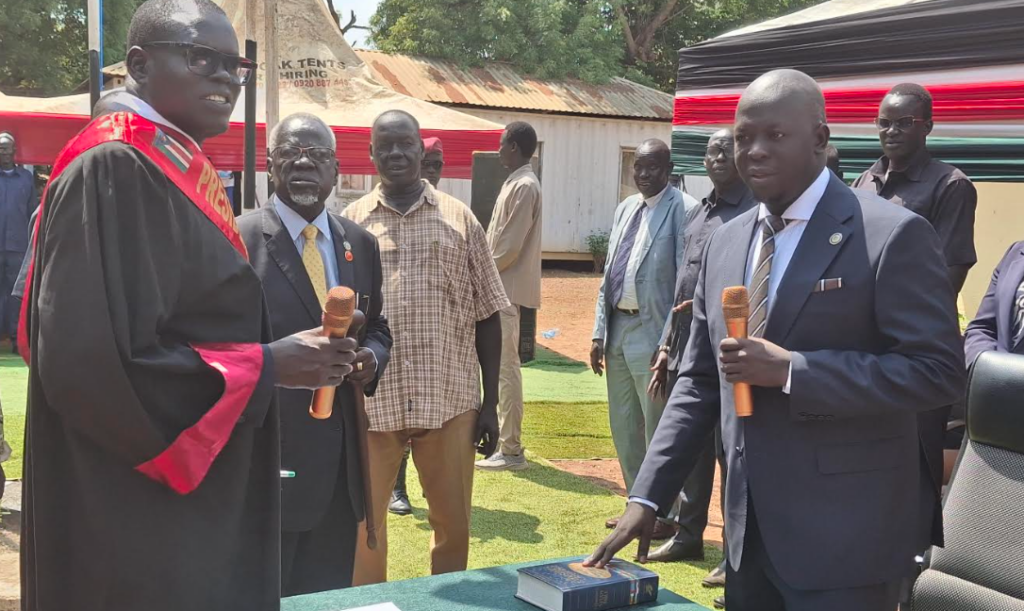
The newly appointed Speaker of the Jonglei State Legislative Assembly, Malual Gabriel Kon, was sworn into office on Wednesday, pledging to work with lawmakers, the executive and local communities to promote peace, unity and development, despite the state legislative assembly remaining inactive for nearly two years.
The swearing-in ceremony took place at the assembly premises in Bor and was presided over by Jonglei State Governor Riek Gai Kok.
The Jonglei State Legislative Assembly has remained closed since going into recess in late 2024, with lawmakers previously attributing the prolonged shutdown to political disputes, insecurity and funding shortages.
The closure has left the legislature unable to carry out its constitutional responsibilities, including oversight of the executive and representation of constituents.
Malual, who was appointed by presidential decree in April to replace Amer Ateny Alier, is a member of the Sudan People’s Liberation Movement-in-Opposition (SPLM-IO) faction led by National Peacebuilding Minister Stephen Par Kuol.
Speaking after taking the oath of office, Malual acknowledged the challenges facing the assembly and said reopening the legislature would be among his priorities.
“The assembly must resume its full responsibilities to serve the people of Jonglei. We will work together to strengthen peace, accountability and development across the state,” he said.
Malual, who also serves as SPLM-IO chairperson in Jonglei State, warned that officials who fail to cooperate with the state government risk dismissal, saying public servants should prioritise service delivery over political interests.
“We have one governor and one government. Our focus should not be party interests but serving the people of Jonglei State,” he said.
Governor Riek congratulated the new speaker and called on lawmakers to work together to address the state’s challenges.
“The legislature has a critical role in enacting laws, promoting accountability and supporting efforts aimed at peace, security and improved service delivery,” he said.
Bor County Commissioner Samuel Ateny Pech welcomed the anticipated resumption of legislative activities, saying stronger laws were needed to address insecurity and crime.
“The people need effective laws that can help address crime, strengthen security institutions and protect lives and property,” he said.
The ceremony was attended by state officials, lawmakers, traditional leaders, civil society representatives and members of the public.
Anok Buol Deng, a member of the Transitional National Legislative Assembly representing Twic East County under the SPLM-IO, welcomed Malual’s appointment.
“His appointment comes at a critical moment when the people of Jonglei are looking to their leaders for unity, peace and effective governance,” Deng said, urging the assembly to strengthen accountability and address community concerns.
However, civil society activist Edmund Yakani criticised the move, questioning the decision to swear in a speaker while the assembly itself remains inactive.
Yakani, executive director of the Community Empowerment for Progress Organization (CEPO), called on President Salva Kiir, the national parliament and the Council of States to ensure state legislatures resume their constitutional functions.
“How can a speaker of a legislative assembly be sworn in when parliament is not in session?” Yakani said. “There is a need to recall the parliament of Jonglei from the long recess so that it can function.”
He argued that the prolonged closure deprived citizens of legislative oversight and weakened accountability at the state level.
Yakani also questioned how state governments could operate for extended periods without legislative scrutiny, noting that national institutions such as the Transitional National Legislative Assembly and the Council of States continued to function despite financial constraints.
“The executive cannot continue to undermine the oversight role of state legislative assemblies,” he said.
He urged the Council of States to intervene and ensure governors facilitate the resumption of legislative activities, warning that prolonged inactivity of state assemblies could undermine democratic governance and accountability.
Yakani further accused some governors of exercising excessive authority in the absence of functioning legislatures, saying citizens were being denied effective representation and oversight.

 and then