



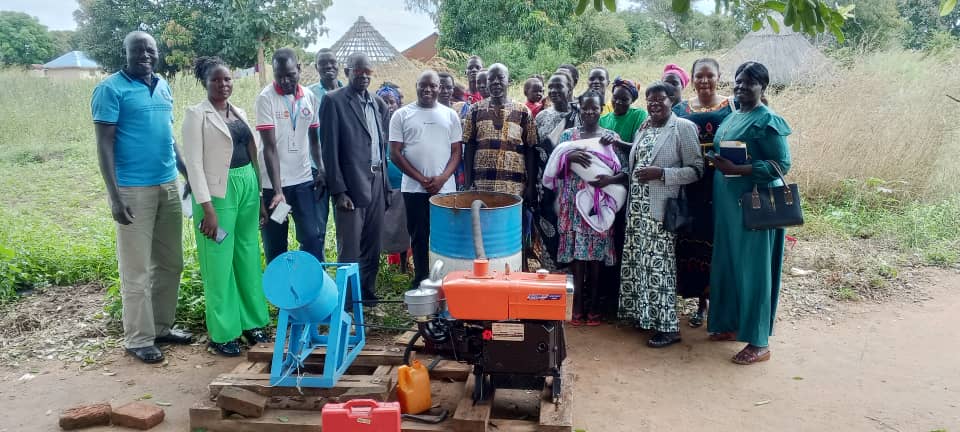
More than 100 families in Torit County, Eastern Equatoria State, are earning income through small businesses established under a youth and women’s economic empowerment programme aimed at strengthening community resilience and social cohesion.
The $74,393 initiative was implemented by the Support Peace Initiative Development Organization (SPIDO) with funding from the Korea International Cooperation Agency (KOICA) through the United Nations Development Programme’s (UNDP) Peacebuilding, Access to Justice and Community Cohesion Programme.
The six-month project, which ran from May to November last year, involved training youth and women in business skills and supporting five groups with startup equipment. The kits included two grain-grinding mills, a paste-grinding machine, tailoring machines, bakery equipment and five desktop computers with printers.
“We provided them with startup kits that included various essential tools,” SPIDO’s focal person in Torit, Ewot Felix, told Radio Tamazuj.
“For instance, there were two grinding machines, one for grain, specifically sorghum and maize, given to the Hope Women’s Cooperative Society. Additionally, a machine for grinding paste was provided to the Logire Cooperative Society,” he said.
“We also supplied tailoring machines to a group of 14 beneficiaries, and the bakery group received their necessary equipment as well. Finally, the ICT group was given five desktops and one printer. Although the project was titled the Peace Building Project, it had a significant entrepreneurial component that included the startup kits for five groups.”
Felix said the project’s implementation covered all eight payams of Torit County to ensure equitable access to opportunities.
“The selection criteria were based on the payams of Torit. Participants registered according to their payams, and at the end of the selection process, the final beneficiaries received the startup kits,” he said.
“We’ve been mentoring these beneficiaries to help them navigate the economic difficulties they face, as overcoming these challenges is essential for their success.”
Beneficiaries said the businesses had helped them generate income to support their families despite South Sudan’s difficult economic conditions.
Josephine Backita, a member of the 14-person tailoring group known as “Step by Step”, said the equipment had enabled members to earn money through clothing repairs and alterations.
“When we received the tailoring machines, we quickly put them to use in the market. Now, we wait for clothes to mend, which helps us earn some income,” she said.
“We manage our earnings to support our children’s school fees, healthcare needs and food purchases. We divide our tasks among eight people each day in the market. While we face a shortage of materials, we continue to repair and mend clothes.”
She said the group earned between 20,000 and 30,000 South Sudanese pounds (SSP) on a good day before sharing the proceeds among members.
“We charge around SSP 2,000 to 3,000 depending on the complexity of the repairs. Our main challenge is the lack of materials. We are currently relying on others for sewing threads, which have run out,” Backita said.
Thomas Okilek, a member of the Logire Cooperative, said the grain-grinding machine had improved members’ livelihoods by generating income and supporting access to loans.
“This grinding machine has greatly benefited us. We now have a significant amount of money in our funds, allowing members to take loans to support their families and cover healthcare costs,” he said.
“Our earnings depend on customer demand, but rising fuel prices and economic instability have impacted our business.”
Okilek said the cooperative could earn between SSP 600,000 and SSP 700,000 on a good day, although worsening economic conditions had reduced customer demand.
“Many clients are now bringing less to grind due to worsened conditions. To sustain this business, we are maintaining a small fund to ensure the machine remains operational,” he said.
“I urge my community in Eastern Equatoria to focus on farming until the situation improves.”
Betty Hibworo, a member of the 30-person Amwoi (Future) Bakery group, said the bakery had significantly improved members’ livelihoods.
“Our work has significantly improved our lives, especially before last year when prices were more stable,” she said.
“We were able to sell bread and earn up to SSP 50,000 to 60,000 daily. This income allowed us to pay school fees for our children without difficulty, and we could also reinvest in purchasing more flour for our business.”
Wodan Lazarus Saviour, SPIDO’s executive director, thanked KOICA and UNDP for supporting the project.
“On behalf of the organization, I want to recognize our donor, KOICA, through UNDP PACC, for providing us with this funding at a critical time. This project arrived when our community desperately needed it,” he said.
“Based on meetings I facilitated, we received valuable feedback from participants about their success stories.”
Saviour said beneficiaries had reported using income generated from the businesses to pay school fees and meet healthcare costs.
“Our achievements include members being able to pay their children’s school fees and provide loans through cooperatives like Logire and HOPE. These cooperatives enable members to assist their families with educational and medical expenses whenever necessary,” he said.
“Despite the ongoing economic hardships and rising market prices affecting businesses, the community continues to rise with hope and resilience.”

 and then