



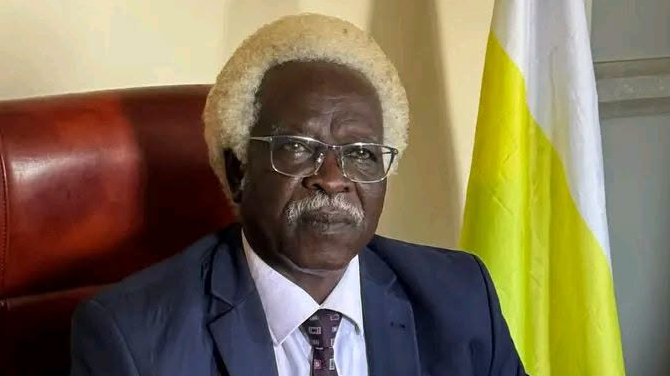
South Sudanese politician Kornelio Kon Ngu has withdrawn his bid for the presidency, weeks after declaring his intention to challenge President Salva Kiir Mayardit in the Dec. 22 election.
Kon, who leads the opposition National United Democratic Front (NUDF) and a faction of the National Alliance of Political Parties, announced his presidential bid on Aug. 31, becoming the first politician to publicly declare a challenge to Kiir in the December election.
In a statement announcing his withdrawal on Thursday, Kon said he had reached the decision after reviewing the country’s political, legal, security and electoral conditions.
He said his decision was not motivated by fear of political competition or personal considerations, but by concerns about the electoral framework and whether the conditions for a free and fair election had been established.
“An election is not merely a ballot box,” Kon said, arguing that a credible election requires the rule of law, respect for political agreements, equal opportunities, civil liberties, institutional neutrality, media freedom and security for candidates and voters.
Electoral law
Kon, a former third deputy speaker of parliament, criticised recent amendments to South Sudan’s electoral law, saying changes made raises questions about the stability of the legal framework governing the election.
He said he did not oppose amendments to electoral laws in principle, but objected to changes that he said could alter the rules of political competition while the electoral process was under way.
President Kiir signed amendments to the National Elections Act into law on Sept. 21 after they were approved by parliament. The amended law separates the elections from the permanent constitution-making process and national census and provides for the incumbent executive leadership to remain in office until an elected president assumes power.
Kon said the changes should not be used to alter the conditions of political competition during the electoral process.
Peace agreement
Kon said the 2018 Revitalised Agreement on the Resolution of the Conflict in South Sudan remains the foundation of the country’s transitional political arrangements.
He warned that changes that weaken commitments or safeguards contained in the 2018 peace agreement could affect peace, stability and democratic development.
South Sudan’s elections have been repeatedly delayed during the transitional period established under the 2018 peace agreement.
Kon said South Sudan should take greater account of the views of regional and continental organisations involved in the country’s peace process.
He cited the African Union, the Intergovernmental Authority on Development (IGAD) and the C5 group of African countries involved in diplomatic efforts on South Sudan.
He said broader consultations should have taken place before proceeding with the election.
Electoral preparations
Kon questioned whether the technical and logistical preparations required for a nationwide election had been completed.
He cited voter registration, polling-centre arrangements, distribution of election materials, security planning, training of election officials, voter education, access to polling stations and funding.
Kon had previously questioned whether the National Elections Commission could organise a credible election within the remaining time. The commission said in September that voter registration had not yet begun and that it was preparing for the registration process.
The commission has maintained that the election will be held on Dec. 22.
Kon said the time remaining before the election was insufficient, in his view, for presidential candidates and political parties to organise nationwide campaigns and reach voters across South Sudan.
He said an election requires adequate time, preparation, resources and safeguards rather than simply setting a polling date.
Kon said he cannot compete fairly against an incumbent president who is in control of the executive branch and state institutions during the election period. He said his concern is not personal opposition to Kiir but the principle of equal political competition.
“How can a political party candidate compete fairly against an incumbent president who has the executive power and state institutions at his disposal while contesting the election?” Kon said.
Kon said he doesn’t want to participate in an election that, in his view, could be used to legitimise the continuation of the existing political order rather than allow voters to freely choose their leaders.
Press freedom and civic space
Kon also cited restrictions on freedom of expression and the media as reasons for his withdrawal.
“There is no democracy without a free press,” he said, arguing that journalists should be able to report freely and candidates should be able to present their political programmes without fear or intimidation.
He said candidates should be able to hold political rallies, travel, communicate with voters and campaign without restrictions or security threats.
Kon said candidates should have clear guarantees allowing them to conduct political activities, hold meetings and communicate with voters without intimidation or interference.
He said he believes those conditions had been adequately established.
Kon stressed that his withdrawal should not be interpreted as opposition to elections. “I am not against elections. I believe in elections more than any political position,” he said.
He said, however, that he cannot participate in a vote unless he is convinced that that conditions for free and fair competition had been established.
He said he would continue pursuing political change through peaceful and democratic means.
Fewer challengers
Kon’s withdrawal removes one of the politicians who had publicly declared an intention to challenge Kiir in the presidential election.
Another potential challenger, People’s Liberal Party leader Peter Mayen Majongdit, also dropped out of the presidential race after Kiir appointed him caretaker minister of Humanitarian Affairs and Disaster Management. Mayen had previously declared his intention to contest the presidency but later said he would not run in December following his appointment.
The withdrawals leave lawyer Issa Muzamil Sebit Makelele and Tijwog Agwet among the politicians who have publicly positioned themselves to challenge Kiir.

 and then