



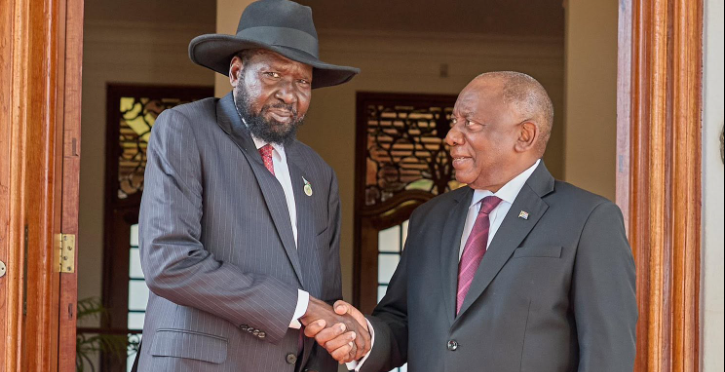
South African President Cyril Ramaphosa met South Sudanese President Salva Kiir Mayardit at Mahlamba Ndlopfu, the official presidential residence in Pretoria, on Wednesday afternoon and urged him to uphold and fully implement the 2018 peace agreement as South Sudan prepares for elections scheduled for December.
Ramaphosa, who chairs the African Union High-Level Ad Hoc Committee on South Sudan, known as the C5, stressed the importance of adherence to the Revitalised Agreement on the Resolution of the Conflict in South Sudan (R-ARCSS), the South African presidency said in a statement.
Ramaphosa said an inclusive electoral process based on trust and cooperation among South Sudanese political stakeholders is needed to address outstanding challenges and support implementation of the peace agreement, according to the statement.
The meeting comes less than three months before the Dec. 22 elections and follows the dissolution of South Sudan’s transitional government on Sept. 22.
Kiir arrived in South Africa on Tuesday, Oct. 6, after travelling from Nairobi, where he had held talks with Kenyan President William Ruto. He left Juba on Oct. 4 for a two-day visit to Kenya before travelling to South Africa.
South Sudan’s presidency said the visit to South Africa was intended to provide an opportunity for follow-up discussions with Ramaphosa after the C5’s latest declaration on South Sudan.
The C5, comprising South Africa, Algeria, Chad, Nigeria and Rwanda, has been leading regional efforts to support implementation of the peace agreement and South Sudan’s political transition.
At its Sept. 29 virtual meeting, convened by Ramaphosa in his capacity as C5 chair, the committee assessed developments in South Sudan ahead of the elections and considered areas requiring further regional and continental support.
According to Kiir’s office on Wednesday, the South Sudanese president thanked Ramaphosa for South Africa’s support for his country’s peace process and highlighted Pretoria’s role in supporting South Sudan’s 2005 Comprehensive Peace Agreement and 2011 independence referendum.
Kiir reaffirmed his government’s commitment to holding elections on Dec. 22 and outlined preparations including securing the National Elections Commission’s headquarters, launching civic education, identifying voter-registration centres and beginning the printing of voter-registration ledgers, his office said.
More than 20,000 election workers are being recruited, while more than 25,000 election security personnel are undergoing training, according to Kiir’s office.
Kiir also requested South African support for ballot boxes, training for elections commission staff, uniforms for election security personnel and digital identification cards for election officials and operational staff.
His office said the requests were among the reasons for Kiir’s visit to South Africa and that he stressed the need for close coordination to ensure support was delivered in time.
Ramaphosa agreed to support the four areas, according to Kiir’s office, which said both leaders agreed that work should begin as soon as possible through South Sudan’s independent National Elections Commission.
Kiir’s latest trips to Kenya and South Africa come amid reports circulating on social media about his health. His office has not publicly commented on those reports.
Kiir also visited South Africa from Aug. 23 to Aug. 30, when he held talks with Ramaphosa.

 and then