



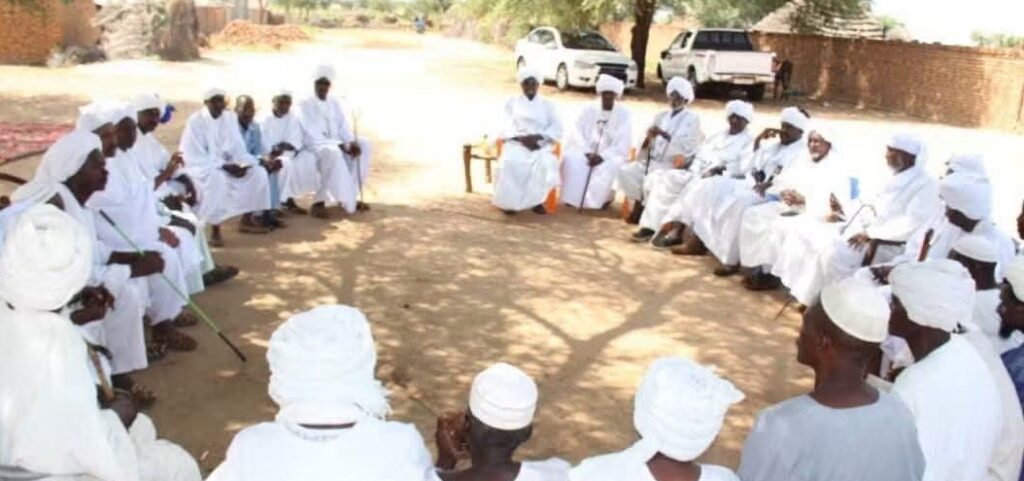
The Fallata and Masalit communities in Sudan’s South Darfur have reached a peace agreement aimed at preventing further violence following recent deadly clashes in Gireida Locality, community leaders and members of the mediation committee said on Wednesday.
The agreement was reached at the conclusion of a peace and reconciliation conference in Nyala that brought together traditional leaders and representatives of the two communities.
The conference followed clashes in Gireida in September that killed 16 people and injured 23. The violence began with a dispute between two men at Abuja market before escalating into clashes between members of the two communities.
Major Tala’at Khawf Al-Shanahi, head of the peace and reconciliation department of the Social Cohesion Initiative and rapporteur of the mediation committee, told Radio Tamazuj on Wednesday that the conference had adopted a series of resolutions and recommendations to prevent a recurrence of the violence.
The two communities agreed to reject division and racism and pledged not to use tribal solidarity to protect people accused of committing crimes, Al-Shanahi said.
He said members of each community had agreed to distance themselves from anyone who commits a crime and prevent the community from mobilising in their support or shielding them from legal proceedings.
The conference also called on the government to improve access to water sources by constructing two water stations, one in Gireida and another in the Saadoun area, he said.
Nazer Mohamed Al-Fateh Al-Samani, the tribal leader of the Fallata, said the conference had helped contain the dispute and improve relations between the two communities.
“We and the Masalit are one people, and we have longstanding relations that include intermarriage,” he told Radio Tamazuj.
Masalit tribal leader King Adel Hassan said both sides had committed themselves to maintaining peace and had taken an oath to uphold the agreement.
Hassan said the conference had adopted 12 resolutions and recommendations, including a commitment by both communities not to attack or encroach on people’s homes or farmland.
He said the provision would help create conditions for displaced residents to return voluntarily to their villages.
Hassan also called for security forces to be deployed to strengthen state authority in the area and for judicial and law-enforcement institutions to be established or strengthened.
He called for a functioning justice system, including a judge, public prosecution service and properly equipped police force, so that people accused of crimes could be dealt with through the law.
Mohamed Hassan Al-Taishi, prime minister of the RSF-aligned Government of Peace, attended the signing of the conference’s final resolutions and pledged to implement its recommendations, according to participants.
Al-Taishi also announced the formation of a committee to monitor implementation of the agreement.
Nyala is the seat of the parallel administration aligned with the Rapid Support Forces (RSF), which controls much of Darfur. Al-Taishi has previously blamed the weakness and absence of state institutions for contributing to local conflicts and called for stronger security and justice institutions.
The reconciliation effort comes as communities in Darfur face continuing insecurity amid Sudan’s wider war between the army and the RSF, which erupted in April 2023.

 and then