



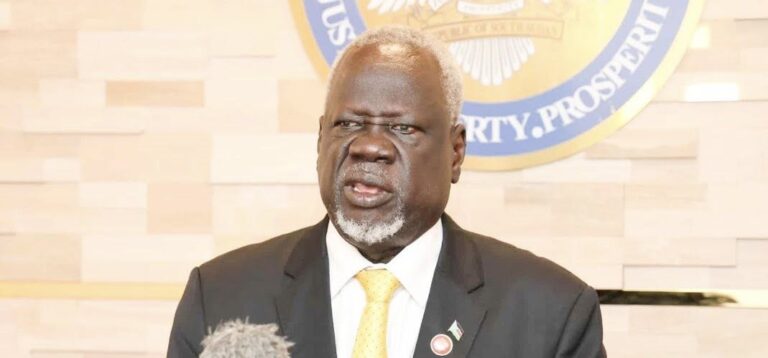
Jonglei State Governor Dr. Riek Gai Kok on Tuesday lamented that development partners operating in South Sudan prefer to engage communities directly rather than working through government institutions, saying communities have legitimate representatives who should be included in coordination efforts.
Speaking at the opening of a two-day Stakeholder Engagement Workshop on Humanitarian Access and Protection of Civilians in Bor, Gai said the approach had sidelined official government structures.
“Our partners have decided not to deal with the government of the Republic of South Sudan directly. They came up with a funny idea that we want to deal with the communities as a policy. But communities have representatives,” he said.
“Communities have representatives, so you must also encourage very basic principles that they have representatives, but of course it has been entrenched now. It is difficult for our partners to be convinced and brought back in line again,” Gai added.
The governor said a development partner recently met the SPLM-IO-appointed commissioner of Akobo County in Jonglei State and asked him to speak to residents in Akobo West, noting that the commissioner was not appointed in line with the constitution.
He said the recognition of the opposition-appointed commissioner by a development partner was “one example”, adding that there were other similar cases.
Jonglei is one of South Sudan’s conflict-affected states, with territory divided between government and opposition forces.
Gai, a member of the ruling SPLM party, cautioned humanitarian organizations against politicizing aid activities or influencing local communities, urging non-governmental organizations to adhere to the principles of neutrality, impartiality and independence while respecting South Sudan’s legal framework.
He acknowledged the critical role humanitarian agencies play in supporting vulnerable populations but pointed to persistent operational challenges, including disagreements over security procedures and compliance with national laws.
Gai said state authorities have a constitutional responsibility to protect communities from harmful substances, including illegal drugs such as tramadol.
“Our administration remains committed to fostering a strong partnership with humanitarian organizations to ensure assistance reaches those in need while maintaining security and respecting the laws of our country,” the governor said.
He expressed hope that the workshop would generate practical recommendations to strengthen cooperation between authorities and humanitarian actors, improve peacebuilding efforts and enhance the welfare of communities across Jonglei State.
Gai also called for practical resolutions to promote peace, unity and coordination among communities, government institutions and development partners.
The forum brought together county commissioners, government officials, humanitarian agencies, civil society representatives and other stakeholders to discuss ways of improving humanitarian access and strengthening the protection of civilians.
Meanwhile, Khalifa Para, a representative of the United Nations Mission in South Sudan (UNMISS), praised the state government for maintaining dialogue with humanitarian actors and reaffirmed the mission’s commitment to supporting peacebuilding and development initiatives.
Participants described the workshop as an important platform for dialogue and coordination aimed at addressing challenges affecting humanitarian operations and strengthening civilian protection mechanisms.
The workshop is expected to conclude with recommendations focused on improving humanitarian access, enhancing civilian protection and reinforcing cooperation between authorities and humanitarian partners across Jonglei State.

 and then