



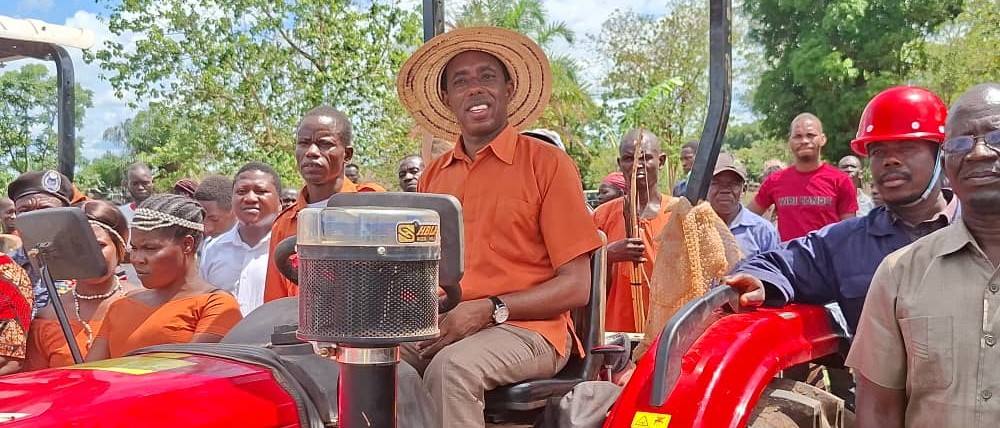
The Azande Kingdom, working with authorities in Western Equatoria State, has expanded a mechanized farming programme that has cultivated about 75 feddans of land with food crops and oil palm, as part of efforts to boost agricultural production.
The initiative, launched in April at the royal palace in Bazungua, received agricultural machinery donated by the Chinese government through its embassy in Juba, alongside additional equipment provided by South Sudan’s national government.
The Chinese donation included two tractors, four power tillers, four maize-processing machines, spare parts and other farming equipment. The national government contributed additional tractors to support the programme.
Kingdom officials said the machinery is being used to promote large-scale mechanized farming across Western Equatoria State.
Tadeo Mario Sasa, prime minister of the Azande Kingdom, told Radio Tamazuj that the equipment had enabled farmers to cultivate about 75 feddans of land with rice, maize, groundnuts, sorghum and oil palm.
“These machines have helped us open large areas of land within a short time,” Sasa said.
The tractors were initially deployed at a demonstration farm in Bazungua, where around 75,000 oil palm seedlings were planted under a pilot project aimed at showcasing the benefits of mechanized agriculture, he said.
Following the pilot phase, the machinery was deployed to other farming areas around Bazungua, where additional land has been prepared for cultivation.
Officials said the oil palm project forms part of a broader strategy to promote agro-industrial development and value addition through local processing of products such as cooking oil, soap, cosmetics, animal feed and biofuel.
The kingdom plans to expand mechanized farming across Western Equatoria, including a proposed 500-hectare farming project in Yambio County, with similar initiatives planned for Nzara and Ezo counties.
According to Sasa, more than 20 farmers and at least 12 cooperative societies have expressed interest in accessing the tractors through a hiring system managed by the kingdom.
He said the programme faces challenges including poor road infrastructure, fuel shortages, a lack of trained tractor operators and maintenance constraints.
“The main challenge is poor roads and fuel supply, which affects operations in some areas,” he said.
King Atoroba Peni Rikito Gbudue said the mechanization programme was intended to transform agriculture into a major driver of economic growth and food security.
“Agriculture is our second oil after soil. Through mechanization, we can increase production, fight hunger, create jobs and improve livelihoods,” the king said.
Western Equatoria State Agriculture, Forestry and Environment Minister Nagomoro Briget said the initiative followed discussions between the king and China’s ambassador to South Sudan on support for agricultural mechanization.
She welcomed the contributions from both the Chinese government and South Sudan’s Ministry of Agriculture, saying the equipment was already improving farming activities in the state.
“The objective is to eliminate hunger in Western Equatoria State and strengthen food security across South Sudan through increased production and commercial agriculture,” Briget said.
Local residents and civil society representatives also welcomed the programme, saying it had helped expand farmland and could create employment opportunities, particularly for young people.
Wanga Emmanuel, chairperson of Western Equatoria’s civil society network, said the project had expanded cultivation of rice, maize, groundnuts, oil palm and sorghum, helping address food shortages in the region.
He urged the government and development partners to continue investing in mechanized agriculture, road infrastructure and farmer support programmes to unlock the state’s agricultural potential.

 and then