



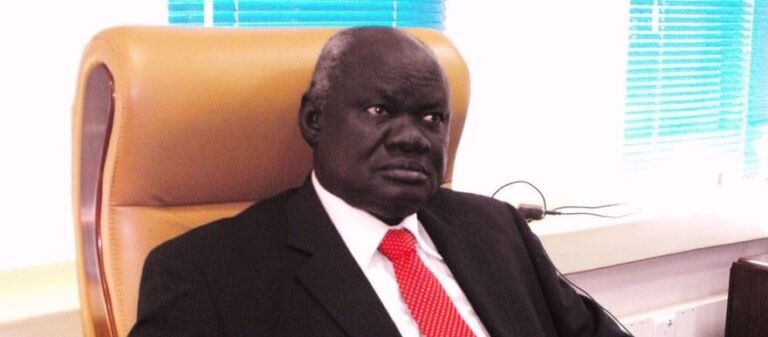
Gabriel Changson Chang, South Sudan’s former minister of higher education and a senior figure in the South Sudan Opposition Alliance (SSOA), said the country’s 2018 peace agreement had effectively collapsed, accusing the president of undermining key provisions on power-sharing and security arrangements.
In an exclusive interview with Radio Tamazuj on Tuesday, the former signatory to the peace deal said he resigned from the Federal Democratic Party (FDP) and distanced himself from the transitional government after concluding the agreement was no longer being implemented.
Changson also confirmed the formation of a new opposition movement, the People’s Resistance Front (PRF), and said South Sudan needed a fresh political settlement based on inclusive dialogue.
Below are the edited excerpts:
Q: Hon. Changson, there have been a lot of developments, and the public is asking many questions after the Tanzania consultations and seeing you as part of the opposition, although everyone knows you were part of the R-ARCSS and the government in South Sudan. Later, there was a press release about a new movement you launched. Can you tell the public what is going on?
A: Thank you, Radio Tamazuj, for giving me this opportunity and for interviewing me.
Yes, I was part of the R-ARCSS. Not only part of it, but also a prominent signatory on behalf of the South Sudan Opposition Alliance (SSOA) in 2018. We developed that agreement and agreed to its provisions because we believed it was the only way to rescue South Sudan at that time. We were committed to it.
The agreement went through many hurdles in terms of implementation, and we made several extensions, which we called Roadmap 1 and Roadmap 2.
However, by 2025, and even before that, there were signs that the SPLM-IG was walking away from the R-ARCSS. Those signs became visible in 2024 when the process was abandoned. To me, that was one of the indications that things would not go well.
Then, in March 2025, the Nasir incident occurred, where government forces and the White Army clashed. The White Army scattered government forces in Nasir and surrounded the officer, Major General Majur Dak. He was wounded at that time, and a rescue plan was put in place to save him. Unfortunately, the rescue plan failed, and eventually Major General Majur and others lost their lives.
That was another trigger that placed the R-ARCSS in intensive care. There were many incidents where things went wrong, but we continued to endure them.
As a result, in March, Dr. Riek Machar was placed under house arrest and later taken to court. I tried to meet the President. I used some of my friends, including the Chief Justice, to connect me with him, but without success.
I also wanted to meet Bol Mel, who was Vice President at that time, but I was unable to do so.
Q: Were you planning to meet the President in what capacity? As a signatory to the R-ARCSS or as a community leader?
A: I wanted to meet him as a South Sudanese minister in the government. I wanted to convey to him that the decision they had taken was not going to help the country because, at that time, they had chosen the military option.
When I failed, we also met President Yoweri Museveni. I was very clear with him that if you are a guarantor, you must encourage the President and the First Vice President to dialogue because they were no longer talking to each other.
I was very blunt, and I was branded as somebody coming from one of the hostile counties. At that point, I requested permission to travel for a medical check-up.
The permission was granted in April. Around that time, our community in Greater Nasir came under bombardment with chemical weapons. So I left, came to Kenya, and later attended a workshop in Dar es Salaam. On the first night there, I learned that I had been relieved of my position while I was abroad.
Q: So while you were pursuing reconciliation between the President and the First Vice President and trying to address the Nasir incident, were you still serving as Minister of Higher Education?
A: Yes. I failed in those efforts, then I left, came here, and was relieved of my position. After that, I observed how events were unfolding.
Eventually, late last year, the so-called High-Level Implementation Committee held what they called an extended meeting with the Presidency, during which amendments to the agreement were introduced. By then, Dr. Riek was already in detention, and I was already out of government.
Under the agreement, any amendment must be agreed upon by the signatories to the peace agreement. That did not happen.
The two key areas targeted were the unification of forces and Article 8 of the agreement. They did not like the unification of forces, and eventually opposition forces from SPLA-IO and SSOA that were in the training camps were forcefully removed. They were dispersed, and up to now nothing has happened regarding unification. That is Article 2 of the agreement.
Article 8, which is the heart of the agreement, states that the agreement is supreme over all South Sudanese laws. If you remove that provision, where do you derive legitimacy from?
Our legitimacy as the R-TGoNU, as ministers, vice presidents, and even the President, comes from the R-ARCSS and the amended constitution. If you remove that, you are trying to return to the 2011 Constitution, which was already superseded by the agreement.
So it became apparent that the agreement no longer existed.
Not only that, Dr. Riek was imprisoned, and I was removed, yet we were the only two signatories. Dr. Riek signed on behalf of SPLM-IO, and I signed on behalf of SSOA. If you remove the signatories themselves, what remains of the agreement?
Q: Hon. Changson, are these the reasons why you decided to resign from the Federal Democratic Party (FDP) and the transitional government and form a new opposition movement called the People’s Resistance Front (PRF)?
A: Yes, but not only that. The R-ARCSS was based on power-sharing ratios, and those ratios are no longer respected by the government. We have seen many appointments made by the President outside the framework of the agreement.
My party, the FDP, also saw all its members in Upper Nile State removed and replaced with people supporting the system, against the spirit of the agreement.
The same thing has happened to SPLM-IO. Hussein Abdelbagi became a prominent partner of the SPLM-IG, alongside Stephen Par. The trend is that anything originally meant for SSOA is redirected to Hussein Abdelbagi. Even our ministers were replaced and given to his side. The same has happened to SPLM-IO.
So where is the agreement? We went to Juba because of the agreement and to implement it. If it no longer exists, what is the purpose of our presence there?
As a result, I decided to separate myself from the agreement by resigning from the FDP and leaving my colleagues in Juba to continue running the party.
If they are comfortable remaining there, that is their decision. But for me, since the agreement has either been abrogated or is being dismantled, and in a manner that worsens the situation, we must think carefully. We cannot allow the country to continue in this direction.
Q: If you are called by the President, would you return to South Sudan for talks or reconciliation?
A: No, I cannot do that under the same circumstances that caused the R-ARCSS to fail.
Struggle is of two types. Normally, it is political. Sometimes people express grievances through force. But ultimately, because it is a political problem, it requires a political solution.
We believe that since the agreement has been abrogated and we want genuine peace, South Sudanese leaders must return to the drawing board for dialogue, as recommended by the African Union and other partners.
Once a sustainable agreement is reached, then we can try again. But many things would have to change before people can return.
Q: You recently announced a new movement after the consultations in Tanzania with AU envoy Jakaya Kikwete. Is it a political or armed movement?
A: Any struggle begins as a political struggle because the objective is a political solution.
If all political efforts fail, people may eventually feel compelled to pursue other options. But our main focus is to return to the negotiating table and seek a solution, as we did in Dar es Salaam.
Q: Hon. Changson, don’t you see a contradiction in your position? You went to Tanzania to negotiate peace with the same government you resigned from. How do you explain that?
A: There is no contradiction because we want peace for our people. Whether you are in government or opposition, eventually everyone must sit at the negotiating table. But whatever is agreed there cannot simply be another version of the R-ARCSS.
Q: What will be different?
A: We will ensure that the loopholes in the R-ARCSS are addressed.
One major problem was that the President monopolized the implementation process. If another agreement is proposed in the same manner, many of us will not participate.
We have our own ideas about what a sustainable agreement should look like, and we will present them for discussion.
Q: Many people say you only recently formed your movement but were already included in the Dar es Salaam consultations, while other opposition leaders, including Gen. Simon Gatwech Dual, were not invited. How do you explain that? Did you use connections?
A: No, that is not true. The Dar es Salaam meeting was only a preliminary consultation, not a negotiation. We were divided into five groups, and each group was asked two questions. First: What are the root causes of the conflict in South Sudan? Second: What is the way forward?
The AU special envoy told us he would gather information from both the government and opposition groups and compile a report for the AU Commission.
The AU Commission will then engage the C5 countries, discuss the report, and determine the next steps. Only then will they decide whether to invite the warring parties for formal negotiations.
So this preliminary consultation did not exclude anybody. Some groups have already applied for inclusion, and they will likely be included later.
Q: Are you now officially no longer part of SSOA, the FDP, or the R-ARCSS?
A: Yes, that is correct. I am no longer the leader or a member of the FDP, the party we established.
People may ask why Changson keeps moving. In 2013 and 2014, I left the UDSF mainstream, where I was chairman, and joined the rebellion. I did that because my house was ransacked, a boy was killed, and I was detained at the President’s residence in 2013 over a conflict that did not involve me directly. It was an internal SPLM conflict between the President and his Vice President.
So I was forced out. I left the party under the leadership of my deputy and secretary-general, and they remain there today.
This is not simply about voluntarily moving from one group to another. The same thing happened with the FDP, which we formed in 2015. When Dr. Riek returned to Juba, I refused to go because I believed the agreement was inadequate.
This time again, I felt compelled to disassociate myself from the FDP and the R-ARCSS.
When SSOA heard that I participated in Dar es Salaam, they removed me from the leadership forum without consultation. I told them there was no problem and that they could replace me with the person who succeeded me. I had already restructured the FDP so that if they wanted to remain, they could continue as a functioning party.
Q: Do you believe there will be elections in December 2026?
A: To the best of my knowledge, there will be no elections.
The conducive environment for elections does not exist. Elections have never been held in South Sudan in December because it is still part of the rainy season. Many regions, especially Greater Bahr el Ghazal, remain inaccessible.
How can elections be conducted under such conditions unless they are limited to towns only?
That is why they are amending the agreement, because the agreement calls for elections at the end of the transitional period, and they want to abruptly terminate that transition.
Q: What is your comment on the cabinet’s decision to halt amendments affecting the supremacy of the 2018 peace agreement?
A: They halted it after being cautioned by the international community. They were told that if they amended Chapter 8, they would undermine the very source of their legitimacy. Their legitimacy would effectively hang in the air.
That is why they backtracked and said Articles 8.1, 8.2, and 8.3 would not be amended.
To me, this raises the question of whether they did not already know from the beginning that their legitimacy came from the agreement itself.
So, in my view, even the so-called elections will not take place.
Q: What is the way forward for South Sudan’s political crisis?
A: The way forward is for South Sudanese political leaders to be realistic.
South Sudan belongs to all 64 tribes. Leadership should come from those who demonstrate capacity, ability, and love for the country and its people through fair, credible, and peaceful elections.
The transition that began in 2005 must come to an end through an elected government chosen by the people, not imposed leaders.
Once that happens, this poor style of governance will end. You cannot go 12 or 15 months without paying organized forces and civil servants. These people work under a social contract with the government. After 30 days of work, they should receive their salaries.
That is not happening. So people naturally ask: where does the money go?
Q: Personally, as Changson, what is your solution for South Sudan if you were given a chance to address its challenges?
A: We have ideas about how South Sudan’s problems can be resolved, and this time I do not think another agreement should simply be discarded as happened in the past.
One of our proposals is for South Sudan to be governed under a federal system. We also propose restoring the three greater regions: Greater Bahr el Ghazal, Greater Equatoria, and Greater Upper Nile.
This system would allow the regions to participate fairly in national leadership through a rotational arrangement rather than allowing power to remain monopolized. That is our vision as the People’s Resistance Front (PRF).
Q: Can you tell the public more about the People’s Resistance Front (PRF), including its membership and structure?
A: We will provide full details when the movement is officially launched. The Dar es Salaam consultations effectively became a partial launch, but we are planning a formal launch where we will present our structure, objectives, and membership to the public.
Q: You were part of the government. You should know where the money goes, shouldn’t you?
A: Yes, we used to discuss these issues within government, but as members of government we do not simply complain through the media.
Q: You were Minister of Higher Education. Were you not receiving budget allocations and resources during your time in office?
A: If resources were properly provided, then why were university salaries and staff unpaid?
I served as acting Minister of Finance in 2007 and was nicknamed “Mr. Sanction” because I closed loopholes and introduced systems to ensure that money was properly managed. Only those with legitimate claims received payments.
At that time, the financial situation was extremely difficult, yet systems existed.
So why are embassies closing? Why are staff unpaid? The problem is not a lack of resources; it is poor management.
In cabinet meetings, I repeatedly raised these concerns. I would even hold up a bottle of water and say, “Mr. President, this water is only consumed for free in South Sudan and Sudan. Why don’t we digitize revenue collection?”
There is huge non-oil revenue that is not properly collected because money simply passes through the system without accountability. We raised these issues repeatedly.
Q: What is your message to the people of South Sudan and other stakeholders as we conclude this interview?
A: My message is that we understand the suffering of the people of South Sudan because of political and security instability.
If you look at Greater Nasir, Greater Akobo, and Greater Fangak, many people are displaced and others have become refugees. The same situation exists in places such as Kajo-Keji and Nimule.
But people should not despair.
Solving these problems requires commitment. Yes, tragedies occurred in 2013 and 2016, and many people were killed, but nation-building involves both successes and setbacks.
We must transform those tragedies into opportunities to correct what went wrong. Look at Rwanda, which experienced one of the worst tragedies in history. The country recovered because its leadership had a vision and pursued reconciliation.

 and then