



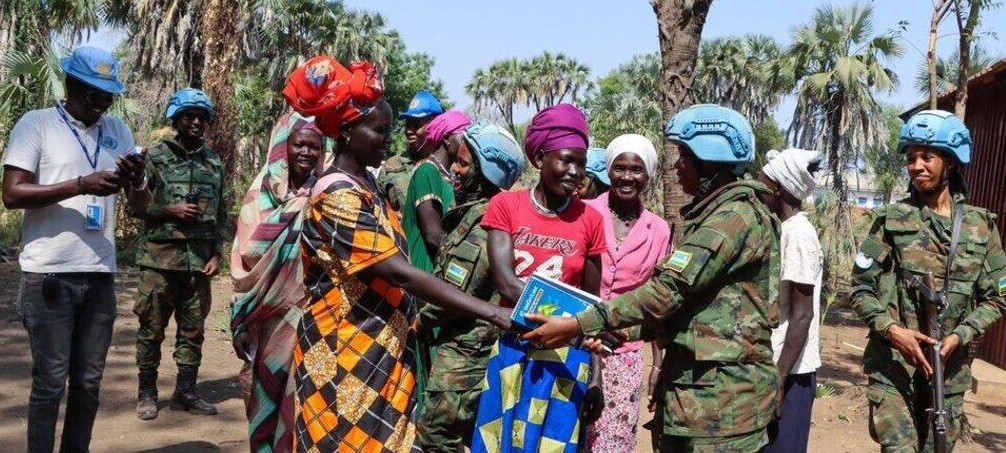
When South Sudanese women face domestic abuse, sexual violence or other forms of gender based violence, finding someone they can trust is often the first hurdle.
For many, that person is another woman.
Across South Sudan, female police officers serving with the United Nations Mission in South Sudan (UNMISS) have become a source of support for women seeking advice, protection or a safe space to share experiences of violence.
“They train us on how to overcome gender violence,” said Reyad Umjema, who has participated in workshops on gender based violence and reported cases through U.N. supported programmes.
“They give us advice on how to deal with these issues,” she added.
The experiences women bring forward often reflect the realities of communities grappling with conflict, displacement and insecurity, according to female peacekeepers working in the country.
“We get very positive reactions from the local communities,” said Millicent Alambo, UNMISS police gender adviser, who works on women, peace and security issues in collaboration with the South Sudan National Police Service.
“We go out not only as uniformed personnel but as women who understand the needs and the challenges that women go through,” she said.
Established after South Sudan gained independence in 2011, UNMISS is mandated to protect civilians, support implementation of peace agreements, facilitate humanitarian assistance and strengthen the rule of law. The mission includes military, police and civilian personnel deployed across the country.
Alambo said community visits often provide insight into the challenges faced by women and girls, particularly in remote areas where access to services remains limited.
“You get to meet the most vulnerable people in the community,” she said. “You see potential in so many people, but there are no opportunities for them to step up and be part of the development of the nation.”
Many of those conversations centre on violence against women.
“The cases that we handle often are related to gender based violence,” Alambo said. “Most women are not regarded as leaders, but mostly seen as victims. They do not have the platform where they can voice out their concerns.”
According to female peacekeepers, women and girls are often more willing to speak openly with women officers about issues ranging from domestic violence to sexual abuse.
“We always get a very positive response from women and girls,” Alambo said. “Especially girls who look up to us as role models, who have a lot of questions and just want to know what support we bring to them.”
UNMISS officials say that trust has become a critical part of community outreach efforts.
“People are more inclined to be open, to share their concerns and to accept feedback, advice and support from women peacekeepers,” said Francesca Mold, the mission’s chief of communications.
Female engagement teams conducting patrols and community visits have also helped uncover cases that might otherwise go unreported, she said.
“We have found that these female only patrols actually identify more sexual violence within communities because women are willing to come forward,” Mold said.
Beyond protection, advocates argue that women’s participation remains essential to South Sudan’s long term stability and development.
Speaking at a recent U.N. event in Juba, Humanitarian Affairs Minister Albino Atak said investments in peace should include “strong institutions, youth empowerment, women’s participation, community cohesion, education, livelihoods and sustainable development.”
UNMISS says female officers also help connect survivors of gender based violence with psychosocial support, medical care and legal assistance through programmes run by the mission and its partners.
Mold said women officers often assist survivors in navigating the justice system, including through mobile courts operating in some parts of the country.
Despite growing recognition of their role, women remain underrepresented in peacekeeping missions worldwide.
“It is definitely a priority for us,” Mold said. “The numbers are still way too low in the military.”
Female peacekeepers face many of the same operational challenges as their male counterparts, including poor infrastructure, seasonal flooding and the difficulty of reaching isolated communities.
“We face challenges with the weather, with climate change, with the terrain, with accessing vulnerable communities,” Mold said.
For Alambo, those obstacles have reinforced her commitment to peacekeeping.
“Being a woman and recognizing the vital role that women play in peacebuilding, I felt it is important, having gotten this opportunity, to come and try to support my fellow women and girls in South Sudan,” she said.
U.N. officials say such efforts are part of a broader goal of ensuring women are not only protected during conflict but are also able to participate in shaping the country’s future.
Anita Kiki Gbeho, the U.N. Secretary General’s Special Representative in South Sudan, recently described that vision as “a peaceful, a stable, a prosperous nation where no woman, no girl, no man, no boy is left behind.”
For women such as Umjema, the impact of female peacekeepers is often felt in quieter ways.
Sometimes, she said, it starts with finding the confidence to tell a story and knowing someone is willing to listen.

 and then