



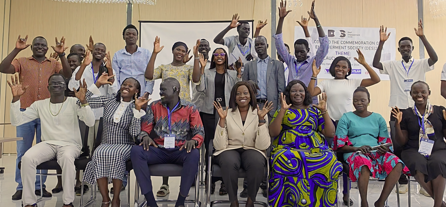
South Sudan’s deaf community on Tuesday launched the Deaf Empowerment Society (DES), a new advocacy and support organisation aimed at advancing their rights, inclusion, and opportunities across the country.
The Deaf Empowerment Society (DES), unveiled in Juba, aims to address barriers that campaigners say continue to leave many deaf people excluded from public services, economic opportunities, and political decision-making.
Advocates at the launch said a lack of sign language interpreters, limited access to education and employment, and inadequate representation in public institutions continue to marginalise deaf people across the country.
“In the government, they have not yet put in place those policies for deaf people,” said Josephine Kiden Simon, executive director of the South Sudan National Deaf Children and Youth Organisation. “We do not have someone to represent us as a person with a hearing impairment in the parliament, but we will not give up advocating for our rights.”
Her remarks underscored concerns that despite South Sudan’s ratification of the United Nations Convention on the Rights of Persons with Disabilities in 2023, many deaf people remain excluded from services and opportunities available to other citizens.
Manuel Madute, President of the South Sudan Deaf Sports Federation, said many deaf people continue to face obstacles in their daily lives.
“In South Sudan, many deaf people still face challenges, including a lack of access to education, a lack of sign language interpreters, limited employment opportunities, and communication barriers in healthcare and public services,” he said in a statement delivered during the event. “Deaf people have talents, skills, and leadership abilities that can contribute to the development of our nation. They can achieve anything when they are given equal opportunity and support.”
According to disability rights advocates, communication barriers remain among the most challenging facing the deaf community.
Many public institutions, including hospitals, schools, and government offices, lack sign language interpretation services, making it difficult for deaf people to access information and essential services.
The problem is particularly acute in rural areas, where awareness of deaf rights remains limited, and access to specialised services is scarce.
Benjamin Malice Alfred, Secretary-General of the South Sudan Union of Persons with Disabilities, described the launch of DES as an important step in strengthening the country’s disability rights movement.
“Disability is not inability,” he told participants, urging government institutions, donors, and civil society organisations to support initiatives led by persons with disabilities.
Government officials acknowledged that persons with disabilities continue to face exclusion despite legal commitments to protect their rights.
Adeng Andrew Malual, Undersecretary at the Ministry of Gender, Child and Social Welfare, said disability inclusion should be treated as a matter of human rights and social justice rather than charity.
“When persons with disabilities are excluded, society loses valuable talents, perspectives, and contributions,” she said.
Malual added that the government remains committed to implementing the rights guaranteed under national laws and international agreements, while calling on development partners, the private sector, and the media to support disability-inclusive programmes.
Some of the participants said the creation of the Deaf Empowerment Society shows the growing frustration with slow progress on inclusion, but also renewed determination to push for change.
The organisation says it will focus on advocacy, awareness raising, leadership development, and partnerships aimed at improving access to education, healthcare, employment, and public participation for deaf South Sudanese.
As campaigners seek greater recognition and representation, they say the challenge now is ensuring that commitments to inclusion are translated into action.
“This is not just a ceremony,” Madute said. “It is the opening of new opportunities, new partnerships, and new hope for deaf people in South Sudan.”

 and then