



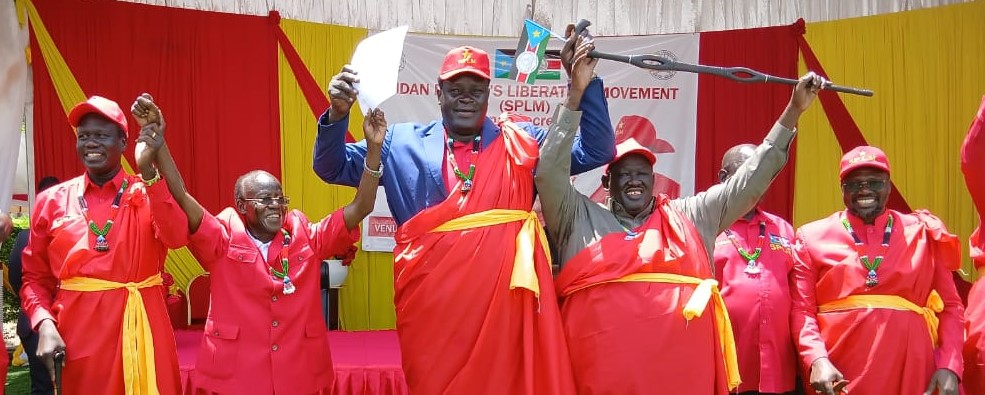
The Sudan People’s Liberation Movement (SPLM), the governing party of South Sudan, has formally absorbed members of the Agwelek-Kit-Gwang faction, with faction leader Lt. Gen. Johnson Olony declaring allegiance to President Salva Kiir’s party ahead of elections scheduled for December.
The move, announced at a ceremony at the SPLM House in Juba on Saturday, ends the faction’s separate political identity and brings its members into the ruling party.
Olony declared his allegiance to the SPLM and said he was abandoning the faction’s separate identity.
SPLM First Deputy Chairman James Wani Igga welcomed the new members and called for peace, unity and political dialogue as the country prepares for the elections.
SPLM Secretary-General Akol Paul Kordit said the new members would strengthen the party’s grassroots support and said the SPLM was prepared for the electoral process.
The integration follows political engagements between the SPLM leadership and representatives of the Agwelek-Kit-Gwang faction that began in early 2024, the party said.
The SPLM also called on its members across the country to register and said it would continue engaging opposition figures and groups as part of efforts to promote peace and reconciliation ahead of the elections.
Background
Lt. Gen. Johnson Olony is the leader of the Agwelek forces, an armed group from Upper Nile State whose initial purpose was to defend Shilluk land and oppose what its leaders described as land grabbing.
Olony later joined Riek Machar’s Sudan People’s Liberation Movement in Opposition (SPLM-IO) and was nominated by the opposition to become governor of Upper Nile under the 2018 peace agreement, but President Salva Kiir rejected his nomination.
In August 2021, Olony joined Gen. Simon Gatwech Dual and other SPLM-IO commanders in the Kit-Gwang declaration, which challenged Machar’s leadership. Gatwech became leader of the breakaway faction and appointed Olony as his deputy. The two later signed separate agreements with Kiir’s government in January 2022, but their alliance subsequently broke down.
Olony returned to Juba in May 2023 after reaching an understanding with Kiir’s government. His Agwelek forces were subsequently partially integrated into the South Sudan People’s Defence Forces (SSPDF).
In January 2025, Kiir appointed Olony assistant chief of defence forces for mobilisation and disarmament, placing the former rebel commander in a senior position in the national military. Olony and more than 15 senior Agwelek officers had been integrated into the SSPDF, although the integration of the wider force, including political figures aligned with it, remained incomplete.
Olony’s entry into the ruling SPLM marks a further shift in his political alignment, bringing his former armed movement closer to Kiir ahead of the December elections.
The move also raises questions about the neutrality of the armed forces. Article 151(2) of South Sudan’s Transitional Constitution provides that the SSPDF shall be a non-partisan national institution, while Article 152 requires a distinction between military and partisan political functions.
Section 15(2)(a) of the Political Parties Act further provides that members of the organized forces and law-enforcement agencies shall not be members of any political party.
South Sudan is due to hold its first elections since gaining independence in 2011 under the 2018 Revitalized Agreement on the Resolution of the Conflict in South Sudan (R-ARCSS). The vote has been postponed repeatedly, while opposition groups, civil society organisations and international observers have questioned whether conditions exist for credible elections in December, citing insecurity, delays in implementing the peace agreement and inadequate funding.
President Kiir’s camp says the country is ready to transition from a transitional unity government to an elected administration through the December polls, arguing that elections are necessary to end the prolonged transitional period.

 and then