



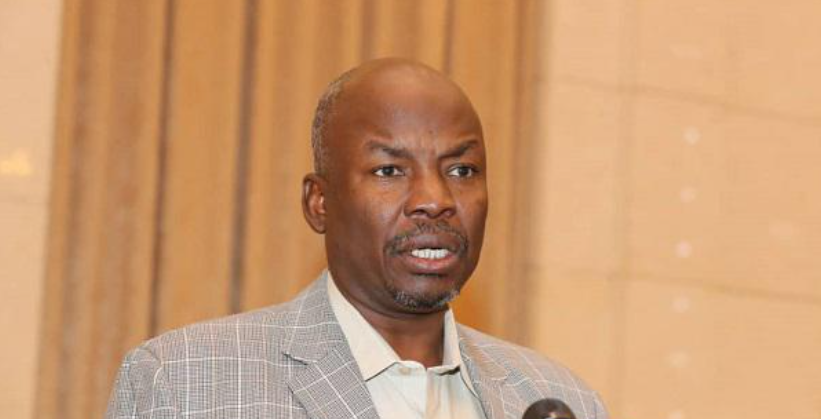
The public appearance of Ahmed Haroun, chairman of Sudan’s former ruling National Congress Party (NCP), has put the country’s military authorities in an uncomfortable position, raising questions about their handling of his case, the influence of former regime figures and the independence of judicial institutions, Sudanese lawyer Muaz Hadra has said.
Speaking to Radio Tamazuj about the legal and political implications of Haroun’s recent public appearances, Hadra said Monday that the former official faces criminal charges before Sudanese courts relating to war crimes and crimes against humanity, offences that are not eligible for release on ordinary bail.
“These are war crimes and crimes against humanity,” Hadra said, adding that Haroun is also wanted by the International Criminal Court (ICC) over alleged war crimes and crimes against humanity committed in Darfur in the early 2000s. Haroun has denied the charges, describing them as politically motivated.
Hadra said Haroun was initially detained under the former transitional government but left prison amid the security breakdown following the outbreak of war in April 2023. Haroun escaped from Kober Prison in April 2024 after the facility was attacked during fighting between the Sudanese army and the paramilitary Rapid Support Forces (RSF).
Questioning why Haroun had not returned to prison despite being at large for more than two years, Hadra said: “So why did he not return to prison? This is the question.”
Military’s handling questioned
Hadra questioned the circumstances surrounding Haroun’s detention on Sunday by the Sudanese Armed Forces (SAF), arguing that the military was not the appropriate institution to handle his arrest and detention.
“The army is not the institution that should arrest Ahmed Haroun. He should be arrested by the police and the judicial authorities because he is facing criminal charges. The army has nothing to do with him,” Hadra said.
He argued that the military’s involvement suggested Haroun could be held at a secure location under military protection rather than being subjected to ordinary judicial procedures.
“This shows that they want to protect him in a safe place, as they did with al-Bashir, Abdel Rahim Mohamed Hussein and others,” he said, referring to former president Omar al-Bashir and former defence minister Abdel Rahim Mohamed Hussein.
NCP influence resurfaces
Hadra said Haroun’s media appearances and public statements demonstrated the continued influence of the former ruling NCP, suggesting that the disbanded party was moving from operating discreetly to openly asserting its political presence.
He said Haroun had criticised various political actors, the December 2018 revolution that led to al-Bashir’s removal from power in April 2019, and the armed forces.
Although Haroun had not directly criticised army chief General Abdel Fattah al-Burhan, Hadra said some of his remarks amounted to indirect criticism of the military leadership. He argued that Haroun appeared to suggest that Burhan had protected individuals who had betrayed the former ruling party.
Describing the shift in the party’s public posture, Hadra said: “He used to be secretive, but now he is public.”
Regional and international implications
Hadra said Haroun’s public appearance had created an uncomfortable situation for the authorities in their relations with neighbouring countries, particularly Saudi Arabia and Egypt.
“This is a big embarrassment for the government, especially towards some of its neighbours, such as Saudi Arabia, Egypt and others,” he said.
He argued that the development could undermine efforts by the authorities to distance themselves from the former ruling party and its Islamist networks, amid regional concerns about the possible restoration of political influence by figures associated with al-Bashir’s government.
Hadra also pointed to international pressure over Haroun’s outstanding ICC case, citing a $5 million reward offered by the United States for information leading to his capture.
The US State Department has accused Haroun of recruiting, financing and arming the Janjaweed militia, which was implicated in atrocities in Darfur, including killings, rape, torture and forced displacement.
Hadra expressed doubt that the military leadership would cooperate with US efforts to secure Haroun’s arrest, arguing that senior figures within the armed forces remained closely aligned with the former ruling NCP.
“I don’t think the army is cooperating with the United States because the army leadership is completely aligned with the National Congress Party,” he said.
Accountability concerns
Hadra said the circumstances surrounding Haroun’s public appearance and detention raised broader questions about the relationship between the military establishment and former ruling party figures, as well as the prospects for accountability.
He argued that close ties between senior military figures and former NCP officials could undermine efforts to establish independent judicial institutions and ensure accountability for crimes committed under the previous government.
The case, he said, placed the independence of Sudan’s judicial institutions and the prospects for transitional justice under scrutiny as the country continues to grapple with war and political instability.

 and then