



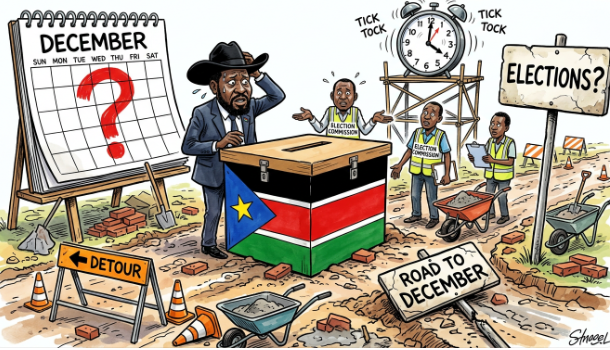
Question: Can the National Elections Commission (NEC) conduct the general elections fixed for 22 December 2026 in compliance with the time frames that the National Elections Act, 2012, as amended by the 2023 and 2026 Amendment Acts, requires it to observe?
Answer: No. In my considered legal opinion, the NEC is not in a position to conduct the 22 December elections in conformity with the time frames in the Act. The register, the nomination windows and the polling station notices on which a lawful election depends have either lapsed or cannot be completed within the Act’s own minimum periods in the 45 days that remain. The Act does give the Commission a narrow power to adapt its timetable, but that power must be used openly, with reasons and with notice to every party. It cannot be used by silence.
Basis of the opinion
The National Elections Act, 2012 (Amendment) Act, 2023, assented to on 25 September 2023 (the 2023 Act). Section numbers below follow its renumbered text.
The National Elections Act, 2012 (Amendment) Act, 2026 (the 2026 Act).
Public statements and media reports from June to early November 2026, used only to establish which steps the NEC has taken.
All periods are counted in calendar days backwards from 22nd of December, 2026. The opinion deals with law and procedure.
1. The legal framework
1.1 The Act binds the Commission that administers it
The NEC derives every power it has from the Act. It must regulate, conduct and supervise elections, maintain the voter register and register candidates (section 15(2)). The Act is drafted in mandatory terms: the NEC “shall” announce, publish, notify and open the register by fixed dates. The Commission may issue regulations only “for proper implementation” of the Act (section 139). Regulations cannot lawfully shorten, waive or replace a period fixed by the Act itself.
1.2 The Act sets standards of credibility, not only dates
The Act must be construed consistently with the principles of credible, open, transparent and impartial administration of elections (section 6(1) and (2)). It requires preparation and conduct of elections to be professional, credible, transparent and open, and obliges the NEC to inform the public about voter registers, polling stations and candidates (section 7). The register publication, inspection, objection and audit provisions (sections 36 to 38) are the mechanism through which those principles reach the voter.
1.3 The 2026 Act: what it changed and what it left
The 2026 Act refers expressly to the December 2026 elections (section 9(1)). It “delinks” the schedule of elections from completion of a permanent constitution and a census, so those are no longer legal preconditions. It shortened a number of periods, including the voter register publication period, register inspection, signature forms and the campaign. It did not touch the final-register rule in section 38, the nomination windows in sections 49, 71 and 72, the polling station notice in section 32(6), or the independent-candidate deadlines in section 57.
As I understand it, the Transitional Period ends in February 2027, so section 9(1) requires polling about 60 days earlier. This should be verified against the current Agreement and Constitution.
2. Findings
a. The election date was properly announced
The NEC announced 22 December 2026 in June 2026. Section 16(1) requires at least six months’ notice, which, on 22 December, means 22 June. On the record, this requirement was met, subject to confirming the exact date and form of publication.
b. The voter register deadlines have been missed
Section 36(e), as amended in 2026, required the register to be published at least three months before polling, which was 22nd of September, 2026. Under the 2023 text, it was 22 June. Section 38(1), which the 2026 Act left in place, requires the final register to be approved and published at least six months before polling, which was 22nd of June, 2026, and forbids further objections once it is published. In early November, the NEC itself said registration had not started, and no register existed. A register that does not exist cannot have been published, inspected (section 37(c)), audited (section 37A), or used for voter transfers (section 35(6) and (7)).
This is the central legal defect. Every later stage of the electoral process, from candidate seconders to polling station lists, depends on a verified register.
c. The nomination windows have closed on the statutory arithmetic
Section 49(2) fixes the seven-day nomination period for President and Governors to start between 90 and 60 days before polling, that is between 2 September and 23 October 2026, with at least 15 days’ public notice. Sections 71(2) and 72(2) fix legislative assembly nominations at 65 to 50 days before polling, that is between 18 October and 2 November. Independent candidates must file their name and symbol 90 days before and their nomination paper 60 days before polling (section 57), that is, by 23 September and 23 October. I found no public notice that any of these windows opened. Absent a lawful adjustment, they cannot be reopened by the NEC simply by announcing new dates.
d. Polling station notice is overdue
Section 32(6) requires the NEC to notify voters of their polling stations at least 60 days before an election, which was 23 October 2026. The 3,161 centres the NEC has identified are registration centres. They are not the polling station notice the Act requires.
e. The remaining period cannot accommodate the Act’s minimum steps
If nominations opened today, the Act’s own sequence would run roughly as follows: a seven-day window to about 13 November, (section 49(1)); publication of the nominee list within 14 days of close, to about 27 November (section 51(1)); challenges within seven days, to about 4th of December (section 52(1)); a Court decision within seven days, to about 11 December (section 52(2)); then publication of the final list (section 53), ballot printing and distribution in about ten days. The 45-day campaign ceiling in section 80(1) could not begin before today. This assumes a completed register and ready regulations, neither of which exists on the record.
f. The 2026 Act is internally inconsistent, and the inconsistencies are litigable
The copy of the 2026 amendment reads as a bill with “New:” text set beside the old text. It is headed “Bill”, the assent clause names a “National Elections Commission Act”, and the date entries in the assent block are irregular. Public reports state that the President signed on 21th of September, 2026. The gazetted, consolidated text must be published and checked.
Section 65(2). The amendment purports to change the Council of States nomination period (45 days under the 2023 Act) but uses the wording of section 49(2) (President and Governors, 90 to 60 days) with new figures of 60 to 30 days. It is unclear which provision was intended, and section 49(2) was not formally amended.
Register rules. Section 36(e) now says three months. Section 38(1) still says six months.
Campaign. Section 80(1) caps campaigns at 45 days. Section 75(3) fixes 30 to 50 days for legislative assemblies.
Signature forms. Section 70(4) now says 15 days. Sections 48(3) and 64(2) still say 30 days.
Diaspora. Section 35(3), as amended, limits out-of-country registration to Presidential elections and referenda. Section 35(4) of the 2023 Act still requires regulations for out-of-country voting generally.
National Legislative Assembly. Section 60(2) fixes 270 members under the 50, 35 and 15 percent formula and adds 66 appointees. The total, and the fate of the earlier provisions on 332 members, must be stated clearly.
Each of these gives a party or candidate an argument that the election was not conducted in compliance with written law (sections 112, 118 and 130).
3. Can the Commission Cure the Position?
3.1. Section 138: possible, but only openly and for real exigencies
Section 138 allows the NEC, where a mistake, miscalculation, emergency, or unusual or unforeseen circumstance means a provision of the Act or other election law cannot be followed, to extend time, add officers or polling stations, or adapt any provision other than the Constitution, to the extent necessary. It must inform all parties and independent candidates of any action taken (section 138(2)).
The power has real limits. It cannot touch the Constitution. It is designed for exceptional circumstances, and the Commission set the 22nd of December date itself, in June, knowing the register and nomination periods the Act prescribes. A party that challenges its use will say the shortfall was foreseeable and within the Commission’s own control, not “unforeseen”. The safest use of section 138 is one published, reasoned timetable that states each provision being adapted and why, not a series of unexplained date changes.
3.2 Section 60: not available for administrative unreadiness
The Commission may postpone Presidential, Gubernatorial and Chief Administrator elections only for proven imminent danger or a declared state of emergency, and must fix a new date within 60 days of the original. Unreadiness is not a listed ground. Any longer deferral would need an amending Act or a constitutional route, and would have to be reconciled with the end of the Transitional Period.
3.3 Legislative correction
The 2026 Act itself proves that the Transitional National Legislative Assembly treats the calendar as amendable. A short amending Act reconciling sections 32, 36, 37, 38, 49, 57, 71, 72, 75 and 80, and correcting section 65(2), is the cleanest way to give a compressed timetable a secure legal footing.
4. Consequences of proceeding without a lawful basis
petitions
Any voter, candidate or aspirant may petition on grounds including the validity of the conduct of the election and non-compliance with the Constitution and written law that substantially affected the result (sections 112 and 124).
Nullification.
An election may be declared void where non-compliance substantially affected the result (sections 118(b) and 130). A new election would then follow (sections 121 and 133).
Speed.
Presidential petitions must be filed within 28 days and decided within 14 days (section 111). Governor and Chief Administrator petitions must be decided within three months, and legislative petitions within 120 days (section 123(5)).
Practical effect.
A defect built into the calendar from the start is a ready-made ground of challenge. It shifts the dispute from the ballot box to the courtroom after results are announced, which is the worst moment for national stability.
5. Fairness to the Commission
The Commission has made real progress. On the public record, it has announced the date, trained State High Election Committee and Administrative Area staff on registration, approved the registration book, identified 3,161 registration centres, passed 14 regulations, and received funding assurances and offers of African Union technical help. It has itself identified resources, security and logistics as continuing challenges. These steps are important. But they are preparatory, and the Act measures readiness by the completed legal steps, not by effort. The register, the nomination process and the polling station and candidate lists are the legally decisive items, and they are outstanding.
6. Conclusion
The National Elections Act is not a set of aspirations. It prescribes, in mandatory language, when the register must be published, when nominations must open and close, when polling stations must be announced, and how long each challenge may take. Those periods exist so that every voter can check the register, every candidate can compete on known terms, and every result can be defended.
Measured against that calendar, my opinion is as follows:
1. The election date was lawfully announced. The NEC has missed the statutory deadlines for publishing the voter register and the final register, and the periods for inspection, audit and voter transfer cannot now run as the Act prescribes.
2. The statutory nomination windows for President, Governors and the legislative assemblies, and the deadlines for independent candidates and polling station notices, have passed on the statutory arithmetic.
3. The 45 days that remain cannot hold the minimum durations the Act itself sets for registration, nomination, challenge, ballot production, and campaign.
4. The 2026 Act did not cure these problems. It left the final-register, nomination, and polling station provisions untouched, and introduced contradictions of its own.
5. Postponement under section 60 is not available for administrative unreadiness. The only lawful routes to a 22nd of December poll are an open and reasoned use of section 138, or a corrective amendment by the Transitional National Legislative Assembly which has already been dissolved on the 22nd of September, 2026.
Accordingly, the NEC is not legally ready to conduct the 22 December 2026 elections within the time frames of the Act as it stands. An election held on that date without a published legal basis for each departure would rest on a foundation that any court could be asked to examine. The better course, and the one most likely to protect the credibility of the outcome, is for the NEC to publish a single gazetted electoral calendar stating which deadlines were met and the legal basis for each adjustment; for the Legislature to correct the inconsistencies in the Act and gazette a consolidated text; and for the Commission to consult all parties, independent candidates and observers before the adjusted timetable takes effect.
The Act asks for elections that are credible, open, transparent and fair. The date matters, but so does the law that gives the date its authority.
The writer is an advocate & commissioner for oaths and secretary of Legal Affairs and Human Rights National Secretariat of the United Sudan African Party (USAP). He can be contacted via bullenkulang@gmail.com.
The views expressed in ‘opinion’ articles published by Radio Tamazuj are solely those of the writer. The veracity of any claims made is the responsibility of the author, not Radio Tamazuj.

 and then